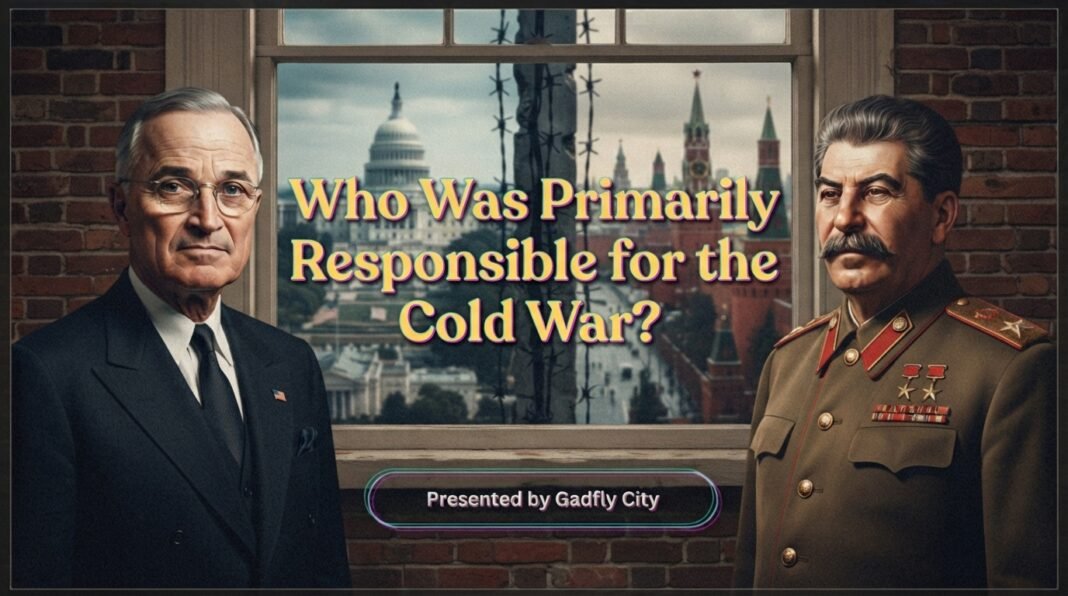



The question of who won the Cold War sounds simple, but the answer is more complicated than declaring one country the winner. The Cold War was a decades-long political, economic, military, and ideological struggle between the United States and the Soviet Union. It ended without a direct war between the two superpowers, but its final outcome clearly favored the United States and its Western allies. The Soviet Union dissolved in 1991, Communist governments across Eastern Europe collapsed, Germany reunified, and the Western political and economic model emerged in a much stronger position.
Still, saying that America simply “defeated” the Soviet Union misses an important part of the story. The Soviet collapse resulted from several interconnected forces, including economic difficulties, political reforms, nationalist movements, military pressures, and changing relations with the West.
Table of Contents
What Was The Cold War?
The Cold War began after World War II as the wartime alliance between the United States and Soviet Union broke down. The two powers had fundamentally different visions for the postwar world. The United States generally supported liberal democracy, market-based economics, and a system of international alliances, while the Soviet Union promoted a communist political and economic system and maintained strong influence over Eastern Europe.
The conflict rarely became a direct military confrontation between Washington and Moscow. Instead, both sides competed through diplomacy, nuclear weapons, intelligence operations, economic assistance, technological development, alliances, propaganda, and proxy conflicts.
The National Archives’ Cold War collection provides extensive documentation showing how this competition shaped American foreign policy for decades.
For readers interested in the wider historical context, our History section explores other major events and questions that shaped American and world history.
So, Who Won The Cold War?
The clearest answer is that the United States and its Western allies won in the Cold War, particularly in geopolitical and ideological terms.
The reason is straightforward. By 1991, the Soviet Union no longer existed as a unified superpower. Communist governments throughout Eastern Europe had fallen, Germany had reunified, and former Soviet-controlled states were pursuing independence.
Meanwhile, the United States remained intact, economically powerful, politically stable, and at the center of a major international alliance system.
The U.S. Department of State’s historical account of the Soviet collapse records that the Soviet Union formally ceased to exist on December 25, 1991.
However, this outcome should not be interpreted as a simple military victory. There was no final battlefield where American troops defeated Soviet forces. The result was instead determined by the inability of the Soviet system to maintain its political and economic structure while competing with the West.
Why Did The United States And Its Allies Prevail?
Economic Strength And Recovery
Economic competition was one of the most important dimensions of the Cold War.
After World War II, Western Europe was devastated. The United States responded with the Marshall Plan, providing substantial economic assistance intended to support European recovery. According to the Office of the Historian’s account of the Marshall Plan, the program eventually received more than $12 billion in approved funding for rebuilding Western Europe.
The significance went beyond financial assistance. Economic recovery strengthened Western European governments and helped create a stable political environment in which communist parties had less opportunity to gain control.
The Soviet Union, meanwhile, maintained a centrally planned economic system that struggled with long-term inefficiencies and shortages.
The important lesson is that the Cold War was not only about missiles and armies. It was also a competition over which political and economic system could provide sustainable prosperity.
Strong Alliances And International Cooperation
The United States also benefited from a powerful network of allies.
NATO was created in 1949 as a collective defense organization. Instead of confronting the Soviet Union alone, the United States developed a coordinated security system involving Western European countries and North America.
The U.S. Department of State’s history of NATO explains how NATO became an important part of Western European defense during the Cold War.
This created an important strategic advantage. The Soviet Union faced not one powerful country but an organized group of countries with significant economic, industrial, and military resources.
The Soviet Union Faced Growing Internal Problems
External pressure alone does not explain the Soviet collapse.
By the 1980s, the Soviet system faced serious internal difficulties. Economic growth had weakened, political institutions were increasingly rigid, and maintaining military commitments was expensive.
Mikhail Gorbachev attempted to address these problems through reforms known as glasnost and perestroika. Instead of saving the existing system, however, these reforms helped expose problems that had previously been tightly controlled.
Once political discussion became more open, opposition and nationalist movements gained greater space.
The Role Of Gorbachev And The End Of Soviet Control
One of the most important developments was Gorbachev’s decision to reduce Soviet intervention in Eastern Europe.
For decades, Moscow had used political and military power to maintain communist governments across its sphere of influence. In the late 1980s, that approach changed.
The result was dramatic.
Communist governments began falling across Eastern Europe. The Berlin Wall came down in November 1989, and Germany reunified in 1990. The Office of the Historian’s account of German reunification describes how East Germany was ultimately absorbed into the Federal Republic of Germany.
This was a major turning point because Berlin had become one of the most recognizable symbols of the Cold War division between East and West.
For a broader look at historical movements and political change, readers can also explore Gadfly Through History.
Did Ronald Reagan Win The Cold War?
Ronald Reagan is frequently described as the president who “won” the Cold War, but that interpretation is too simplistic.
Reagan certainly played an important role. His administration increased military pressure on the Soviet Union, strengthened American defense policy, and pursued negotiations with Gorbachev later in his presidency.
However, the Cold War lasted across the administrations of many American presidents. Truman established containment, Eisenhower strengthened alliances, Kennedy managed the Cuban Missile Crisis, Nixon pursued détente, Carter confronted renewed tensions, Reagan combined military pressure with diplomacy, and George H. W. Bush managed the final transition.
Therefore, attributing the entire victory to one president ignores decades of policy decisions.
The National Archives’ Cold War materials demonstrate how many administrations and institutions contributed to America’s Cold War strategy.
Was The Soviet Union Defeated Militarily?
Not in the traditional sense.
The Soviet Union still possessed enormous military capabilities when it collapsed. It had nuclear weapons, a large conventional military, and significant scientific and industrial capacity.
The decisive problem was that military power could not solve the Soviet Union’s broader political and economic difficulties.
Gorbachev eventually accepted major changes in Soviet relations with Eastern Europe and the West. The Soviet leadership also pursued arms-control agreements and reduced military commitments.
The Office of the Historian’s account of the Soviet collapse explains how the failed August 1991 coup weakened Gorbachev further and accelerated the political forces leading toward dissolution.
On December 25, 1991, Gorbachev resigned, and the Soviet Union ceased to exist.
The Cold War Was A Victory, But Not A Simple One
So, who won the Cold War?
The United States and its allies ultimately prevailed because the Western system survived and expanded while the Soviet Union dissolved and communist rule collapsed across much of Eastern Europe.
But the outcome was not simply caused by American military strength.
Economic performance, political institutions, alliances, technological competition, popular movements, Soviet reforms, nationalist pressures, and diplomatic decisions all contributed.
There were also enormous costs. The Cold War produced nuclear tensions, proxy wars, political repression, espionage, military spending, and instability across different regions of the world.
That makes the historical answer more interesting than a simple scoreboard.
The West won the strategic competition, but the ending also demonstrated that powerful states can weaken from internal contradictions even when their military capabilities remain formidable.
What Can We Learn From The Cold War?
The Cold War shows that international power is broader than military strength.
A country can possess nuclear weapons and still face economic stagnation. An alliance can become more powerful when its members share common interests. Political legitimacy can matter as much as military capability. And reforms intended to strengthen a political system can sometimes accelerate demands for deeper change.
That is why the Cold War remains relevant today. Understanding its conclusion requires looking beyond individual presidents or famous speeches and examining how economic systems, institutions, alliances, and public expectations interact over time.
For more accessible historical analysis, visit Gadfly City and explore our wider Blog collection.
Frequently Asked Questions
Who Won the Cold War?
The United States and its Western allies are generally considered the winners because the Soviet Union dissolved in 1991, communist governments collapsed across Eastern Europe, and the Western political and economic system remained dominant.
Why Did The Soviet Union Lose The Cold War?
The Soviet Union faced a combination of economic stagnation, political rigidity, expensive military commitments, nationalist movements, and reform-related instability. These problems weakened Moscow’s ability to maintain its political system and influence.
Did Ronald Reagan Win The Cold War?
Ronald Reagan played an important role, particularly through defense policy and later negotiations with Mikhail Gorbachev. However, the Cold War lasted through many administrations, so its outcome cannot reasonably be credited to one president alone.
When Did The Cold War End?
The Cold War is generally considered to have ended between 1989 and 1991. The fall of the Berlin Wall in 1989 marked a major turning point, while the dissolution of the Soviet Union in December 1991 provided the clearest endpoint.
Was The Cold War A Military Victory?
Not in the traditional sense. The United States did not defeat the Soviet Union in a direct war. Instead, the Soviet political system collapsed while the United States and its alliances remained intact and influential.
Final Thoughts
The best answer to who won the Cold War is the United States and its allies, but the deeper answer is that systems compete through more than military force.
The Cold War ended because the Soviet model could no longer sustain its political, economic, and geopolitical position in the same way, while the Western alliance system remained resilient.
History rarely gives us a clean winner and loser. The more useful question is what made one system endure while another changed beyond recognition. That perspective makes the Cold War less like a contest with a final score and more like a lesson in how nations build, maintain, and eventually lose power.
Sources And References
- U.S. Department Of State – The Collapse Of The Soviet Union
- U.S. Department Of State – The Marshall Plan
- U.S. Department Of State – NATO
- U.S. Department Of State – East Germany And German Reunification
- U.S. National Archives – The Cold War
- U.S. Department Of State – The Berlin Wall Falls And USSR Dissolves
- Harry S. Truman Presidential Library – The Marshall Plan And The Cold War
- NATO – United States And NATO