

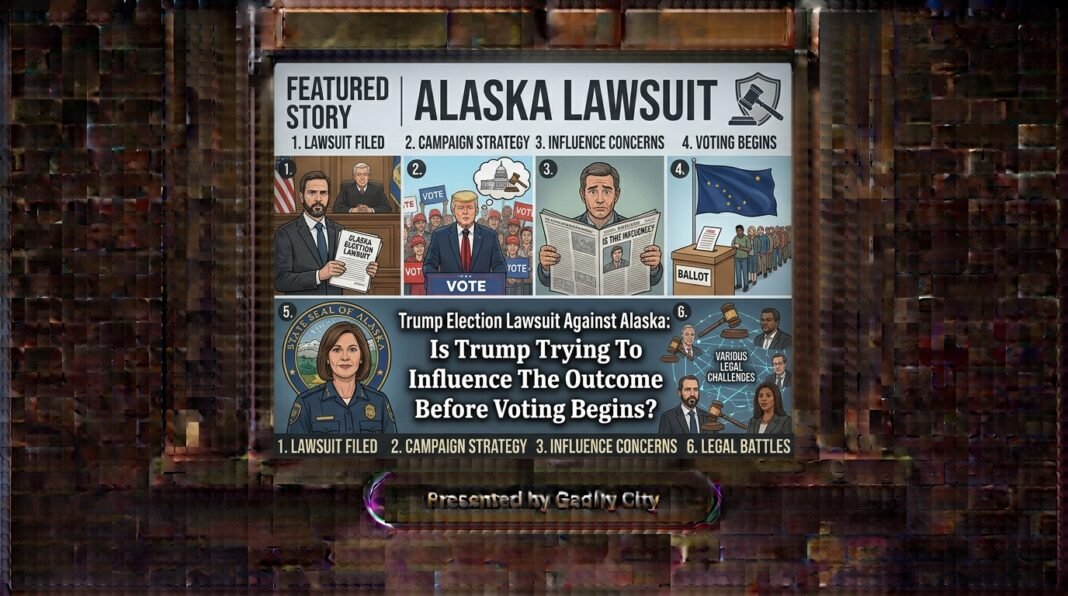
The Trump election lawsuit against Alaska seeks to block certification of the state’s 2026 U.S. Senate election under certain circumstances if Republican Senator Dan Sullivan loses. President Donald Trump says he personally ordered the suit, raising serious questions about federal power, voter choice, and whether election rules can be challenged to protect a preferred candidate.
What The Alaska Lawsuit Actually Seeks
The case, United States v. Alaska, concerns a potential problem with the names of two candidates competing for the same Senate seat. Republican incumbent Dan Sullivan is running against Democrat Mary Peltola, while another candidate, Daniel J. Sullivan Jr., is also on the ballot.
The Justice Department filed its lawsuit on October 22, 2026, arguing that voter confusion could affect the result. The administration wants Alaska prevented from certifying a Peltola victory under the circumstances described in the complaint, pending an investigation into whether votes intended for the incumbent were cast for the other candidate. Trump subsequently said he personally ordered the lawsuit.
This distinction matters. The Trump election lawsuit does not simply challenge a completed count; it seeks a legal safeguard that could affect how the state certifies a result before voters have finished casting their ballots.
The administration’s argument is that ballot confusion could undermine electoral fairness. Critics counter that the proposed remedy could interfere with the electorate’s decision and leave Alaskans without timely representation. Those are competing legal and political arguments, not conclusions that have already been established by a court.
Why The Lawsuit Raises Questions About Federal Power
Who Has Authority Over Elections?
American elections operate under a divided system of authority. States generally administer elections, while Congress has constitutional authority to regulate federal congressional elections through the Elections Clause.
The Congressional Research Service’s explanation of congressional authority over elections outlines this balance. Federal involvement is not automatically unlawful, but the government must identify a valid legal basis for its intervention.
That is where the Trump election lawsuit becomes especially important. The Justice Department invokes the National Voter Registration Act, whose stated purposes include expanding voter registration opportunities, protecting electoral integrity, and maintaining accurate registration rolls. The law’s purpose provisions do not expressly establish a general power to suspend election certification because candidates have similar names.
Readers can examine the actual text of the National Voter Registration Act rather than relying solely on statements from either political party.
The central legal question is whether the statute supports the specific remedy the government seeks. The existence of a legitimate concern about voter confusion does not, by itself, establish that every proposed response is lawful.
Why Timing Matters
According to reporting from Alaska Public Media, the ballot dispute emerged after the candidate list had already been finalized and early voting had begun.
That timing creates a practical problem. Voters have already started making decisions based on the ballot presented to them. A late legal challenge can create uncertainty about whether their votes will ultimately count toward a certified result.
The Trump election controversy is therefore not only about the names printed on a ballot. It is also about whether the rules governing an election remain predictable once voting begins.
The California Arrests And The Wider Election Debate
Our earlier reporting on federal arrests in California provides another part of this developing story. On October 19, the Justice Department announced charges against 28 foreign nationals over alleged election-related offenses, including fraudulent voter registration and illegal voting. Eleven people were arrested that day, according to the department’s announcement.
The Justice Department’s official account of the California cases explains the allegations and the government’s stated rationale. These are criminal accusations, and the defendants’ guilt must be determined through the legal process.
The wider context is important because the Trump election debate increasingly involves two distinct questions: whether individual voting laws have been violated and whether federal enforcement is being used appropriately in politically sensitive circumstances.
Evidence of an individual offense does not automatically establish widespread election fraud. Likewise, criticism of a federal investigation does not prove that the underlying allegations are false.
A responsible assessment must separate the evidence in individual cases from broader political claims.
Connecting California To Alaska
The California cases concern alleged illegal registration and voting. The Alaska lawsuit concerns the potential impact of a candidate’s name on a Senate election and the conditions under which its result may be certified. These are legally different matters.
Their connection is the administration’s broader emphasis on election integrity and the role of federal authorities in enforcing election rules.
The important question is whether each intervention is supported by evidence, authorized by law, and proportionate to the problem it seeks to solve. That framework allows us to scrutinize federal power without dismissing legitimate investigations or accepting every official justification at face value.
The 2020 Election And Trump’s Claims About Fairness
The Trump election lawsuit also invites comparisons with the aftermath of the 2020 presidential election. Trump repeatedly challenged the result of that election, alleging widespread fraud. Courts and election officials examined numerous claims, but those challenges did not establish fraud sufficient to change the outcome.
The U.S. Cybersecurity and Infrastructure Security Agency’s November 2020 statement described that election as the most secure in American history at the time. That assessment is an important part of the historical record when evaluating later claims about election integrity.
In the current election cycle, Trump has again raised concerns about fairness. The question is not whether a president may criticize election procedures; political leaders have every right to raise genuine concerns. The question is what happens when those concerns lead to legal action that could affect whether a state’s voters receive a certified result.
Our earlier reporting has also examined claims about a small group within the administration allegedly working with state officials to resist Trump’s election-related efforts. Those allegations should be assessed through verifiable documents, named officials, court filings, and on-the-record statements rather than treated as established fact without supporting evidence.
That distinction is essential. If government officials are resisting an unlawful directive, their actions raise one set of questions. If officials are improperly obstructing lawful federal authority, they raise another. The evidence must determine which description fits.
The Trump election debate becomes less useful when every disagreement is reduced to a struggle between loyalists and opponents. What matters is whether the conduct involved complies with the law and respects voters’ rights.
Historical Parallels: Political Power And Institutional Resistance
History offers a useful framework for understanding conflicts between executive power and other institutions. In the post-war period, American political leaders frequently faced disputes over how far federal authority should extend and how institutions should respond when competing interpretations of the law emerged.
Those historical struggles were not identical to today’s election disputes. However, they illustrate a recurring principle: political authority is most durable when its limits are defined by rules that apply regardless of who holds office.
The Trump election lawsuit tests that principle in a modern setting. A president may believe that a particular election procedure is unfair, but that belief does not automatically give the executive branch the authority to change the rules or prevent certification.
Similarly, state officials cannot simply ignore valid federal law because they disagree with the president. Both sides must operate within their lawful authority.
This is why the Alaska case deserves scrutiny beyond its immediate partisan consequences. The precedent established by a court could influence how future administrations approach election disputes involving candidates, ballot design, and certification.
What Happens Next In The Trump Election Case?
The immediate issue is whether the court accepts the Justice Department’s legal theory and grants the relief it requested. The American Civil Liberties Union and other voting-rights advocates have moved to intervene and seek dismissal, arguing that the lawsuit lacks a valid legal foundation.
Several questions deserve close attention as the case develops:
- Legal authority: Does the National Voter Registration Act support the requested restriction on certification?
- Evidence: Is there sufficient evidence that the candidate names are likely to confuse enough voters to affect the outcome?
- Proportionality: Would delaying certification address the alleged problem, or would it unnecessarily interfere with voters’ choices?
- Precedent: Could the ruling create a framework that future administrations might use to challenge unfavorable election results?
These questions are more useful than predicting which party will win the legal dispute before the court has ruled.
Our Analysis: Protecting Election Integrity Means Protecting Voter Choice
Our position is straightforward: election integrity requires accurate ballots, lawful investigations, transparent counting procedures, and credible certification. It also requires that governments respect the limits of their authority.
The Trump election lawsuit may be presented as an effort to prevent voter confusion, but the remedy matters as much as the stated objective. If the government can delay certification whenever it argues that a possible problem could have changed an outcome, the same reasoning could become a tool for future political interference.
At the same time, legitimate evidence of election-related wrongdoing should be investigated through established legal procedures. Scrutiny should not depend on whether the investigation benefits or harms a particular party.
As this Trump election dispute unfolds, we should judge the administration by the evidence it presents, the legal authority it invokes, and the consequences of the remedy it requests. We should apply the same standards to state officials and political opponents.
For continuing coverage of political accountability, legal disputes, and the institutions shaping American democracy, we invite readers to explore Gadfly City and our Report and Resist reporting.
Ultimately, a democracy is not tested only by whether its preferred candidates win. It is tested by whether its institutions can accept a lawful result—even when the outcome disappoints those in power.
Frequently Asked Questions
1. What Is The Trump Election Lawsuit Against Alaska About?
The Trump election lawsuit seeks to prevent Alaska from certifying a particular Senate election result under specified circumstances if Senator Dan Sullivan loses. The government argues that confusion involving another candidate could affect the outcome.
2. Why Is Trump Challenging Alaska’s Election Procedures?
The administration argues that two candidates with similar names could confuse voters and compromise the fairness of the Senate election. Critics question whether the federal government has a valid legal basis for delaying certification.
3. Does The Trump Election Lawsuit Mean Alaska’s Election Is Invalid?
No. Filing a lawsuit does not invalidate an election or establish wrongdoing. A court must assess the government’s legal arguments and evidence before deciding whether any requested remedy is justified.
4. How Does The Alaska Lawsuit Relate To The 2020 Election?
Both disputes involve arguments about election integrity and the legitimacy of electoral processes. However, the legal circumstances differ, and comparisons should account for the evidence, applicable laws, and outcomes of each case.
5. Can The Federal Government Control State Elections?
States generally administer elections, while Congress has constitutional authority to regulate federal congressional elections. Federal agencies may enforce applicable laws, but executive actions must remain within their legal authority.
6. Why Does Election Certification Matter?
Certification formally establishes an election’s official result under applicable law. Delaying certification can prolong uncertainty over representation, while safeguards against genuine irregularities must operate through lawful, evidence-based procedures.
Sources And References
- Associated Press – Trump Administration’s Alaska Election Lawsuit
- U.S. Department Of Justice – California Election-Related Charges
- Congressional Research Service – Congressional Authority Over Elections
- U.S. Code – National Voter Registration Act, Section 20501
- U.S. Constitution Annotated – Congress And The Elections Clause
- U.S. Cybersecurity And Infrastructure Security Agency – Joint Statement On Election Security
- American Civil Liberties Union – United States v. Alaska