


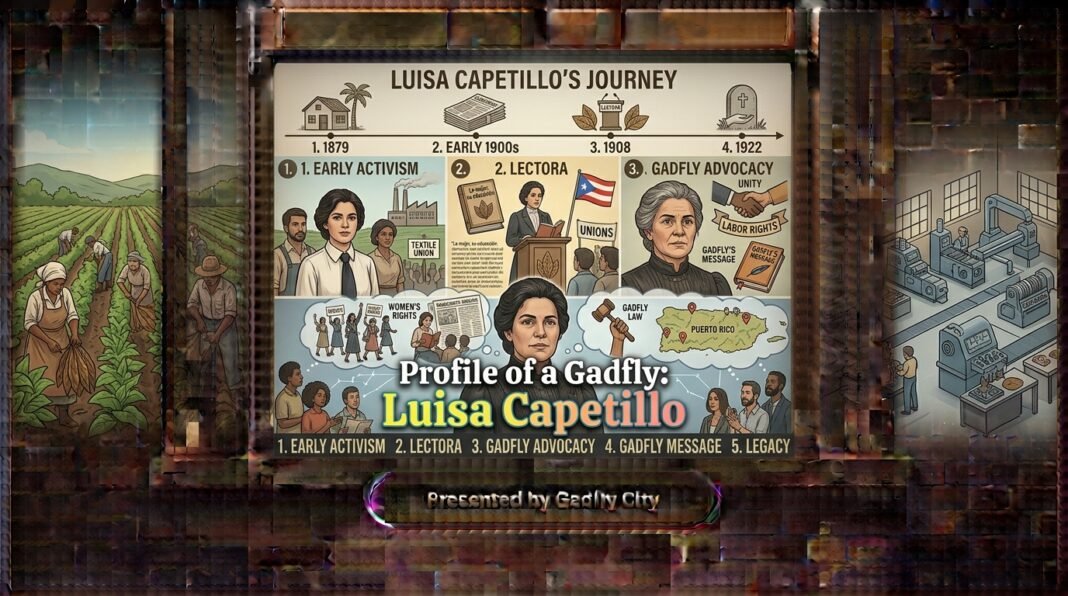
Luisa Capetillo was a Puerto Rican labor organizer, feminist, writer, and anarchist who challenged the social rules of the early 20th century. Through her work for workers’ rights, women’s equality, and personal freedom, Luisa Capetillo confronted powerful institutions and everyday conventions, becoming a lasting symbol of resistance in Puerto Rican history.
Who Was Luisa Capetillo?
Born on October 28, 1879, in Arecibo, Puerto Rico, Luisa Capetillo grew up in a society shaped by colonial rule, economic inequality, and strict expectations for women. Her life unfolded during a period of significant political and social change, as Puerto Rico came under United States control following the Spanish-American War of 1898.
Rather than accept the boundaries assigned to her, Capetillo became involved in the labor movement and used her voice to question the structures that governed ordinary people’s lives. She worked as a reader in tobacco factories, where someone would read newspapers, political essays, and other texts aloud to workers during their shifts.
This role placed her close to working-class communities and helped her understand how ideas could travel beyond books and classrooms. For Capetillo, education was not simply a personal achievement. It was a way for workers to understand their circumstances, challenge unfair treatment, and imagine alternatives.
Her story is particularly striking because she challenged several social conventions at once. She organized workers, advocated for women’s rights, and questioned traditional dress expectations at a time when any one of these actions could attract public hostility. Luisa Capetillo was not merely eccentric; she challenged the people who made the rules and the assumptions that allowed those rules to survive.
Luisa Capetillo And The Fight For Workers’ Rights
Why Tobacco Workers Mattered
Puerto Rico’s tobacco industry depended on large numbers of workers whose labor supported a profitable commercial system. Working conditions, low wages, and the unequal distribution of economic power made labor organizing an important issue.
As a factory reader and labor activist, Capetillo helped connect workers with political ideas about class, exploitation, and collective action. Reading aloud was significant because literacy was not equally accessible to everyone. Workers who spent long hours earning a living could still encounter arguments about labor rights and social reform through shared reading.
Capetillo also participated in labor organizing and supported efforts to improve workers’ conditions. Her activism reflected a broader principle: economic inequality was not simply the result of individual choices. It was also shaped by the institutions, employment arrangements, and social hierarchies that determined who held power.
Anarchism As A Political Philosophy
Capetillo identified with anarchist ideas, which questioned concentrated authority and promoted greater freedom, cooperation, and equality. In her political outlook, workplace inequality and women’s subordination were connected rather than separate problems.
Anarchism does not describe one single political program. Different anarchist traditions disagree about strategy and organization, but many challenge coercive hierarchies and argue that people should have greater control over their collective lives. Capetillo drew on this wider tradition to criticize systems that restricted workers and women.
Her beliefs were radical for her time, but they were not disconnected from practical concerns. Fair treatment at work, access to education, and freedom from rigid social expectations were issues people encountered in everyday life. Capetillo’s activism tried to show how those experiences were connected to larger questions of power.
How Luisa Capetillo Challenged Women’s Rights And Social Norms
A Woman Who Refused To Dress By The Rules
One of the most memorable aspects of Luisa Capetillo’s life was her decision to wear trousers in public. In the early 20th century, women’s clothing carried strong social expectations. Conventional dress helped communicate ideas about femininity, respectability, and a woman’s place in society.
Capetillo’s clothing challenged those expectations in a visible and unmistakable way. She was not simply choosing a different style. She was questioning why society treated certain forms of dress as acceptable for men but improper for women.
Her clothing became an extension of her politics: if people were expected to follow social conventions without questioning them, changing those conventions could itself become an act of protest.
Historical accounts describe Capetillo facing legal scrutiny in Cuba in 1915 after appearing in public wearing trousers. The episode illustrates how an ordinary act of personal expression could attract institutional attention when it crossed the boundaries of accepted gender behavior. The precise legal details should be understood in their historical context, rather than reduced to a modern slogan about clothing.
The larger point is that Capetillo challenged social control at more than one level. She questioned the authority of employers over workers, the authority of traditional gender roles over women, and the authority of public opinion over individual choices.
Feminism Beyond Symbolic Gestures
Capetillo’s feminism was broader than her clothing choices. She wrote about women’s independence, questioned conventional marriage, and argued for greater equality between men and women. Her ideas challenged the assumption that women should remain financially, intellectually, or socially dependent on men.
Her position was also connected to economic realities. A woman who lacked access to education or paid work had fewer options when confronting unfair treatment. For Capetillo, personal independence and workers’ rights belonged in the same conversation because both concerned a person’s ability to direct their own life.
Readers interested in how societies define women’s leadership can explore this contrast through Gadfly City’s article, How To Be A Leading Woman, According To Turning Point USA. The historical comparison is useful because the meaning of female leadership changes depending on who sets the standards and whose authority is being questioned.
Luisa Capetillo As A Writer And Public Intellectual
Capetillo did not rely on public appearances alone. She wrote essays, plays, and political works that communicated her beliefs about labor, gender, education, and social change.
One of her best-known works, Mi Opinión Sobre Las Libertades, Derechos Y Deberes De La Mujer (My Opinion on the Liberties, Rights, and Duties of Women), published in 1911, explored women’s freedom and their position in society. Her writing challenged conventional moral expectations and argued that women deserved more control over their lives.
Writing allowed Capetillo to preserve and extend arguments that might otherwise have remained confined to a speech, a meeting, or a factory floor. It also gave readers a way to encounter her ideas independently and evaluate them for themselves.
Her work was not neutral in the sense of avoiding political commitments. Capetillo openly supported social transformation. Still, understanding her contribution requires distinguishing between her historical significance and automatic agreement with every position she held. We can study her arguments critically while recognizing the importance of her willingness to challenge entrenched inequalities.
For a broader historical comparison, Gadfly City’s article on the Harriet Tubman $20 Bill Update (2026) offers another entry point into how societies remember women who challenged established power. Capetillo’s legacy raises a related question: whose contributions become part of the public record, and whose remain less familiar?
The Lasting Legacy Of Luisa Capetillo
Luisa Capetillo died on October 10, 1922, aged 42. Her life was relatively short, but her activism brought together issues that are still discussed separately today: labor rights, gender equality, freedom of expression, education, and resistance to unequal power.
Her historical importance does not depend on portraying her as flawless or suggesting that every modern movement shares her political philosophy. It rests on the way she connected everyday restrictions with broader systems of authority.
Capetillo also offers a useful lesson about historical change. Social conventions often appear natural because people encounter them repeatedly. Yet those conventions have histories, and people can question them. A clothing rule, a workplace hierarchy, or an expectation about women’s behavior may seem ordinary until someone asks who benefits from it and who pays the price.
That is why Capetillo remains worth studying. She did not wait for every institution to approve her ideas before expressing them. She used the opportunities available to her, as a reader, organizer, writer, and public figure, to make disagreements visible.
Her legacy belongs not only to Puerto Rican history but also to a wider history of people who challenged the boundaries of acceptable public behavior. Her example reminds us that meaningful social change can begin when someone refuses to treat an inherited rule as an unquestionable truth.
Frequently Asked Questions About Luisa Capetillo
1. Who Was Luisa Capetillo?
Luisa Capetillo was a Puerto Rican labor organizer, feminist, anarchist, and writer born in 1879. She advocated for workers’ rights and women’s equality while challenging social conventions, including traditional expectations about women’s clothing.
2. Why Is Luisa Capetillo Famous?
Luisa Capetillo is remembered for combining labor activism with feminist ideas and anarchist politics. She also challenged gender norms by wearing trousers publicly, making her a notable figure in the history of women’s freedom and social protest.
3. What Did Luisa Capetillo Do For Workers?
Capetillo worked as a reader in tobacco factories and participated in labor activism. She helped workers encounter political ideas through shared reading and supported efforts to improve working conditions and challenge economic inequality.
4. Was Luisa Capetillo A Feminist?
Yes. Luisa Capetillo advocated women’s independence, equality, and freedom from restrictive social expectations. Her feminist ideas addressed education, relationships, economic dependence, and the unequal standards imposed on women in early 20th-century society.
5. Why Did Luisa Capetillo Wear Trousers?
Capetillo wore trousers publicly to challenge conventional expectations about how women should dress. Her clothing became a visible expression of her broader opposition to restrictive gender roles and the social authority used to enforce them.
6. What Books Did Luisa Capetillo Write?
One of Capetillo’s best-known works is Mi Opinión Sobre Las Libertades, Derechos Y Deberes De La Mujer, published in 1911. Her writing explored women’s rights, personal freedom, labor issues, and the need for social reform.
7. When Did Luisa Capetillo Die?
Luisa Capetillo died on October 10, 1922, at the age of 42. Although her life was relatively short, her writing and activism left a lasting mark on Puerto Rican labor and feminist history.
8. Why Does Luisa Capetillo Matter Today?
Capetillo remains relevant because her life connects workers’ rights, gender equality, personal expression, and resistance to concentrated power. Her story encourages readers to question who creates social rules and whether those rules treat people fairly.
Why We Still Need To Remember Luisa Capetillo
At Gadfly City, we believe history becomes more useful when we examine not only what people did but also the rules they challenged and the consequences they faced. Luisa Capetillo’s life reminds us that resistance can take many forms, from organizing workers and publishing ideas to making an ordinary personal choice that questions an accepted convention.
As we revisit her story, we can recognize both the progress made since her time and the importance of continuing to examine unequal systems. We invite our readers to explore more of our historical and cultural coverage, including Gadfly City’s reporting and analysis, and to keep asking the questions that make history meaningful: who holds power, whose voices are heard, and what happens when someone dares to challenge the rules?
Sources And References
- Encyclopaedia Britannica – Anarchism
- Library Of Congress
- National Women’s History Museum
- Internet Archive – Historical Books And Publications
- Wikipedia – Luisa Capetillo
- Gadfly City – Report And Resist
- Gadfly City – How To Be A Leading Woman, According To Turning Point USA
- Gadfly City – Harriet Tubman $20 Bill Update (2026)