

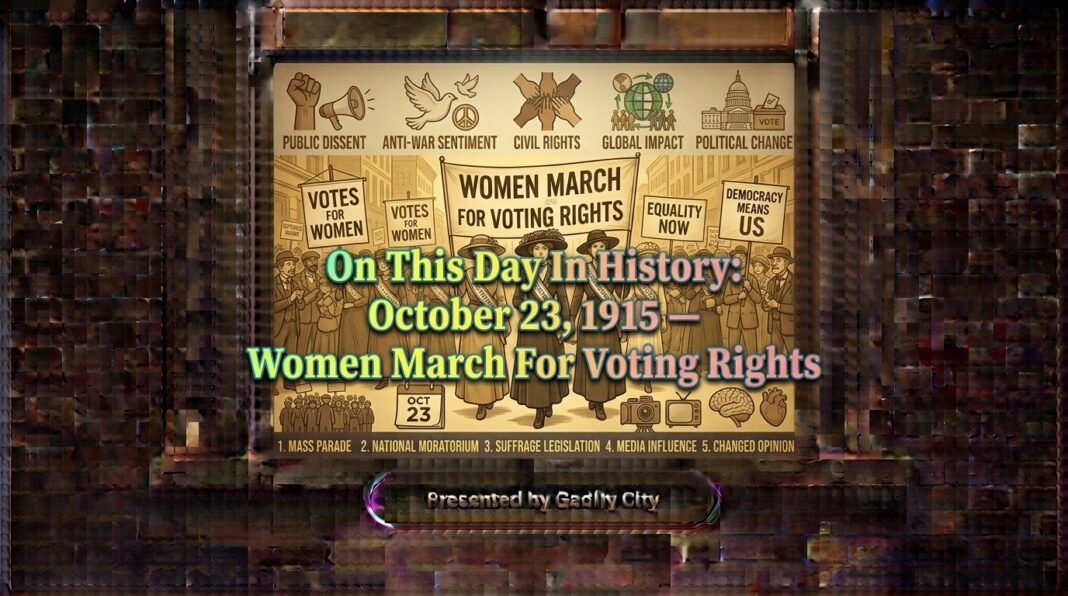
October 23 in History marks a major moment in the American women’s suffrage movement. On October 23, 1915, thousands of supporters marched up Fifth Avenue in New York City to demand voting rights for women, turning public streets into a powerful demonstration of equality, citizenship, and political participation ahead of a statewide referendum.
October 23 In History: The 1915 Women’s Suffrage March
When we look back at October 23 in History, the New York City suffrage parade stands out because it demonstrated how ordinary people could turn a political demand into a public conversation. Women and their supporters marched along Fifth Avenue to challenge the idea that political participation should depend on sex.
According to the Library of Congress, a contemporary photograph documents the pre-election parade on October 23, 1915, when approximately 20,000 women marched for suffrage. Historical accounts give varying estimates of attendance, but the scale of the demonstration was unmistakable.
The march took place at a crucial moment. New York voters were preparing to decide whether to extend voting rights to women through a state constitutional amendment. Organizers wanted to demonstrate that women were ready to participate in public affairs and that their demand for representation deserved serious consideration.
The event was not simply a celebration. It was a carefully organized political demonstration designed to influence public opinion before election day.
Why Women Took To The Streets In 1915
The Fight For Political Representation
For much of American history, women faced legal and political barriers that prevented them from voting on equal terms with men. They could contribute to their communities, work in professions, raise families, and participate in public life while remaining excluded from many of the decisions made by elected officials.
Suffragists argued that this arrangement was fundamentally unfair. If women were expected to obey laws and contribute to society, they believed they should also have a voice in choosing the people who made those laws.
The movement had been developing for decades. The 1848 Seneca Falls Convention helped establish women’s rights as a national reform issue, while later campaigns expanded public discussion of suffrage. By 1915, organizers had learned to combine petitions, speeches, political lobbying, and public demonstrations.
Why A Parade Mattered
A parade offered something that a private meeting or written petition could not: visibility. Thousands of people marching together made it difficult for politicians and newspapers to ignore the demand.
Participants carried banners with messages supporting women’s voting rights. Some wore white clothing, a visual choice associated with the movement’s public image. The organized procession also challenged stereotypes that women were unsuited to political debate or collective action.
The Museum of the City of New York’s history of woman suffrage describes how activists used public relations, memorable slogans, and large demonstrations to attract attention during the 1915 campaign.
October 23 in History therefore offers an important lesson about political advocacy: when people organize around a clear demand, a public demonstration can make an overlooked issue harder to dismiss.
The Outcome Of The 1915 Suffrage Campaign
Why The Referendum Failed
Despite the parade’s size and visibility, the immediate political result was disappointing. On November 2, 1915, New York voters rejected the proposal to grant women voting rights.
This outcome illustrates an important distinction between public attention and political change. A demonstration can bring an issue into the public eye, but changing the law often requires a majority of voters, sustained organizing, and a favorable political environment.
The setback did not end the movement. Suffrage supporters continued campaigning, organizing public events, and persuading voters. Their work eventually helped secure victory in New York’s 1917 referendum, when the state approved women’s suffrage.
The National Park Service’s account of New York and the Nineteenth Amendment explains how winning the vote in New York became an important part of the broader national campaign.
When we examine October 23 in History, the failed 1915 referendum is just as important as the march itself. It reminds us that progress rarely follows a straight line. A campaign can lose one vote while strengthening the organization and public awareness needed for a later victory.
From State Campaigns To The Nineteenth Amendment
New York’s eventual success formed part of a wider struggle to establish women’s voting rights across the country. Activists pursued change through state legislation, constitutional campaigns, demonstrations, lobbying, and other forms of political pressure.
The decisive national milestone came in 1920. The Nineteenth Amendment prohibited the federal and state governments from denying or abridging citizens’ voting rights on the basis of sex.
According to the U.S. National Archives, Congress passed the amendment in 1919, and it was ratified on August 18, 1920. The amendment’s adoption was the result of decades of activism rather than one demonstration or a single political leader.
This broader history also connects to the work of people such as Harriet Tubman, whose legacy represents a wider struggle for freedom and equality. Readers can explore that connection in our article on the Harriet Tubman $20 Bill Update (2026).
The Women Behind The Movement And Its Limitations
The 1915 parade was part of a movement sustained by organizers, workers, reformers, and volunteers whose contributions extended far beyond a single day.
Suffrage leaders such as Carrie Chapman Catt helped coordinate political campaigns, while generations of activists had built the movement through speeches, petitions, and local organizing. Their work showed that lasting change requires both public visibility and the less visible effort of building coalitions and maintaining pressure.
However, the history of women’s suffrage also requires an honest examination of exclusion. Black women played significant roles in the fight for voting rights, yet racism within parts of the suffrage movement often limited their participation or recognition. Even after the Nineteenth Amendment was ratified, discriminatory laws and practices continued to prevent many Black women from voting freely.
The National Park Service’s history of African American women and the Nineteenth Amendment provides further context on these contributions and continuing barriers.
Recognizing these limitations does not diminish the importance of the 1915 march. It gives us a more complete understanding of what political equality requires: not merely a promise in law, but meaningful access to the rights that law is meant to protect.
Why October 23 In History Still Matters Today
The significance of October 23 in History extends beyond the story of women winning the vote. It illustrates how public participation can influence political debate, even when the immediate outcome falls short of the organizers’ goals.
The march also shows why historical progress should not be measured only by its most famous dates. The Nineteenth Amendment was a landmark achievement, but it depended on decades of organizing and did not eliminate every barrier to voting. Rights can be established in law while remaining unevenly protected in practice.
We can see similar principles in later American civil rights campaigns, where marches and voter mobilization helped bring attention to unequal treatment. Our guide to why Martin Luther King Jr. was influential explores how peaceful demonstrations became an important part of the struggle for civil rights.
Likewise, why Jesse Jackson is important offers further context on voter participation and the continuing work of expanding political representation.
These connections are useful because they show that democratic participation is not a finished achievement. It depends on institutions, public awareness, and people who are willing to take part in civic life.
Frequently Asked Questions
What Happened On October 23, 1915?
On October 23, 1915, thousands of women and supporters marched along Fifth Avenue in New York City to demand voting rights for women ahead of a statewide suffrage referendum.
Did Women Win The Vote In New York In 1915?
No. New York voters rejected the suffrage proposal on November 2, 1915. After continued campaigning, voters approved women’s suffrage in 1917, making New York an important part of the national movement.
When Did The Nineteenth Amendment Become Law?
The Nineteenth Amendment was ratified on August 18, 1920, and certified on August 26. It prohibited denying voting rights on the basis of sex, although discriminatory barriers continued to exclude many voters.
Why Is October 23 In History Important?
October 23 in History is significant because the 1915 suffrage march demonstrated how organized public action could influence political debate and contribute to the long struggle for women’s voting rights.
Final Thoughts
The women’s suffrage march of October 23, 1915, reminds us that meaningful change often begins before success becomes visible. The march did not secure an immediate victory, but it helped keep women’s political equality in the public conversation.
Its legacy encourages us to look beyond individual milestones and understand the patience, organization, and collective effort that make progress possible. History is not simply a record of what happened; it is also a way to understand why rights matter and how they are protected.
At Gadfly City, we believe that learning from the past helps us make better sense of the present. We invite you to explore our stories on Harriet Tubman’s legacy and the $20 bill and other turning points in American history, share what you learn, and keep asking the questions that make civic understanding stronger. When we remember the people who challenged the limits of their time, we help ensure that their lessons remain part of our collective future.
Sources And References
- Library Of Congress – Suffrage Parade, NYC, October 23, 1915
- Museum Of The City Of New York – Woman Suffrage
- U.S. National Archives – The 19th Amendment To The U.S. Constitution
- U.S. National Park Service – New York And The 19th Amendment
- U.S. National Park Service – African American Women And The Nineteenth Amendment
- Library Of Congress – Women Fight For The Vote: More To The Movement