

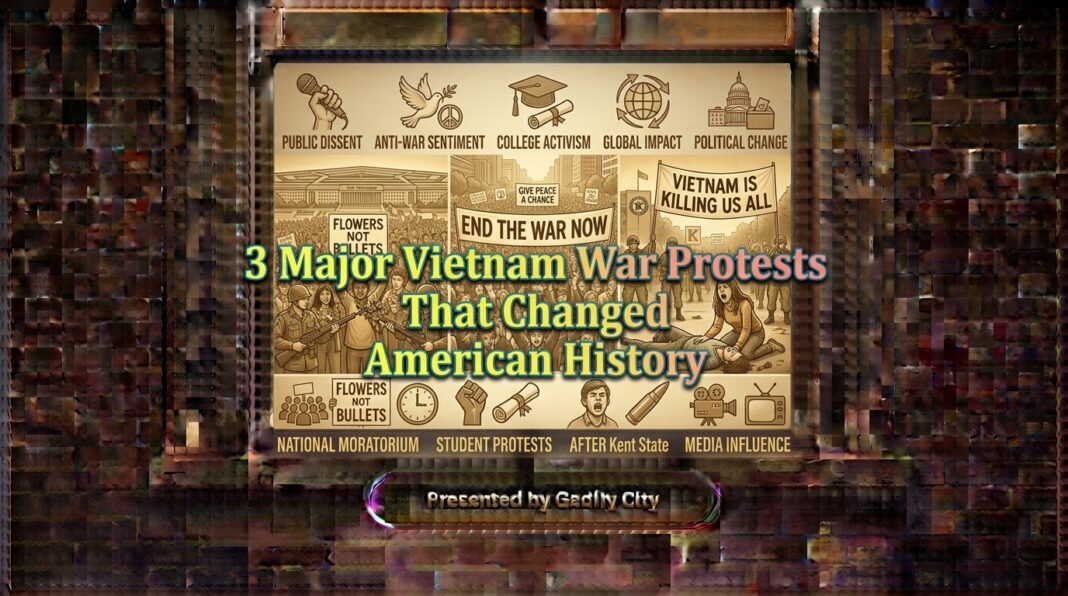
The Major Vietnam War Protests that changed American history included the 1967 March on the Pentagon, the 1969 Vietnam Moratorium, and the 1970 Kent State protests. These demonstrations challenged government decisions, brought public opposition into national debate, and exposed the growing divide between American citizens and political leaders over the Vietnam War.
1. The March On The Pentagon (1967)
By October 1967, American involvement in Vietnam had become increasingly controversial. The United States had deployed hundreds of thousands of troops, casualties were mounting, and the government’s optimistic assessments of military progress were facing growing skepticism.
On October 21, 1967, tens of thousands of demonstrators gathered in Washington, D.C., to oppose the war. Many assembled near the Lincoln Memorial before marching toward the Pentagon, the headquarters of the U.S. Department of Defense.
The demonstration became one of the most recognizable events in the early anti-war movement. According to the National Archives’ historical account of the Vietnam War, approximately 70,000 people participated in the march on the Pentagon.
Why The March Mattered
The protest was significant because it brought opposition directly to the institution responsible for directing America’s military campaign.
Participants included students, peace activists, counterculture figures, and Americans who believed the war was morally wrong or strategically misguided. They did not necessarily share the same political beliefs, but they agreed that continuing the conflict required greater public scrutiny.
The march also revealed a problem facing the Johnson administration: military involvement abroad could not be separated from public confidence at home.
As photographs and news coverage circulated, Americans encountered competing interpretations of patriotism, military service, and dissent. Some viewed the protesters as citizens exercising their democratic rights, while others considered their actions disrespectful to American troops.
The demonstration did not end the war. However, it helped establish anti-war protest as a visible force in national politics.
The march also reflected a broader tradition of pivotal moments in American political history, in which citizens have challenged established policies through collective action.
2. The Vietnam Moratorium (1969)
By 1969, opposition to the Vietnam War had expanded beyond university campuses and organized activist groups. Families, religious communities, workers, and ordinary citizens were increasingly questioning whether the war could be justified.
The Vietnam Moratorium, held on October 15, 1969, represented a major development in this movement. Rather than relying exclusively on a single march in Washington, organizers encouraged Americans across the country to suspend their normal activities and demonstrate against continued U.S. involvement.
According to the Smithsonian National Museum of American History, the nationwide Moratorium mobilized more than 15 million participants across the United States, with over a quarter of a million people marching in Washington, D.C.
How Peaceful Protest Reached A Wider Audience
The Moratorium’s strength came from its accessibility.
People did not need to travel to the capital or join a radical political organization to participate. They could attend local gatherings, join public vigils, or express opposition within their own communities.
This approach helped connect the anti-war movement with Americans who were uncomfortable with the conflict but did not identify with more confrontational forms of protest.
It also demonstrated that public dissent could take different forms. A peaceful gathering, a candlelight vigil, and a large march could all communicate opposition without requiring participants to agree on every political question.
The movement operated within the wider context of the civil rights movements of the 1960s, which had already demonstrated how organized public action could challenge established institutions and influence national conversations.
For a broader historical perspective, readers can explore the influential activist movements in the 20th century and their relationship with changing American political attitudes.
Did The Moratorium End The War?
No. The demonstration did not immediately change American military policy, and President Richard Nixon continued pursuing his administration’s Vietnam strategy.
Nevertheless, the Moratorium made opposition harder to dismiss as the concern of a small group of students or political radicals. Its nationwide participation showed that dissatisfaction with the war had become a significant public issue.
Its lasting importance lies in this shift: a protest movement could influence national debate by making public opposition visible across different communities, even without securing an immediate policy reversal.
3. The Kent State Protests (1970)
The third of these Major Vietnam War Protests became one of the most tragic episodes in modern American history.
On April 30, 1970, President Nixon announced that American and South Vietnamese forces had entered Cambodia, expanding military operations beyond Vietnam. The announcement angered opponents of the war, particularly students who believed the administration was widening a conflict it had promised to bring under control.
Protests spread across college campuses. At Kent State University in Ohio, tensions escalated over several days, prompting local authorities to request assistance from the Ohio National Guard.
On May 4, National Guard members opened fire on students during a campus demonstration. Four students were killed, and nine others were wounded.
The historical account published by HISTORY documents the shootings and their significance during this period of national division.
Why Kent State Changed The National Conversation
Kent State was different from the earlier demonstrations because the protest ended in the deaths of American students at the hands of their own country’s military forces.
The victims included students who were participating in the demonstration and others who were nearby. Their deaths intensified public anger and raised difficult questions about the use of force against civilians.
The immediate consequences extended well beyond Ohio.
Students organized demonstrations across the country, and a nationwide student strike disrupted hundreds of educational institutions. The shootings also increased scrutiny of the government’s handling of dissent and the increasingly tense relationship between protesters and public authorities.
The event did not unite Americans behind a single interpretation. Some defended the National Guard’s actions, while others condemned the shooting and demanded accountability. This disagreement reflected the deep political divisions surrounding the war.
Kent State also illustrated a difficult principle of democratic government: when public authorities respond to dissent with lethal force, the consequences can extend far beyond the immediate incident.
The tragedy became a lasting symbol of the dangers of political polarization and the importance of protecting the rights of people to express their views peacefully.
What These Three Major Vietnam War Protests Changed
Although the March on the Pentagon, Vietnam Moratorium, and Kent State protests differed in their methods and consequences, they reveal how public opposition can influence a country’s political direction.
| Protest | Central Issue | Lasting Significance |
| March on the Pentagon, 1967 | Continued military involvement in Vietnam | Made anti-war activism a major national spectacle |
| Vietnam Moratorium, 1969 | Continued U.S. participation in the war | Demonstrated the nationwide reach of public opposition |
| Kent State protests, 1970 | Expansion of the war into Cambodia and the response to student dissent | Intensified debate about military force, civil liberties, and government accountability |
These events did not single-handedly end the Vietnam War. American military withdrawal, diplomatic negotiations, congressional decisions, and developments on the battlefield all played important roles.
However, the protests helped shape the environment in which those decisions were debated.
They also demonstrated that public opinion is not merely a reflection of government policy. It can become a force that challenges political leaders, questions official explanations, and demands greater accountability.
The history of Major Vietnam War Protests also connects with a broader American tradition of grassroots advocacy and public dissent. Readers interested in how organizers influence political participation can explore political activism that reshaped national debate.
For additional context, the National Archives’ Vietnam War collection preserves historical records that help explain the conflict and the changing public response to it.
Conclusion: The Lasting Legacy Of Vietnam War Protests
The three Major Vietnam War Protests discussed here demonstrate that political change rarely follows a simple path. The March on the Pentagon made opposition visible, the Vietnam Moratorium broadened participation, and Kent State exposed the devastating consequences of escalating tensions.
None of these events independently ended the war. Their significance lies in how they changed the national conversation about military policy, citizenship, and the limits of government authority.
Their legacy remains relevant whenever Americans debate the relationship between patriotism and dissent. A functioning democracy requires more than agreement with political leaders; it also depends on citizens being able to question decisions and demand accountability.
At Gadfly City, we explore the historical events, ideas, and movements that help explain how American society changes. We invite readers to continue examining the evolving legacy of American civil resistance and consider how the choices of ordinary citizens can influence the country’s future.
Frequently Asked Questions
1. What Were The Three Major Vietnam War Protests?
Three influential demonstrations were the 1967 March on the Pentagon, the 1969 Vietnam Moratorium, and the 1970 Kent State protests. Each challenged the war and influenced public debate about American military involvement.
2. Why Did Americans Protest The Vietnam War?
Americans protested because of growing casualties, military escalation, the draft, moral objections, and doubts about government explanations. Opposition included students, religious groups, veterans, civil rights activists, and concerned citizens.
3. What Happened During The March On The Pentagon?
On October 21, 1967, tens of thousands of demonstrators gathered in Washington, D.C., and marched toward the Pentagon. The protest became a defining public demonstration against American involvement in Vietnam.
4. How Did The Vietnam Moratorium Influence Public Opinion?
The October 1969 Vietnam Moratorium mobilized millions of Americans through local demonstrations and public gatherings. Its broad participation showed that opposition to the war extended well beyond university campuses and organized activist groups.
5. Why Were The Kent State Shootings Significant?
On May 4, 1970, Ohio National Guard members killed four students and wounded nine others at Kent State University. The shootings intensified anti-war protests and triggered a nationwide student strike.
6. Did Vietnam War Protests End The War?
No single protest ended the Vietnam War. However, anti-war demonstrations helped shape public debate and political pressure, while military developments, diplomatic negotiations, congressional decisions, and government policies influenced the eventual American withdrawal.