

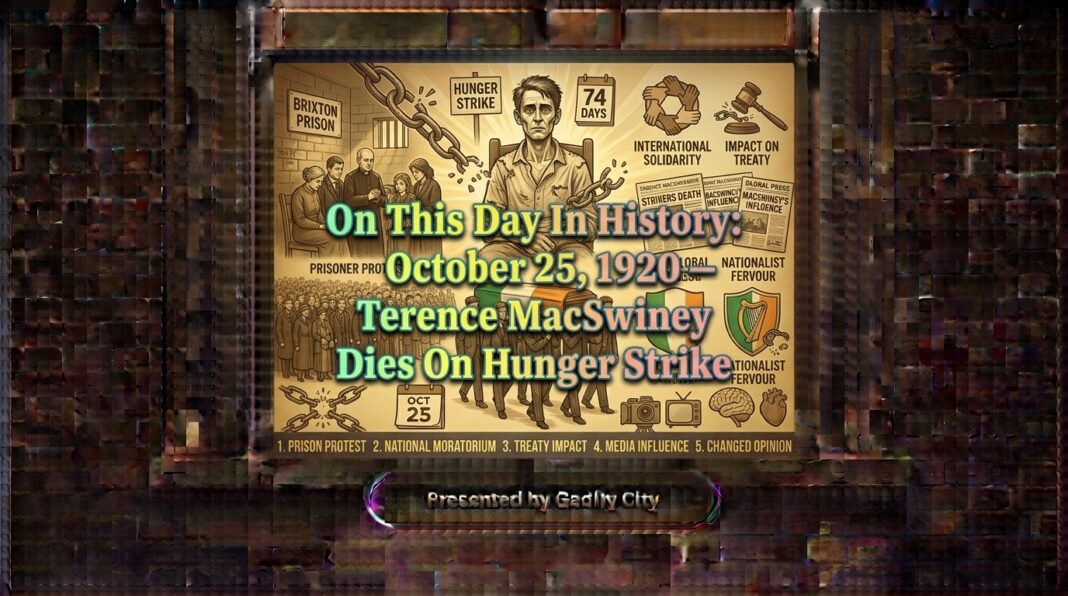
On October 25, 1920, Irish republican and Lord Mayor of Cork Terence MacSwiney died in Brixton Prison, London, after 74 days on hunger strike. This defining moment in OCTOBER 25 in history drew worldwide attention to Ireland’s independence struggle and demonstrated how political resistance could challenge British rule without conventional military force.
OCTOBER 25 In History: Why Terence MacSwiney’s Death Mattered
History often remembers wars through battles, military leaders, and territorial changes. Yet some events demonstrate that political struggles can also turn on individual decisions and the public response they provoke. OCTOBER 25 in history offers one such example through the death of Terence MacSwiney, whose hunger strike became an international symbol of Ireland’s demand for independence.
MacSwiney was not simply a prisoner protesting his treatment. He was the elected Lord Mayor of Cork, a committed Irish republican, and an influential figure in the independence movement. His death in a British prison transformed a local act of resistance into an international political issue.
According to the Dictionary of Irish Biography, his death generated worldwide sympathy for the Irish republican cause and became a pivotal moment in the War of Independence. Understanding why requires looking beyond the date itself to the political tensions that shaped his final months.
Who Was Terence MacSwiney?
Terence James MacSwiney was born in Cork, Ireland, in 1879. A writer, poet, and playwright, he developed a strong interest in Irish history, language, and national identity. His cultural interests gradually became inseparable from his political commitment to Irish independence.
MacSwiney joined the Irish Volunteers, a nationalist organisation established in 1913, and supported the movement seeking to end British rule. He later became involved with Sinn Féin, the political movement associated with the establishment of an independent Irish republic.
In 1918, he was elected to represent Mid-Cork in the British general election as a Sinn Féin candidate. Rather than taking his seat at Westminster, he supported the Irish parliament, Dáil Éireann, which nationalists established in 1919.
His political career reached a critical point in March 1920, when he became Lord Mayor of Cork after his predecessor, Tomás Mac Curtain, was killed. The position placed MacSwiney at the centre of an increasingly violent struggle between Irish republicans and British authorities.
For more background on how political power and ideology shaped the twentieth century, readers can explore our article on Who Was Primarily Responsible For The Cold War?, which examines a different historical conflict through the forces that drove it.
Why Did MacSwiney Begin A Hunger Strike?
The Arrest That Sparked An International Protest
On August 12, 1920, British authorities arrested MacSwiney at Cork City Hall while he was presiding over a Sinn Féin court. He was found in possession of documents and a cipher key associated with the republican movement. On August 16, he was sentenced to two years in prison and transferred to Brixton Prison in London.
MacSwiney responded by refusing food. His hunger strike was a deliberate act of political resistance: rather than accept imprisonment as an ordinary criminal matter, he sought to challenge the legitimacy of British authority over Ireland.
The strategy carried an obvious physical cost. Hunger strikes could weaken the authorities’ public standing, but they also placed the protester’s life at risk. MacSwiney’s decision made the question of his release increasingly difficult for the British government to contain.
The Irish independence struggle was already marked by armed clashes, arrests, reprisals, and competing claims to political legitimacy. His protest added another dimension by making the treatment of an imprisoned elected official a matter of international concern.
OCTOBER 25 In History: The Final 74 Days
MacSwiney’s hunger strike lasted from his arrest in August until his death in October. As the weeks passed, his health deteriorated, and reports about his condition continued to attract attention in Ireland, Britain, the United States, and continental Europe.
The Cork City Council’s historical account documents his political background and the international attention generated by his protest. Supporters called for his release, while others questioned whether the British government should allow a prisoner to die rather than reconsider its position.
The authorities ultimately refused to release him. The government feared that conceding to his demand could weaken its ability to maintain control during the independence conflict.
At approximately 5:40 a.m. on October 25, 1920, MacSwiney died in Brixton Prison. He was 41 years old.
The historical record establishes the essential facts clearly:
| Event | Date |
| MacSwiney Becomes Lord Mayor Of Cork | March 1920 |
| His Arrest In Cork | August 12, 1920 |
| His Prison Sentence | August 16, 1920 |
| Death After 74 Days On Hunger Strike | October 25, 1920 |
These milestones explain why OCTOBER 25 in history is associated with political resistance as much as with an individual death. The event placed the consequences of the independence conflict before an audience far beyond Ireland.
How His Death Influenced Ireland’s Independence Struggle
MacSwiney’s death did not immediately secure Irish independence, and it would be misleading to suggest that one person’s sacrifice determined the outcome of the conflict. Its importance lay instead in how it influenced public opinion and strengthened the visibility of the republican cause.
According to RTÉ’s historical coverage of the Irish hunger strikes, his death received extensive international media attention. Supporters abroad interpreted the case as evidence of the costs of British rule, while critics of the government questioned its refusal to intervene.
The response also extended beyond newspaper coverage. MacSwiney’s death generated expressions of sympathy from different countries and political communities. His story became a way for supporters to explain Ireland’s demand for self-determination to people who might otherwise have paid little attention to the conflict.
His funeral and burial in Cork drew large crowds. The public response reinforced his status as a symbol of the independence movement, even as the political and military struggle continued.
The broader lesson is that political pressure does not operate through force alone. Public legitimacy, international attention, and the ability to explain a cause to people outside a conflict can influence how governments are judged. These factors do not guarantee a particular outcome, but they can change the political environment in which decisions are made.
That principle also helps readers understand other independence movements. Our article on U.S. Independence: 10 Dates That Explain How America Became Independent explores a different struggle in which political claims, public mobilisation, and armed conflict shaped the eventual creation of an independent nation.
The Legacy Of Terence MacSwiney
MacSwiney’s influence continued after his death. His writings, particularly Principles of Freedom, published in 1921, circulated his ideas about political conviction and national liberation. His life also became a reference point for later activists who studied the relationship between personal sacrifice and political resistance.
However, historical interpretation requires balance. MacSwiney was both a political figure and a committed participant in a revolutionary movement that included armed struggle. Remembering his hunger strike does not require ignoring the wider conflict or assuming that every aspect of his politics should be endorsed.
His legacy is better understood by examining what his actions reveal about the pressures people face when they believe established institutions deny them political rights. His protest made his body the focus of a dispute that neither side could easily dismiss, but it also demonstrated the terrible human cost of that strategy.
The Dictionary of Irish Biography records that his death became a pivotal moment in the Irish War of Independence. That assessment reflects the reach of his symbolic influence, rather than a claim that his death alone brought about independence.
For readers interested in the longer history of political activism, our article Why Is Jesse Jackson Important? examines how public advocacy and organised movements can bring questions of equality and political participation into national debate.
Ultimately, OCTOBER 25 in history reminds us that the significance of a historical event often extends beyond its immediate result. MacSwiney did not live to see the Anglo-Irish Treaty signed in December 1921, which established the Irish Free State as a self-governing dominion within the British Commonwealth. Yet his protest helped keep Ireland’s independence struggle in the international conversation during a decisive period.
His story invites us to consider a difficult question: what happens when political conviction becomes so deeply held that a person is willing to risk everything for it? History cannot give a single answer, but it can help us understand the consequences.
FAQs
1. What Happened On October 25, 1920?
Terence MacSwiney, the Lord Mayor of Cork, died in Brixton Prison after 74 days on hunger strike, drawing worldwide attention to Ireland’s struggle for independence from British rule.
2. Why Did Terence MacSwiney Go On Hunger Strike?
MacSwiney began his hunger strike after his arrest and imprisonment by British authorities in August 1920, using his refusal to eat as a political protest against British rule in Ireland.
3. How Did MacSwiney’s Death Affect Irish Independence?
His death generated international sympathy for Irish republicans, intensified scrutiny of British policy, and strengthened his symbolic importance during the Irish War of Independence, although it did not immediately achieve independence.
4. Where Did Terence MacSwiney Die?
MacSwiney died in Brixton Prison in London, England, on October 25, 1920. His death followed a 74-day hunger strike, and his remains were subsequently taken to Cork for burial.
Conclusion
The story of Terence MacSwiney shows how one person’s protest can become part of a much larger historical struggle. OCTOBER 25 in history is not simply a date marking a death; it is an opportunity to examine the relationship between political authority, individual conviction, and the pursuit of national freedom.
As we revisit these events, we can learn to look beyond familiar timelines and consider the people, decisions, and consequences behind them. At Gadfly City, we explore history to help us understand how the past continues to shape political debates, social movements, and the meaning of freedom today. By examining these stories with curiosity and care, we can build a clearer understanding of the choices that shape our shared world.
Sources And References
- Dictionary Of Irish Biography – Terence James MacSwiney
- Cork City Council – Lord Mayor Terence MacSwiney
- RTÉ – Hunger Strikes And The War Of Independence
- Irish Military Archives – Terence MacSwiney
- RTÉ Century Ireland – Terence MacSwiney Dies After 74 Days On Hunger Strike
- Cambridge University Press – The Hunger-Strike Of The Lord Mayor Of Cork, 1920
- National Library Of Medicine – A History Of Force Feeding