


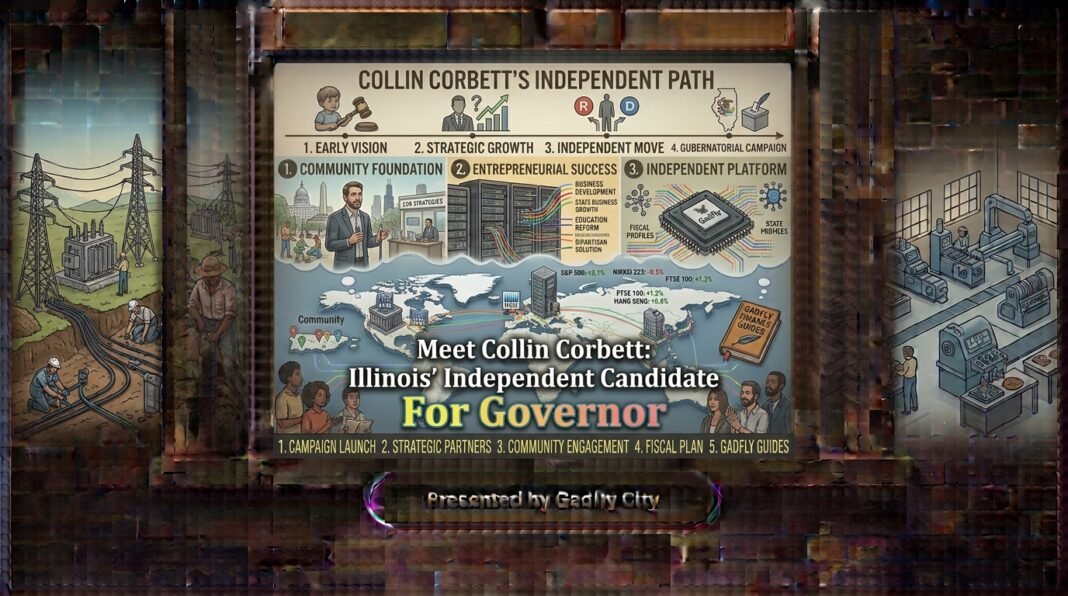
Collin Corbett is an independent candidate for Illinois governor in the November 3, 2026, general election, running alongside lieutenant governor candidate Carolyn Schofield. A political strategist and small business owner, Collin Corbett has built his campaign around affordability, economic growth, and political reform, offering voters an alternative to the traditional Democratic and Republican parties.
Who Is Collin Corbett?
Collin Corbett is a 40-year-old political strategist and small business owner from Palatine, Illinois. According to his campaign biography, he has spent approximately two decades helping people participate in politics and has founded three businesses: Cor Strategies, EmpowerPolitics, and Long9 Studio. His professional experience spans campaign strategy, civic engagement, and business development.
Corbett’s background is relevant because his campaign focuses heavily on how political decisions affect communities, local businesses, and household budgets. Rather than presenting himself as a career elected official, he emphasizes his experience working with political organizations and bringing residents, businesses, and government leaders together.
His campaign biography states that he has recruited and trained more than 3,500 people to participate in the political process and worked with nearly 1,200 organizations and campaigns. These figures come from his campaign, so readers should understand them as self-reported credentials rather than independently audited results.
His personal story also features prominently in his public profile. Corbett says he began working at age 12 to help his family and could not afford to attend college. He later started his first business from a closet in his apartment. These experiences inform the affordability message at the center of his gubernatorial campaign.
For more background, readers can visit his official campaign biography.
Why Is Collin Corbett Running As An Independent?
Collin Corbett’s candidacy reflects a broader question in American politics: can a candidate outside the two major parties build a meaningful alternative?
Illinois has a competitive political environment, but statewide elections are generally shaped by Democratic and Republican candidates. Corbett argues that partisan conflict can distract from practical problems such as living costs, taxes, and public services. His campaign describes its approach as building an independent political majority focused on everyday concerns.
His political history adds context. According to Capitol News Illinois, Corbett previously worked as a Republican strategist before launching his independent gubernatorial campaign. He has also publicly supported positions that differ from some traditional Republican positions, including marriage equality and abortion rights. His views on taxation and government spending likewise do not fit neatly into a single party label.
This background helps explain why Collin Corbett presents independence as more than a ballot designation. He wants voters to consider individual proposals without automatically accepting a party’s entire policy package.
For readers interested in how alternative political movements challenge established institutions, Gadfly City’s Report And Resist offers a related editorial context for thinking about political participation and accountability.
However, independence alone does not establish whether a candidate’s proposals will work. The practical test is whether the policies are clearly explained, financially realistic, and capable of gaining legislative support.
What Is Collin Corbett’s Policy Platform?
Collin Corbett organizes his campaign around three broad priorities: making life more affordable, encouraging economic growth, and reforming state government. His campaign website outlines these themes, while interviews provide additional detail about selected proposals.
1. Making Life More Affordable
Affordability is a central theme of the Collin Corbett campaign. His proposals include lowering property taxes, controlling state spending, reducing energy and health care costs, offering relief at the pump, and encouraging the construction of affordable housing. He has also called for addressing the effects of expanding data center development on local communities.
The financial logic behind these proposals is straightforward: when housing, transportation, utilities, and medical expenses consume a larger share of household income, families have less money available for savings and other needs.
But lowering one tax does not automatically reduce the overall cost of government. Policymakers must determine how to replace any lost revenue, reduce spending, or change the way public services are funded.
That question is particularly important when assessing Collin Corbett’s property tax proposals. Illinois communities rely on local revenue to fund services such as schools and public safety. Any sustainable tax-relief plan must consider both household savings and the resources needed to maintain those services.
For broader economic context, readers can explore Gadfly City’s article, What Would Happen If The US Economy Collapsed?, which provides a related starting point for considering economic stability and financial pressures.
2. Reforming Illinois’ Tax Structure
Collin Corbett has also questioned Illinois’ reliance on sales taxes for everyday purchases. In an interview with Capitol News Illinois, he argued that taxing essential goods can place a disproportionate burden on working families. He has proposed shifting some taxation toward services, particularly higher-end services, while using additional revenue to help lower property taxes.
The underlying idea is to reconsider what gets taxed rather than simply debating whether taxes should rise or fall.
For example, a household with limited disposable income may feel a sales tax on essential purchases more directly than a wealthier household feels the same tax. A change in the tax base could alter that burden, but the result would depend on which services are covered, the rates applied, and how businesses respond.
There are trade-offs to consider. Expanding a tax to services could raise revenue, but it could also increase costs for consumers or businesses purchasing those services. Exemptions, enforcement, and the distribution of the tax burden would all affect the outcome.
The key question is whether a proposed reform produces measurable relief for households without creating new economic pressures or undermining essential public services.
3. Encouraging Economic Growth
Another priority for Collin Corbett is making Illinois more attractive to businesses. His campaign proposes reducing unnecessary regulations, supporting established industries, strengthening the workforce, and attracting new investment. It also emphasizes making the state more competitive for employers and workers.
The reasoning is that businesses are more likely to expand when operating costs, regulatory requirements, and access to skilled workers are manageable. Expansion can create jobs, increase household earnings, and broaden the tax base.
However, economic development requires more than lower costs for employers. Infrastructure, education, access to markets, housing availability, and the quality of public services can all influence business decisions.
For that reason, evaluating Collin Corbett’s economic platform requires looking beyond its stated goals. Voters can examine how the campaign proposes to measure new investment, job creation, wage growth, and the long-term public cost of incentives or regulatory changes.
How Does Collin Corbett Approach Government Reform?
Collin Corbett argues that political polarization makes it harder to solve practical problems. His campaign emphasizes bringing people with different views together rather than treating every policy disagreement as a conflict between political parties.
One of his specific proposals concerns ethics oversight. In his interview with Capitol News Illinois, Corbett called for stronger powers for the legislative inspector general, including subpoena authority and the ability to release reports. He also proposed an independent ethics oversight commission covering state government more broadly.
These ideas address a basic governance issue: oversight is more effective when investigators can obtain relevant information and make findings public under clear rules.
The details matter, though. An oversight body needs a defined mandate, appropriate independence, procedural safeguards, and sufficient resources to investigate potential misconduct fairly. Greater authority by itself does not guarantee better accountability.
For Collin Corbett, government reform is therefore connected to his broader argument that public institutions should focus on delivering results rather than serving partisan interests.
Readers can also explore Gadfly City’s Briefly Weird for lighter coverage of unusual political developments and campaigns outside conventional party structures.
Who Is Running With Collin Corbett?
Collin Corbett’s running mate is Carolyn Schofield, who is seeking the office of lieutenant governor. The pair are listed as independent candidates in Illinois’ 2026 gubernatorial election. The Illinois State Board Of Elections provides official candidate information, while WTTW’s 2026 voter guide offers additional background on the ticket.
The election is scheduled for November 3, 2026. Collin Corbett is running against candidates from the major parties, including incumbent Democratic Governor JB Pritzker and Republican nominee Darren Bailey.
An independent campaign faces structural challenges, including ballot access, fundraising, public recognition, and the difficulty of building support without an established party network. Those challenges do not determine the value of any individual proposal, but they help explain the environment in which the campaign operates.
For readers, the useful distinction is between a candidate’s political positioning and the practical implications of their policies. A candidate can challenge the established parties, but governing also requires building legislative support, managing public finances, and implementing decisions through state institutions.
What Should Voters Examine Before Assessing Collin Corbett?
A brief candidate profile can introduce a person’s background and priorities, but it cannot establish whether a platform will deliver its intended results. Voters who want to assess Collin Corbett’s proposals can start with three questions:
- What Is The Cost? Look for budget estimates, proposed funding sources, and explanations of how tax changes would affect state and local revenue.
- Who Benefits? Examine whether a proposal offers broad relief, targets particular households, or primarily benefits certain businesses or industries.
- How Will Success Be Measured? Look for specific targets, timelines, implementation details, and public reporting that would allow voters to evaluate results.
These questions also help distinguish a campaign promise from a workable policy. Lowering taxes, improving services, and encouraging growth can all be reasonable goals, but achieving them together may involve difficult trade-offs.
Collin Corbett’s platform should therefore be considered through the same practical lens as any other candidate’s proposals: the underlying evidence, the likely costs, the distribution of benefits, and the capacity of state government to deliver the promised outcomes.
Frequently Asked Questions About Collin Corbett
Who Is Collin Corbett?
Collin Corbett is an independent political candidate, political strategist, and small business owner running for governor of Illinois in 2026. His campaign emphasizes affordability, economic development, and government reform.
Is Collin Corbett Running For Governor Of Illinois In 2026?
Yes. Collin Corbett is running as an independent candidate for Illinois governor in the November 3, 2026, general election, with Carolyn Schofield as his running mate for lieutenant governor.
What Is Collin Corbett’s Political Party?
Collin Corbett is running as an independent rather than as a Democratic or Republican nominee. He describes his campaign as an effort to build a broader independent political movement in Illinois.
What Are Collin Corbett’s Main Campaign Priorities?
Collin Corbett’s campaign focuses on reducing living costs, providing property tax relief, encouraging business growth, and reforming government oversight. His proposals include changes to taxation, energy costs, housing, and economic development.
Who Is Collin Corbett’s Running Mate?
Carolyn Schofield is Collin Corbett’s running mate for lieutenant governor. Together, they are campaigning as independents in Illinois’ 2026 gubernatorial election, presenting their platform as an alternative to the major-party candidates.
Conclusion
Collin Corbett’s candidacy raises questions about affordability, political accountability, and the role independent candidates can play in Illinois politics. His professional background in political strategy and community engagement informs a platform that emphasizes household costs, economic development, and government reform.
The important next step is to examine how his proposals would work in practice. Tax relief needs a funding plan, economic development needs measurable outcomes, and government reform needs enforceable rules. Those considerations apply to every candidate, regardless of party affiliation.
At Gadfly City, we believe informed political discussion begins with understanding the people, proposals, and trade-offs shaping public life. Explore our political news and analysis through Report And Resist to continue examining the ideas and institutions that influence American politics.
Ultimately, a candidate’s significance is not defined by party label alone. It is also shaped by the questions they raise, the evidence supporting their proposals, and the results they can demonstrate.
Sources And References
- Illinois State Board Of Elections – Candidate Details
- Collin For Illinois – Official Campaign Biography
- Collin For Illinois – Official Campaign Platform
- Capitol News Illinois – Republican-Turned-Independent Collin Corbett Hopes To Provide Voters An Alternative For Governor
- The Daily Illini – A Q&A With Independent Gubernatorial Candidate Collin Corbett
- WTTW – Collin Corbett And Carolyn Schofield Voter Guide
- WBEZ Chicago – What To Know About The Race For Illinois Governor
- Ballotpedia – Illinois Gubernatorial Election 2026