


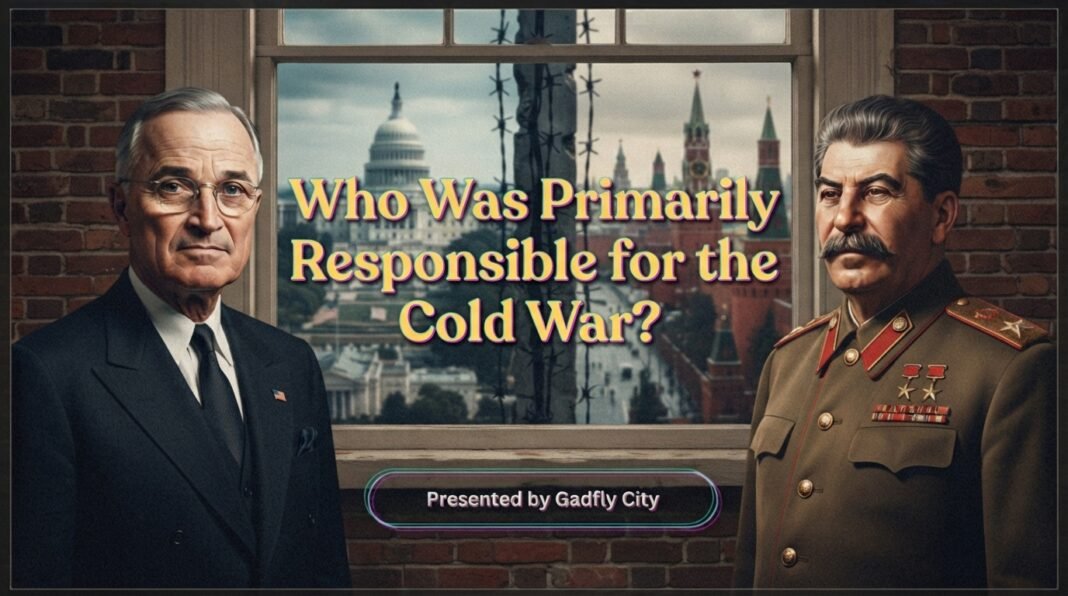
The question of who was primary responsible for the cold war has divided historians for decades. Some argue that the Soviet Union, particularly under Joseph Stalin, was mainly responsible because of its expansion into Eastern Europe and its refusal to accept genuinely independent political systems in countries under Soviet influence. Others argue that the United States helped create the conflict through containment, military alliances, economic pressure, and its determination to limit communism worldwide.
The most balanced answer is that both the United States and the Soviet Union were responsible, but their responsibilities were different. The Soviet Union contributed through its security-driven expansion and political control of Eastern Europe, while the United States responded with increasingly global policies designed to contain communism. Understanding the Cold War therefore requires looking beyond the question of who was simply “the villain.”
For readers exploring more American history, the Gadfly City History section provides additional historical topics and context.
What Started The Cold War?
The Cold War did not begin with one declaration of war or one isolated event. It developed gradually after World War II as the wartime alliance between the United States and Soviet Union broke down.
During World War II, the two countries had cooperated because they shared a common enemy: Nazi Germany. But that cooperation concealed major differences. The United States supported liberal democracy and a capitalist economic system, while the Soviet Union operated under a communist political and economic model.
The end of the war removed the common enemy holding the alliance together. Europe was devastated, Germany was occupied, and both superpowers became increasingly concerned about what the postwar political order would look like.
The U.S. Department of State’s historical record describes the early Cold War as a period in which the United States became increasingly concerned about Soviet resistance to wartime agreements and Soviet influence in Eastern Europe. At the same time, Washington began building a Western alliance designed to contain communist expansion.
Why Was The Soviet Union Blamed For Starting The Cold War?
The traditional interpretation places significant responsibility on Joseph Stalin and the Soviet government.
After the war, Soviet influence expanded across much of Eastern Europe. Governments in countries such as Poland, Hungary, Romania, Bulgaria, and Czechoslovakia increasingly came under communist control or Soviet influence.
From Moscow’s perspective, this expansion was partly about security. The Soviet Union had suffered enormous destruction during World War II and had experienced repeated invasions from the West. Creating friendly governments along its western border therefore appeared to Soviet leaders as a defensive necessity.
But the problem was that security for Moscow could look like domination to Washington.
The United States believed that Soviet control over Eastern Europe could become the foundation for further expansion. This encouraged American policymakers to adopt a policy of containment rather than simply accepting Soviet influence as a temporary postwar arrangement.
George Kennan’s 1947 containment strategy became particularly influential. Kennan argued that Soviet pressure should be resisted patiently through political and economic strength rather than automatically through direct military confrontation.
Stalin’s Security Concerns And Expansion
This is where the historical debate becomes more complicated.
It is inaccurate to describe every Soviet action as an attempt to conquer the entire world. Soviet leaders had genuine security concerns, particularly after the devastation of the war.
However, security concerns do not completely explain Soviet behavior. Political control over Eastern European governments limited their independence and increased Moscow’s strategic influence.
This combination of fear, ideology, and power created a cycle. Soviet expansion increased American fears, while American responses increased Soviet fears in return.
That cycle became one of the central mechanisms of the Cold War.
How Did The United States Contribute To The Cold War?
If the question is who was primary responsible for the cold war, it is equally important to examine American actions.
The United States did not simply react passively to Soviet policy. Washington made deliberate choices that transformed the disagreement into a broader global confrontation.
The Truman Doctrine, announced in 1947, committed the United States to supporting countries threatened by authoritarian or communist forces. It represented a major change in American foreign policy because Washington was becoming more willing to intervene in conflicts far beyond the Western Hemisphere.
The following year, the United States also introduced the Marshall Plan, a major economic reconstruction program for Europe. The plan was designed to rebuild economies devastated by World War II, but it also served a strategic purpose by reducing the conditions in which communist political movements could gain influence.
This illustrates an important point: American policymakers increasingly viewed economic stability and political stability as part of the same security problem.
Was The Marshall Plan A Cause Of The Cold War?
The Marshall Plan itself was not simply an aggressive military measure. It provided substantial economic assistance to European countries struggling to recover from the war.
However, the Soviet government viewed American economic influence with suspicion. Moscow rejected participation and prevented countries within its sphere of influence from accepting the program.
The result was further separation between Eastern and Western Europe.
The plan therefore did not single-handedly create the Cold War. Instead, it reinforced an already developing division. Western Europe became increasingly connected to the United States economically and politically, while Eastern Europe became more closely tied to Moscow.
This is an example of how Cold War policies often produced unintended consequences: actions that one side considered defensive could appear threatening to the other.
Did Nuclear Weapons Make The Cold War Worse?
Yes. Nuclear weapons transformed the consequences of the rivalry.
The United States had used atomic bombs against Japan in 1945, demonstrating an extraordinary level of destructive power. The Soviet Union successfully tested its own atomic bomb in 1949.
This eliminated America’s nuclear monopoly and intensified the strategic competition.
The problem was not simply that both countries possessed powerful weapons. Each side also had to assume that the other might eventually use those weapons if it believed its survival was threatened.
This created a security dilemma. Building more weapons could make one country feel safer while making the other country feel less safe.
By 1950, American policymakers were increasingly committed to military expansion. The influential NSC-68 report described the Soviet Union as a major threat and recommended a substantial increase in American military strength.
Did NATO Increase Cold War Tensions?
The creation of NATO in 1949 strengthened the Western side of the emerging divide.
NATO was established as a collective-security alliance involving the United States, Canada, and several Western European countries. Its purpose was to provide protection against potential Soviet aggression.
From the American perspective, an alliance could discourage Soviet expansion by making aggression more costly.
From the Soviet perspective, however, the creation of a large Western military alliance near its sphere of influence could appear threatening.
The same pattern appeared repeatedly throughout the Cold War:
One side strengthened its security → the other side felt threatened → the second side increased its military or political strength → the first side became even more suspicious.
That feedback loop helps explain why assigning responsibility to only one country can be misleading.
Who Was Primary Responsible For The Cold War?
So, who was primary responsible for the cold war?
The strongest historical answer is that responsibility was shared, but Soviet actions probably played the more important role in creating the immediate postwar crisis in Europe, while American policies played a major role in transforming that crisis into a worldwide strategic confrontation.
The Soviet Union’s control over Eastern Europe convinced many Americans that Stalin intended to expand Soviet influence. Meanwhile, American containment, economic assistance, military alliances, and global commitments convinced Soviet leaders that the United States was attempting to surround and weaken the USSR.
Neither interpretation tells the entire story by itself.
The Soviet Union was not simply an innocent defensive power responding to American aggression. At the same time, the United States was not merely an innocent observer responding to Soviet expansion. Both governments made strategic choices based on their own interests, assumptions, fears, and ideologies.
The Orthodox, Revisionist, And Post-Revisionist Views
Historians have traditionally approached responsibility through three broad interpretations.
The orthodox interpretation places greater responsibility on the Soviet Union. From this perspective, Stalin’s authoritarianism, expansion into Eastern Europe, and rejection of Western political influence created the central problem.
The revisionist interpretation shifts more responsibility toward the United States. Revisionist historians have emphasized America’s economic interests, its desire for an open international economic system, and its determination to prevent communist influence from spreading.
The post-revisionist interpretation attempts to move beyond this blame-based framework. It argues that the Cold War emerged from interaction between both superpowers rather than from one country’s decisions alone.
This third approach is often the most useful for understanding the period because international conflicts rarely develop from a single decision.
What Can We Learn From The Cold War?
The Cold War demonstrates how quickly mutual suspicion can become self-reinforcing.
A government may take an action because it believes it is protecting itself. Its rival may interpret that same action as evidence of aggressive intentions. The rival then responds with its own defensive measure, which creates another threat perception.
Over time, both sides can become trapped by their own assumptions.
This pattern is useful beyond Cold War history. Understanding how political systems interpret one another can also help explain other periods of international tension.
Readers interested in how American political movements developed during the same broad historical era can explore why Martin Luther King Jr. was influential and why Jesse Jackson is important.
Final Assessment
Ultimately, asking who was primary responsible for the cold war produces a more useful answer when “responsibility” is separated into different categories.
The Soviet Union was responsible for imposing and maintaining a sphere of political influence across much of Eastern Europe. The United States was responsible for building a containment system that included economic aid, political commitments, military alliances, and eventually a massive military buildup.
The Cold War emerged from the interaction between these policies.
The fairest conclusion is therefore not that one side caused everything while the other merely reacted. Rather, Soviet expansion created powerful incentives for American containment, while American containment reinforced Soviet fears of encirclement. Each side’s response helped strengthen the other side’s original fears.
History becomes more useful when it moves beyond assigning simple blame. The Cold War was ultimately a lesson in how competing ideas of security can turn into decades of confrontation when neither side trusts the intentions of the other.
FAQs
Who Was Primarily Responsible For The Cold War?
Most historians do not assign complete responsibility to one country. Soviet expansion in Eastern Europe and American containment policies both contributed, creating a cycle of suspicion, competition, military preparation, and political division.
Why Did The United States And Soviet Union Become Enemies?
The wartime alliance disappeared after Nazi Germany’s defeat. Their conflicting political systems, security interests, economic models, and visions for postwar Europe gradually turned cooperation into strategic rivalry.
Did Stalin Start The Cold War?
Stalin’s policies contributed significantly to the Cold War, especially through Soviet domination of Eastern Europe. However, American responses also shaped the conflict, so describing Stalin as solely responsible oversimplifies the historical evidence.
Was The United States Responsible For The Cold War?
The United States contributed through containment, the Truman Doctrine, the Marshall Plan, NATO, and military expansion. These policies were largely presented as defensive, but they also intensified Soviet perceptions of American strategic pressure.
What Was The Main Cause Of The Cold War?
There was no single cause. Ideological conflict, Soviet security concerns, Eastern European political control, American containment, nuclear competition, economic interests, and mutual distrust combined to create the Cold War.
A Calm Conclusion
History rarely gives us the comfort of a single person to blame. The Cold War shows something more complicated: countries can make decisions that seem rational from inside their own security systems while making the international environment more dangerous for everyone else.
At Gadfly City, we believe history becomes more meaningful when we examine those choices carefully rather than reducing them to simple heroes and villains. Explore our History and wider Blog for more thoughtful perspectives on the events and people that shaped the modern world.
Sources And References
- U.S. Department of State : The Truman Doctrine, 1947
- U.S. Department of State : 1945–1952: The Early Cold War
- U.S. Department of State : Marshall Plan, 1948
- U.S. Department of State : Kennan And Containment, 1947
- U.S. Department of State : North Atlantic Treaty Organization (NATO), 1949
- U.S. Department of State : NSC-68, 1950
- National Archives : The Cold War
- U.S. Department of State : Historical Documents And Foreign Relations Records