

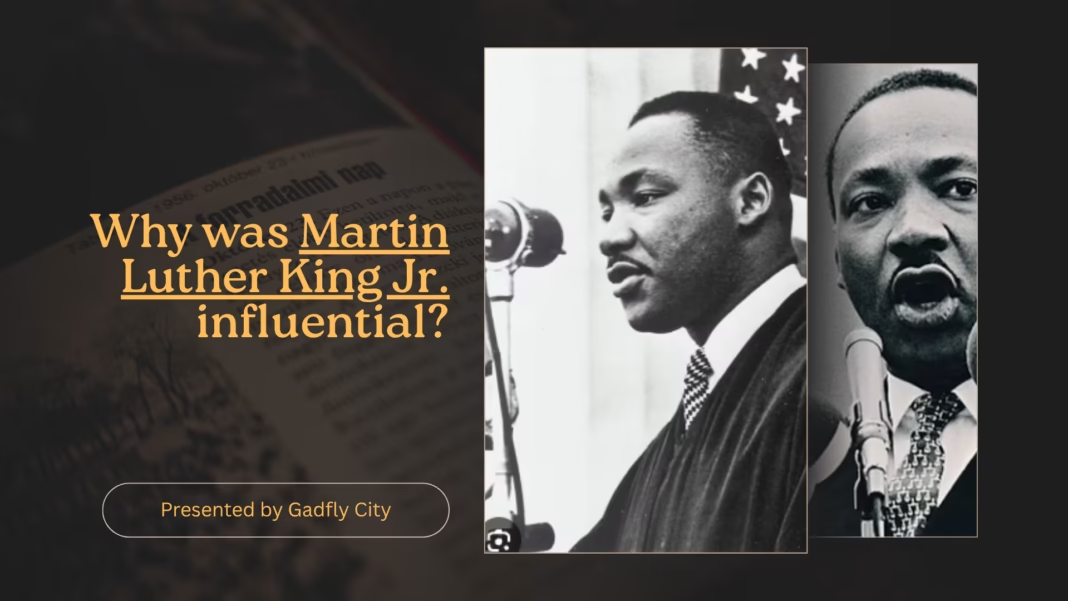
Why Was Martin Luther King Jr. Influential? The Real Reasons Behind His Impact
Ever asked yourself why was Martin Luther King Jr. influential? It was because he linked a clear moral argument against racism with disciplined nonviolent protest, powerful communication, and coordinated grassroots campaigns that forced the United States to confront segregation in public view. His leadership helped turn local struggles into national crises that produced public pressure on politicians, contributing to landmark civil-rights laws while amplifying the work of thousands of other activists and organizations.
Why Was Martin Luther King Jr. Influential?
Martin Luther King Jr. became influential not just because he was inspiring, but because he helped build a repeatable pattern for turning injustice into political change: Action → Public reaction → Media attention → Public pressure → Political pressure → Change.
He worked within a broad Civil Rights Movement that already included groups like the NAACP, local Black churches, student activists, and lawyers, but he gave this movement a moral voice and national strategy that many Americans could understand and support.
He turned racial injustice into a national moral issue
King did not frame segregation as only a “Southern problem” or a local dispute over buses and lunch counters; he argued that it violated basic ideas of justice, democracy, and human dignity that the country claimed to believe in. By connecting the fight against Jim Crow to the promises of the U.S. Constitution and the Bible, he made racial inequality a question of national conscience rather than private opinion.
This moral framing mattered because it widened the audience. People who had never joined a protest could still understand the conflict in simple terms: either the country lived up to its ideals, or it did not. That gave King and other activists a powerful way to argue that civil-rights laws were not “special favors” but basic justice long overdue.
He made nonviolent protest a powerful strategy
King argued that carefully planned, nonviolent actions—boycotts, sit-ins, marches, and civil disobedience—could expose the cruelty of segregation when the world was watching. When peaceful protesters were arrested, beaten, or attacked, the contrast between their discipline and the violence used against them created strong public sympathy, especially once photos and television coverage spread across the country.
Nonviolence was not only a moral choice but also a strategic one. It made it harder for officials to justify harsh crackdowns, drew in people uncomfortable with violent resistance, and kept the movement’s focus on changing laws rather than winning street fights. This strategy increased King’s influence because he became the best-known defender and organizer of nonviolent protest in the United States.
He knew how to communicate with a national audience
King was a trained preacher, and he used that background to speak in ways that many different groups could understand—churchgoers, students, workers, and politicians. His speeches mixed plain language, vivid stories, religious references, and repeated phrases (“I have a dream,” “Let freedom ring”) that were easy to remember and to quote.
By tying civil rights to core American symbols—the Declaration of Independence, the Constitution, the Lincoln Memorial—King turned a Black freedom struggle into a question about what kind of country America wanted to be. This communication style helped him become one of the main public voices of the movement, even while many other leaders were organizing behind the scenes.
He helped turn local conflicts into national issues
Before King, many fights against segregation were local and often ignored outside their communities. King and the Southern Christian Leadership Conference (SCLC) made it a priority to join local campaigns—like those in Montgomery, Birmingham, and Selma—and help turn them into national stories.
The pattern was consistent: organizers worked on the ground; SCLC helped plan nonviolent actions; local authorities responded; journalists recorded what happened; and suddenly a city’s bus system or voting office became front-page news and a federal concern. King’s visibility as a spokesperson meant his influence grew whenever these campaigns forced the wider public to choose sides.
Read about Jesse Jackson Accomplishments.
Watch video about Jesse Jackson:
How Did Martin Luther King Jr. Influence the Civil Rights Movement?
King did not start the Civil Rights Movement, but he helped reshape how it operated and how it was seen across the country. His influence showed up in key campaigns where he worked with other groups to combine grassroots organizing, nonviolent protest, and national media attention.
The Montgomery Bus Boycott
The Montgomery Bus Boycott began in December 1955 after Rosa Parks refused to give up her seat to a white passenger, and local activists organized a boycott of the city’s buses. King, then a young pastor, was chosen to lead the Montgomery Improvement Association, which coordinated carpools, mass meetings, and negotiations for more than a year.
This boycott mattered for King’s influence because it introduced him as a leader who could connect everyday grievances—segregated buses—to wider ideas about dignity and citizenship. Later, King himself emphasized that he did not start the protest but was asked to be its spokesman, showing how his leadership worked alongside existing community organizing rather than replacing it. The success of the boycott, which helped push federal courts to strike down bus segregation in Montgomery, showed that organized nonviolent action could win real change.
The Southern Christian Leadership Conference
In 1957, King became the first president of the newly formed Southern Christian Leadership Conference (SCLC), a coalition of Black churches and ministers committed to nonviolent struggle against segregation. SCLC’s goal was to build campaigns beyond individual cities by training local leaders, planning mass meetings, and coordinating protests rooted in church networks.
This expanded King’s influence because the SCLC gave him an organizational base and a way to work with other groups like the NAACP and, later, the Student Nonviolent Coordinating Committee (SNCC). Rather than acting alone, King used SCLC to connect local struggles—such as voter-registration drives and citywide protests—into a larger movement that kept pushing for federal attention.kinginstitute.
Birmingham
In 1963, King and SCLC joined Black leaders in Birmingham, Alabama, to challenge one of the most rigidly segregated cities in the South. The Birmingham campaign used marches, sit-ins, and boycotts to confront segregation in downtown businesses and public spaces, and it drew violent responses, including police dogs and fire hoses directed at young protesters.
Here the cause-and-effect pattern was clear: Action (nonviolent marches and sit-ins) → Public reaction (mass arrests and violence against protesters) → Media attention (striking photographs and national news coverage) → Public pressure (growing outrage among Americans watching the images) → Political pressure (the Kennedy administration pushed for a strong civil-rights bill) → Change (local desegregation agreements and momentum for federal legislation). King’s role as a visible leader, including his “Letter from Birmingham Jail,” helped explain why the campaign mattered and kept national focus on the injustice being exposed.
The March on Washington
On August 28, 1963, King was one of many leaders who helped organize and speak at the March on Washington for Jobs and Freedom, where about 250,000 people gathered near the Lincoln Memorial. The march brought together labor unions, civil-rights groups, faith communities, and student organizations to demand civil-rights and economic reforms, and it was broadcast widely on television.
King’s “I Have a Dream” speech at the march did not by itself pass laws, but it became a widely shared expression of the movement’s hopes and moral argument. By speaking to such a large audience in the capital, King strengthened his influence as a national voice while again acting within a broad coalition of groups who had done the organizing work to bring people there.
How Did Martin Luther King Jr. Help Create Political Change?
King’s influence on political change came from his ability to link street-level activism to pressure on lawmakers, not from personal control over Congress. He worked with other leaders and organizations to make it politically costly for the federal government to ignore segregation and voting discrimination.
The Civil Rights Act of 1964
The Civil Rights Act of 1964, signed by President Lyndon B. Johnson on July 2, 1964, outlawed discrimination in public places, ended legal segregation in many businesses and public facilities, and banned employment discrimination based on race, color, religion, sex, or national origin. It also created the Equal Employment Opportunity Commission to enforce these protections.
King’s role was part of a larger process. Campaigns like Birmingham and the March on Washington demonstrated the depth of public support for civil rights and the costs of continued violence and unrest. King met with presidents, testified, and used speeches to argue that federal action was morally necessary, but the bill’s passage depended on many forces: congressional negotiations, presidential leadership, court decisions, and decades of work by groups like the NAACP that had been challenging segregation in the courts. His influence lay in helping connect mass protest and public opinion to the political will needed for such sweeping legislation.
Selma and the Voting Rights Act of 1965
Even after the Civil Rights Act, racial discrimination in voting remained widespread, with local officials using literacy tests, poll taxes, and intimidation to keep Black citizens from registering. In 1965, King and SCLC joined local leaders in Selma, Alabama, where activists were already challenging voter suppression through registration drives and demonstrations.
The Selma campaign again followed the pattern: Action (peaceful marches and efforts to register voters) → Public reaction (violence by state troopers and local deputies, especially during “Bloody Sunday” on the Edmund Pettus Bridge) → Media attention (national television coverage of the attacks on unarmed marchers) → Public pressure (many Americans demanded federal protection for voting rights) → Political pressure (Johnson and Congress moved quickly on strong voting legislation) → Change (the Voting Rights Act of 1965 banned racially discriminatory voting practices and gave the federal government tools to oversee elections in areas with histories of discrimination).
King was one of several leaders of the Selma marches, but many other activists—including SNCC organizers, local Black citizens, and civil-rights lawyers—had been risking their safety and freedom for voting rights long before national cameras arrived. His influence was to help make their struggle impossible for federal officials and the wider public to ignore.
What Made Martin Luther King Jr. Such an Effective Leader?
King’s effectiveness came from how he combined personal skills—communication, moral clarity, and coalition building—with a willingness to work inside a larger movement structure.
He was an exceptional communicator
King’s speeches and sermons were powerful partly because he used everyday language and clear images to explain complex problems. He could describe segregation not just as a set of laws but as a daily humiliation, and then connect that experience to broad promises of freedom and equality.
He repeated key phrases and used rhythm and storytelling, which made his messages easy to remember and share. This communication strength gave the movement a recognizable voice and helped it reach people who might never attend a protest but would listen to a sermon, watch a television broadcast, or read a speech in the newspaper.
He connected local struggles to national ideals
King constantly tied specific local fights—buses in Montgomery, lunch counters and streets in Birmingham, voting offices in Selma—to national ideals like liberty, justice, and the “American dream.” This made it clear that these were not isolated complaints but tests of whether the country lived up to its own words.
By using locations like the Lincoln Memorial and themes from American history, he showed that civil-rights activism was not “anti-American” but an effort to make the country’s actions match its founding principles. That framing helped win support from people who were unsure about protests but believed in those ideals.
He built broad coalitions
King worked closely with ministers, students, labor leaders, and civil-rights organizations, and he regularly met with national politicians and international figures. SCLC’s church networks meant that campaigns could mobilize congregations, musicians, teachers, and community volunteers, while SNCC brought in younger activists willing to conduct intense local organizing.
This coalition-building mattered because major victories—like the Civil Rights Act and Voting Rights Act—required pressure from many directions: street protests, court cases, lobbying, and election campaigns. King’s influence grew not because he led alone but because he helped align different parts of the movement around shared goals.
Did Martin Luther King Jr. Win Civil Rights Alone?
No. The image of Martin Luther King Jr. as the single person who “won” civil rights is historically incomplete and misleading.
Long before King became nationally known, organizations such as the NAACP were filing lawsuits, Black communities were resisting Jim Crow, and local leaders were running voter-registration drives and boycotts. During the bus boycott, King himself later noted that he did not start the protest but was asked to serve as a spokesperson for a movement already formed by local people.kinginstitute.
The broader movement included:
- Grassroots activists and local organizers who risked jobs, safety, and freedom to challenge segregation in their own towns.
- Student groups like SNCC, which led sit-ins, Freedom Rides, and voter-registration campaigns in dangerous areas.kinginstitute.stanford+1
- Civil-rights lawyers, who spent years challenging discriminatory laws in courts.
- Black churches and community organizations, which provided meeting spaces, funds, and moral support.
Government action also played a crucial role. Congress passed civil-rights laws, presidents used federal power, and courts ruled against segregation and discriminatory voting rules. King’s influence was real, but it worked through and alongside these wider networks rather than replacing them.
What Were Martin Luther King Jr.’s Most Important Achievements?
Below is a concise timeline showing key achievements, what happened, what King did, and why each event mattered.
| Event | What happened | What King did | Why it mattered |
|---|---|---|---|
| Montgomery Bus Boycott (1955–1956) | Black residents boycotted segregated buses after Rosa Parks’ arrest. | Led the Montgomery Improvement Association, spoke at mass meetings, defended nonviolent discipline. | Proved that coordinated nonviolent protest could win local change and introduced King as a national leader. |
| Founding of SCLC (1957) | Southern ministers formed a new group to coordinate nonviolent campaigns. | Became SCLC’s first president and helped set its focus on nonviolent, church-based activism. | Gave the movement an organization for regional campaigns and helped connect local efforts. |
| Birmingham campaign (1963) | Mass protests challenged segregation; officials responded with arrests and violence. | Helped plan protests and wrote “Letter from Birmingham Jail” explaining the strategy. | National outrage over brutal images helped build support for federal civil-rights legislation. |
| March on Washington (1963) | About 250,000 people gathered for jobs and freedom at the Lincoln Memorial. | Delivered the “I Have a Dream” speech and supported the march’s coalition. | Showed huge public backing for civil-rights reforms and gave the movement a powerful public message. |
| Nobel Peace Prize (1964) | King received the Nobel Peace Prize for his nonviolent leadership. | Accepted the award and used it to highlight ongoing struggles in the U.S. | Increased international attention and moral legitimacy for the movement. |
| Civil Rights Act (1964) | Federal law banned many forms of racial discrimination and segregation. | Supported the push for the law through speeches, meetings, and campaigns that built public pressure. | Gave legal backing to desegregation in public places and workplaces across the country. |
| Selma campaign (1965) | Protests against voting discrimination led to marches and violent confrontations. | Helped organize and lead marches from Selma to Montgomery, calling for federal protection of voting rights. | Helped drive passage of the Voting Rights Act of 1965, which attacked discriminatory voting practices. |
| Voting Rights Act (1965) | Law banned racially biased voting rules and allowed federal oversight where discrimination was common. | Supported its passage through continued advocacy and public campaigning. | Expanded Black political participation and shifted long-term power structures in the South. |
Why Was the “I Have a Dream” Speech So Influential?
King’s “I Have a Dream” speech, delivered during the March on Washington in 1963, became influential because it combined a clear description of current injustice with a hopeful vision rooted in widely shared American values. He talked about segregation and discrimination in simple, painful images and then described a future where children of different races could live and learn together.
The speech reached a huge live audience and millions more through television and radio, making its phrases part of everyday language. Its power came from symbolism and persuasion, not from direct lawmaking: the speech helped strengthen public support for civil-rights reforms, but legislation like the Civil Rights Act still required political negotiations and sustained activism.
Was Martin Luther King Jr. Always Accepted by Everyone?
King was not universally accepted. He faced FBI surveillance, arrests, threats, and harsh opposition from segregationist politicians and local officials who saw his campaigns as dangerous. In many cities, he and other activists were jailed for protesting or marching, even when they used nonviolent methods.
He also faced criticism from within the movement. Some activists, including Malcolm X and later Black Power advocates, argued that King’s focus on nonviolence and cooperation with white allies was too slow or too forgiving of the system. While they differed in tactics and emphasis, these debates reflected a larger question: how best to fight deep, long-lasting injustice. King’s influence thus existed inside a field of competing strategies, not above it.
How Did Martin Luther King Jr.’s Influence Change Over Time?
In the mid-1950s and early 1960s, King’s main focus was on segregation, basic civil rights, and voting access, especially in the South. After major laws passed in 1964 and 1965, he increasingly spoke about issues like poverty, housing, economic inequality, and the challenges facing northern cities.catdir.
King also took strong positions on the Vietnam War, arguing that the war drained resources and moral energy from the fight against racism and poverty at home. This shift showed that he saw civil rights not only as a matter of legal equality but also as a question of economic justice and peace. As his concerns widened, his support base shifted too—some people welcomed his broader agenda, while others criticized him for moving beyond “civil rights” as they understood it.
Why Is Martin Luther King Jr. Still Influential Today?
King remains influential because the tools he helped refine—moral arguments, nonviolent protest, broad coalitions, and effective public communication—are still used by movements around the world. Many activists continue to study his campaigns to understand how to turn local injustices into national or global issues through visible, disciplined action.
His words are widely taught in schools, his birthday is a U.S. federal holiday, and his image appears in public spaces and museums like the National Archives and the Library of Congress’s online exhibits. This public memory can sometimes flatten history into simple praise, but it also keeps his ideas in circulation, encouraging new generations to consider how to connect moral principles with organized action.
What Is the Biggest Reason Martin Luther King Jr. Was Influential?
The biggest reason Martin Luther King Jr. was influential is that he showed, again and again, how moral argument plus organized nonviolent action plus skillful communication could create public and political pressure strong enough to change laws and habits that had lasted for generations.
From Montgomery to Birmingham to Selma, King worked with countless other activists to follow the same pattern: take visible, disciplined action; endure and expose unjust responses; draw media and public attention; turn sympathy into pressure on leaders; and push that pressure until it produced real legal change. His personal voice mattered, but his greatest contribution was helping a wide movement show how conscience, community organizing, and political struggle could work together.
That is the core Gadfly City insight: King mattered not simply because he was a famous speaker, but because he helped amplify a much larger movement and demonstrated a practical, repeatable way to turn moral claims into political results.
Frequently Asked Questions About Martin Luther King Jr.’s Influence
Why was Martin Luther King Jr. important?
Martin Luther King Jr. was important because he helped lead a nationwide push to end legal segregation and protect civil rights using nonviolent protest and broad coalitions. His work linked local struggles to national debates and contributed to major laws like the Civil Rights Act and the Voting Rights Act.
Why was Martin Luther King Jr. influential?
He was influential because he combined moral leadership, powerful speeches, disciplined nonviolence, and organized activism in ways that captured public attention and pressured political leaders. His influence rested on the wider movement around him, which turned his ideas into daily action.
What made Martin Luther King Jr. a good leader?
King was a good leader because he listened to local organizers, worked with many groups, and kept the movement’s goals clear and rooted in shared ideals. He used his position at SCLC to support grassroots campaigns rather than claim credit for everything himself.
How did Martin Luther King Jr. change America?
King helped change America by making the reality of segregation and voting discrimination visible to people who had not experienced them directly. His leadership in campaigns like Birmingham and Selma helped build the pressure needed for federal civil-rights and voting-rights protections.
How did MLK influence the Civil Rights Movement?
MLK influenced the Civil Rights Movement by popularizing nonviolent protest, connecting church networks to political campaigns, and giving the movement a widely recognized public voice. He did this while working alongside other organizations such as the NAACP, SNCC, and local groups.
What was Martin Luther King Jr.’s greatest achievement?
Rather than a single achievement, King’s greatest impact was helping build the conditions for broad civil-rights legislation and expanded Black political participation. His leadership in Montgomery, Birmingham, the March on Washington, and Selma all fed into these larger changes.
Why was the “I Have a Dream” speech important?
The “I Have a Dream” speech was important because it gave a clear, hopeful picture of racial equality and tied it to core American ideals in front of a massive national audience. Its language became a shared way for many people to talk about civil rights, even if the speech itself did not pass laws.
How did Martin Luther King Jr. use nonviolence?
King used nonviolence as both a moral stance and a strategy: protesters refused to fight back, even when attacked, to reveal the injustice of segregation and win public sympathy. This approach helped draw media coverage and made it harder for authorities to justify repression.
How did MLK influence the Voting Rights Act?
By joining and helping lead the Selma voting-rights campaign, King helped bring national attention to violent resistance against Black voter registration. The shock of the attacks on peaceful marchers helped push Congress and President Johnson to pass the Voting Rights Act in 1965.
Why is Martin Luther King Jr. still important today?
King is still important because his ideas about nonviolence, coalition-building, and connecting moral values to political action remain useful for many movements. His life also reminds us that major change usually comes from long-term collective work, not from the actions of one person.
Sources and referrences:
- https://www.loc.gov/classroom-materials/united-states-history-primary-source-timeline/post-war-united-states-1945-1968/martin-luther-king/
- https://kinginstitute.stanford.edu/sites/g/files/sbiybj27721/files/media/file/vol5intro_0.pdf
- https://www.archives.gov/research/african-americans/individuals/martin-luther-king
- https://www.archives.gov/milestone-documents/civil-rights-act
- https://www.archives.gov/nhprc/projects/catalog/martin-luther-king-jr
- http://web.stanford.edu/~ccarson/articles/black_scholar.htm
- https://www.loc.gov/item/today-in-history/january-15/
- https://kinginstitute.stanford.edu/sites/g/files/sbiybj27721/files/media/file/vol3intro_0.pdf
- https://prologue.blogs.archives.gov/2018/02/28/lbj-and-mlk/
- https://www.nps.gov/gwmp/learn/historyculture/lbjandmlk.htm
- https://catdir.loc.gov/catdir/toc/ecip069/2006007005.html
- https://www.loc.gov/item/lcwaN0004179/
- https://kinginstitute.stanford.edu/sites/g/files/sbiybj27721/files/media/file/vol4intro_0.pdf
- https://kinginstitute.stanford.edu/news/robert-s-graetz-montgomery-bus-boycott-supporter-and-lifelong-activist-dies-92
- https://dl.ibdocs.re/IB QUESTIONBANKS/5. Fifth Edition – TOPIC/questionbank.ibo.org/en/teachers/00000/questionbanks/2-dp-history/questions/337096.html