

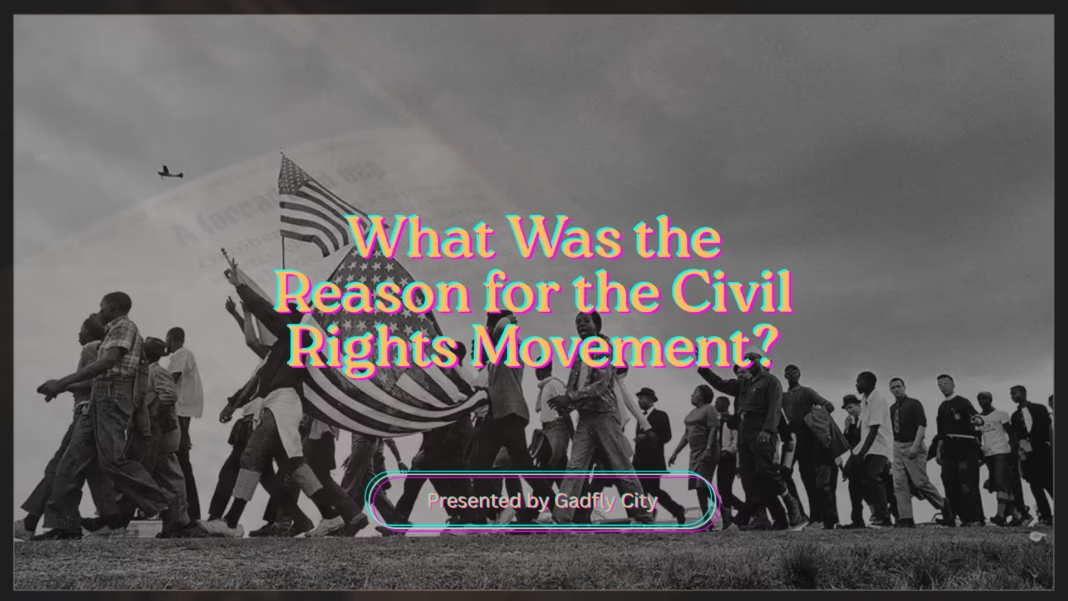
What Was the Reason for the Civil Rights Movement?
Ever wondered, what was the reason for the civil rights movement? The main reason for the Civil Rights Movement was the long‑term, systematic denial of equal rights to Black Americans through segregation, Jim Crow laws, blocked voting rights, unequal schools, economic and housing discrimination, and racial violence.
These deep injustices stretched back to slavery and the failed promises of Reconstruction, when new constitutional amendments did not stop states from stripping Black citizens of real power. Over many decades, Black communities built churches, newspapers, organizations, and legal strategies that turned anger into organized resistance, setting the stage for the mass movement of the 1950s and 1960s.
What Caused the Civil Rights Movement?
The Civil Rights Movement did not have a single cause. It grew from many long‑term problems that affected almost every part of Black life: law, politics, education, work, housing, safety, and dignity.
These deep causes made the movement necessary long before famous events like the Montgomery Bus Boycott or the March on Washington. In this article, we’ll call these long‑term problems causes, and we’ll call specific events that sped up the movement catalysts.
Racial Segregation and Jim Crow Laws
After Reconstruction, many Southern states passed Jim Crow laws that forced Black and white people to live under “separate but equal” rules in schools, buses, restaurants, parks, and more. In reality, “separate” almost always meant worse: Black schools received fewer resources, Black neighborhoods were denied services, and Black citizens were treated as second‑class.
Everyday life—where you could live, where you could sit, which jobs you could get—was controlled by law and custom to keep Black people subordinate, creating a powerful reason for the Civil Rights Movement.
Read about why is Jesse Jackson important? and what did Jesse Jackson accomplish?
Gadfly City Perspective
Jim Crow was not just about a few unfair signs on doors. It was a full social system that shaped where people could go, what they could earn, and how they were treated by courts and police. That system is why the Civil Rights Movement had to attack laws, politics, economics, and culture at the same time.
Denial of Voting Rights
Although the Fifteenth Amendment banned racial discrimination in voting, many states used poll taxes, literacy tests, “good character” clauses, and outright intimidation to stop Black citizens from registering and voting. In some counties, almost no Black adults were on the voter rolls, even though they made up a large share of the population.
Without voting rights, Black communities had little say over schools, policing, taxes, or local leaders, which made other reforms very hard to win and turned voting rights into a central demand of the movement.
When activists pushed for voting rights in places like Selma, Alabama, they were challenging a system that kept Black citizens out of juries, city councils, and state legislatures. The later Voting Rights Act of 1965 attacked these tools of voter suppression by suspending literacy tests and allowing federal oversight of discriminatory voting laws.
Unequal Education
Black children were often sent to segregated schools that had fewer teachers, crowded classrooms, older books, and poorer buildings than nearby white schools. Parents and students knew that unequal education meant fewer chances for good jobs and political leadership in the future.
For decades, the NAACP brought court cases challenging school segregation, culminating in Brown v. Board of Education in 1954. In Brown, the Supreme Court ruled that “separate educational facilities are inherently unequal,” overturning the earlier Plessy v. Ferguson decision that had allowed “separate but equal.”
Brown mattered not only because it targeted schools, but because it signaled that federal courts could be used to attack segregation everywhere, inspiring further legal action and protest.
Economic and Housing Discrimination
Civil rights were also about work and home. Black workers often faced employment discrimination, being kept out of better‑paying jobs, unions, and promotions, or receiving lower wages than white workers doing similar work.
In housing, banks, insurance companies, and local governments used practices like redlining and restrictive covenants to deny Black families access to mortgages and to keep them out of certain neighborhoods. These policies limited wealth‑building, pushed Black families into overcrowded areas, and deepened poverty.
Because discrimination touched paychecks, rent, and basic security, many civil rights campaigns demanded fair hiring, equal pay, and open housing, not just access to buses and lunch counters. Later laws, including the Civil Rights Act and Fair Housing Act, aimed to reduce these economic and housing barriers, though inequalities did not disappear.
Racial Violence and Intimidation
Violence was used to enforce the racial order. Black citizens who tried to vote, fight segregation, or challenge discrimination faced threats, beatings, bombings, and sometimes murder. Lynching and mob violence in the late 19th and early 20th centuries sent a clear message: challenging white supremacy could cost you your life.
Even during the 1950s and 1960s, attacks on activists, church bombings, and police brutality were common responses to protest.
Careful reporting—by Black newspapers first, and then by national media—helped turn these local acts of terror into national issues. The pattern often looked like this: discrimination led to resistance, resistance was met with retaliation, the retaliation drew wider attention, and that attention fueled stronger organizing.
Why Did the Civil Rights Movement Grow in the 1950s and 1960s?
If racial inequality had existed for generations, why did the movement become especially powerful in the 1950s and 1960s? The answer lies in timing. Long‑standing causes met new conditions—legal victories, World War II, television, and expanding networks of churches and student groups—that turned local struggles into a nationwide movement.
Black Americans Had Been Organizing for Decades
The modern Civil Rights Movement built on earlier waves of activism. In the late 19th and early 20th centuries, Black leaders formed organizations like the NAACP, published Black newspapers, and challenged racist laws in court. These groups fought lynching, school segregation, and voting barriers long before the 1950s.
For example, NAACP lawyers spent years building a legal strategy against segregated schools, which led to Brown v. Board. Local community organizations, fraternal groups, and union activists also practiced boycotts, petitions, and public protests, teaching skills that later became vital to mass civil rights campaigns. The movement of the 1950s and 1960s was powerful partly because earlier generations had already built networks, leaders, and legal tools.
World War II Changed Expectations About Equality
During World War II, hundreds of thousands of Black Americans served in the military and worked in defense industries, fighting for “freedom” abroad while facing segregation at home. Many Black veterans returned with a stronger sense that they deserved full citizenship after risking their lives for the country.
Civil rights organizations used this moment to press for change, lobbying for fair employment and challenging segregation in the armed forces and on interstate travel. World War II did not by itself “cause” the movement, but it raised expectations and provided moral arguments—why fight fascism overseas while tolerating racism at home?—that strengthened demands for civil rights.
Black Churches Helped Build the Movement
Black churches became key organizing spaces. They offered trusted meeting places, moral language, and local leaders who could speak to large groups. Ministers and lay members helped plan boycotts, host mass meetings, raise funds, and provide information about protests and court cases.
Organizations like the Southern Christian Leadership Conference (SCLC), founded in 1957 with Martin Luther King Jr. as a leader, are often described as “the political arm of the Black church” because they drew heavily on church networks. Churches also provided an ethical framework, linking civil rights demands to religious ideas about justice and human dignity.
Gadfly City Perspective
The church was not just a place where leaders gave speeches. It was an everyday infrastructure: a space with chairs, phones, trusted leaders, and regular gatherings. That structure made it possible to call a mass meeting on short notice, spread news to hundreds of families, pass the hat to support boycotts, and keep going after arrests or threats.
Television and Mass Media Changed the Movement
By the 1950s and 1960s, television and national news outlets could carry images of racial conflict across the country. Footage of police attacking peaceful marchers in Birmingham or Selma, or of children facing mobs outside newly integrated schools, reached millions of homes.
This coverage created a powerful chain: local protest led to media attention, which created national outrage, which pressured federal officials to act. Activists understood this dynamic and sometimes chose tactics—such as nonviolent marches in public streets—that made injustice visible on camera, turning local struggles into national political crises.
What Events Helped Accelerate the Civil Rights Movement?
The movement’s causes were long‑term inequalities. Specific events were catalysts—turning points that made the movement more visible, urgent, or organized. None of these events alone “caused” the Civil Rights Movement, but together they accelerated it.
Brown v. Board of Education
In 1954, the Supreme Court ruled in Brown v. Board of Education that segregated public schools were unconstitutional, stating that separate schools are inherently unequal. Brown did not instantly desegregate all schools, but it undermined the legal basis for segregation and encouraged further challenges in education and beyond.
Brown also showed that careful legal work could produce major victories. It energized activists, worried segregationists, and marked what many historians call the beginning of the modern civil rights era.
Emmett Till’s Murder
In 1955, 14‑year‑old Emmett Till was murdered in Mississippi after being accused of offending a white woman; his killers were acquitted. His mother chose an open‑casket funeral, and Black newspapers and magazines published photos showing the brutality of the attack.
The case sparked widespread anger and helped convince more people, especially in the North, that racial violence was not just a distant problem. Emmett Till’s death did not start the movement, but it became a symbol of the dangers Black people faced and strengthened support for organized resistance.
Rosa Parks and the Montgomery Bus Boycott
On December 1, 1955, Rosa Parks was arrested in Montgomery, Alabama, for refusing to give up her bus seat to a white passenger. Local activists had been challenging bus segregation for years, and they quickly organized the Montgomery Bus Boycott, a city‑wide refusal to ride segregated buses that lasted more than a year.
The boycott showed the power of coordinated mass action—churches shared rides, volunteers drove carpools, and Black residents maintained unity despite arrests and threats. It also brought Martin Luther King Jr., a young pastor, to national attention. The boycott did not create the movement, but it proved that sustained local organizing could force change.
Gadfly City Perspective
Rosa Parks did not create the Civil Rights Movement on the spot. Her arrest became a catalyst because Montgomery already had active NAACP members, skilled organizers like E.D. Nixon, strong churches, and a history of bus protests. The movement was a community story before it became a story about one brave individual.
The Little Rock Nine
In 1957, nine Black students—known as the Little Rock Nine—attempted to attend Central High School in Little Rock, Arkansas, after Brown v. Board. The governor used the state National Guard to block them, and hostile crowds gathered outside the school. President Dwight Eisenhower responded by sending federal troops and placing the Guard under federal control to enforce desegregation.
Little Rock showed that federal power could be used to uphold court orders against local resistance. It also demonstrated that integrating schools was not just a legal matter but a public crisis, with television cameras capturing angry mobs and frightened students.
Sit‑Ins and Student Activism
In 1960, four Black college students in Greensboro, North Carolina, sat down at a whites‑only lunch counter and refused to leave when they were denied service. Their simple, nonviolent action sparked sit‑ins across the South, where students and community members challenged segregation in restaurants, libraries, and other public places.
These protests helped lead to the formation of the Student Nonviolent Coordinating Committee (SNCC), which became a major force in voter registration and community organizing. Sit‑ins showed that young people could reshape the movement with creative tactics that were easy to copy, highly visible, and morally clear.
The Freedom Rides
In 1961, interracial groups of activists boarded buses in the Freedom Rides to test federal rulings that banned segregation in interstate travel. Riders faced beatings, firebombings, and arrests in several Southern states, especially Alabama.
National coverage of the attacks forced federal officials to act. The Interstate Commerce Commission issued orders to desegregate bus and train stations. The Freedom Rides showed how direct action could reveal the gap between federal law and local practice, pushing Washington to enforce its own rules.
The Birmingham Campaign
In 1963, the SCLC and local leaders launched the Birmingham Campaign to challenge segregation in one of the most rigidly segregated cities in the South. Marchers, including many children and teenagers, faced police dogs, fire hoses, and mass arrests. While jailed, Martin Luther King Jr. wrote his “Letter from Birmingham Jail,” explaining the logic of nonviolent direct action.
Televised images of children being attacked by police shocked viewers nationwide. Birmingham showed that sustained, nonviolent protest could force local negotiations and reshape national opinion, helping build momentum for federal civil rights legislation.
The March on Washington
On August 28, 1963, about 250,000 people gathered in Washington, D.C., for the March on Washington for Jobs and Freedom. The march brought together multiple organizations—NAACP, SCLC, SNCC, CORE, and others—and highlighted demands for jobs, voting rights, school desegregation, and fair housing.
Martin Luther King Jr.’s “I Have a Dream” speech is widely remembered, but the march’s broader impact was to show a massive, disciplined, multiracial crowd supporting civil rights on the national stage. It increased pressure on Congress and the White House to act on civil rights legislation.
The Selma Voting Rights Campaign
In 1965, activists in Selma, Alabama, focused on voting rights, organizing marches and registration drives in a county where most Black adults had been kept off the voter rolls. On “Bloody Sunday,” peaceful marchers attempting to cross the Edmund Pettus Bridge were attacked by state troopers with clubs and tear gas.
Television coverage of the violence outraged viewers nationwide. A later march from Selma to Montgomery went forward with federal protection, and the campaign helped lead directly to the Voting Rights Act of 1965, which removed many of the tools used to suppress Black voting.
Was Martin Luther King Jr. the Reason for the Civil Rights Movement?
No. Martin Luther King Jr. was one of the movement’s most important leaders, but he did not create the movement by himself. When King became widely known during the Montgomery Bus Boycott, he stepped into a struggle already shaped by earlier activists, organizations, and local leaders.
Many people and groups contributed to the movement’s power:
- Legal organizations like the NAACP and lawyers such as Thurgood Marshall.
- Organizers like Ella Baker, who helped build SNCC and believed in strong grassroots leadership.
- Activists such as Fannie Lou Hamer, who spoke out about voter suppression and poverty in Mississippi.
- Strategists like Bayard Rustin, who helped design the March on Washington.
- Student activists in SNCC, volunteers in CORE, and pastors and lay leaders in Black churches.
- Thousands of ordinary people who marched, sat‑in, registered voters, and faced daily risks.
Gadfly City Perspective
Focusing only on King makes the story easier to remember, but less accurate. It turns a community movement—with many leaders, many organizations, and many strategies—into a tale about one heroic man. Understanding the network behind King helps students see how real change usually happens: through many people working together over time.
What Did the Civil Rights Movement Want?
Different organizations had different strategies, but they shared core goals:
- Ending racial segregation in schools, transportation, and public places.
- Protecting voting rights so Black citizens could elect officials and influence laws.
- Equal education, with fair funding and access to quality schools.
- Equal employment opportunities and fair wages.socialwelfare.
- Equal access to public places like restaurants, hotels, theaters, and parks.
- Equal protection under the law, including fair treatment by police and courts.
Some groups focused more on courts and legislation; others emphasized direct action or community organizing. Over time, demands also expanded to include housing discrimination, economic justice, and broader political power.
For deeper reading on specific laws, a Gadfly City article such as “What Was the Civil Rights Act of 1964?” would help connect these goals to the legal changes they produced.
Why Did the Federal Government Eventually Act?
For decades, the federal government often avoided direct confrontation with segregationist states. That began to change when the Civil Rights Movement created a national crisis that leaders could not ignore. A rough chain looked like this:socialwelfare.
Grassroots activism → Local protests → Media attention → National concern → Political pressure → Federal action.
Large protests, strategic litigation, and highly visible violence against peaceful demonstrators pushed presidents and Congress to act. Two landmark laws followed:
- Civil Rights Act of 1964: Outlawed discrimination based on race, color, religion, sex, or national origin in public accommodations, employment, and federally funded programs, and strengthened school desegregation.
- Voting Rights Act of 1965: Suspended literacy tests, allowed federal supervision of voter registration in areas with histories of discrimination, and challenged the use of poll taxes and other barriers.
These laws did not appear because of one march or one leader. They came after years of organizing, court cases, and public pressure.
Was the Civil Rights Movement Only About the South?
The most visible battles—over Jim Crow laws, bus seating, and school desegregation—took place in the South, where segregation was written directly into state law. But racial inequality was not limited to that region.
In the North and West, Black Americans faced housing discrimination, biased policing, school inequality, and employment barriers, even when segregation was less openly written into law. Events like the Watts riots in Los Angeles in 1965 showed that anger over poverty, police abuse, and discrimination existed outside the South as well.
Learning for Justice notes that “most struggles for civil rights took place in the South… But racism and prejudice were nationwide problems,” a point that helps students see the movement as a national story, not only a Southern one.
The Civil Rights Movement Was Bigger Than a Few Famous Events
Many people learn a simplified story:
The simplified version
Rosa Parks → Martin Luther King Jr. → March on Washington → Civil Rights Act
This version highlights important moments but leaves out most of the movement’s work.
The deeper historical picture
Generations of resistance
→ legal challenges and Black newspapers
→ community organizing and Black churches
→ Brown v. Board of Education
→ Emmett Till’s murder and national outrage
→ Montgomery Bus Boycott
→ student sit‑ins and SNCC
→ Freedom Rides
→ Birmingham Campaign
→ March on Washington
→ Selma voting‑rights campaign
→ Civil Rights Act of 1964 + Voting Rights Act of 1965
This fuller picture shows how different forces—legal strategy, grassroots organizing, media, and visible violence—came together over time. It also helps explain why the Civil Rights Movement could survive setbacks: it rested on many pillars, not just one hero or one protest.
Gadfly City Perspective
When we reduce the movement to a handful of scenes, we risk teaching that history changes only when famous people appear. The Civil Rights Movement reminds us that everyday organizing—running meetings, building carpools, registering neighbors to vote, printing flyers—can be just as important as speeches at the Lincoln Memorial.
What Was the Main Reason for the Civil Rights Movement?
The main reason for the Civil Rights Movement was the systematic denial of equal rights to Black Americans through segregation, discrimination, blocked voting, unequal education, limited economic opportunity, and racial violence. These injustices were rooted in slavery and deepened when Reconstruction failed to deliver lasting protection, allowing states to create Jim Crow systems that lasted for generations.
The deeper answer is about power and preparation. The movement became powerful in the mid‑20th century because generations of Black Americans had already built organizations, legal strategies, churches, community networks, and activist traditions that could mobilize quickly when major events—like Brown, Montgomery, Birmingham, and Selma—drew national attention.
Civil Rights Movement Causes at a Glance
Long‑Term Causes
| Cause | What it meant |
|---|---|
| Jim Crow | Legal racial segregation in schools, transport, and public places. |
| Voting discrimination | Poll taxes, literacy tests, and intimidation that limited Black political power. |
| Education inequality | Separate and unequal schools with fewer resources for Black children. |
| Economic discrimination | Fewer job opportunities, lower wages, and barriers to fair employment. |
| Housing discrimination | Redlining and covenants that restricted where Black families could live. |
| Racial violence | Threats, beatings, bombings, and killings used to enforce the racial order. |
| Long‑term resistance | Decades of organizing, lawsuits, and community action that built activist networks. |
Causes and Catalysts
| Long‑term cause | Major catalyst event |
|---|---|
| School segregation | Brown v. Board of Education. |
| Racial violence | Emmett Till’s murder. |
| Bus segregation | Montgomery Bus Boycott. |
| School integration | Little Rock Nine crisis. |
| Voter suppression | Selma voting‑rights campaign. |
A helpful classroom visual here would be a “cause vs. catalyst” diagram showing how deep problems connect to specific triggering events.
Frequently Asked Questions
What was the main reason for the Civil Rights Movement?
The main reason was the long‑term denial of equal rights to Black Americans through segregation, discrimination, blocked voting, unequal schools, and racial violence. The movement rose to challenge this entire system, not just unfair seats on buses.
What caused the Civil Rights Movement?
It was caused by many connected problems: Jim Crow laws, voter suppression, school inequality, economic and housing discrimination, and everyday racial abuse. These causes developed over decades, starting in the period after slavery and Reconstruction.
Why did the Civil Rights Movement start?
Organizing began long before the 1950s, but the movement grew rapidly when earlier efforts met new conditions—World War II, court victories like Brown, television, and expanding church and student networks. These forces turned local struggles into a national movement.
When did the Civil Rights Movement begin?
Historians sometimes describe the “modern” movement as running roughly from the early 1950s to the late 1960s, beginning around Brown v. Board. But earlier civil rights activism, including NAACP lawsuits and anti‑lynching campaigns, dates back to the late 19th and early 20th centuries.
What did the Civil Rights Movement fight for?
It fought for desegregation, voting rights, equal education, fair employment, open housing, and equal protection under the law. Many campaigns also targeted police violence and economic inequality.
Who started the Civil Rights Movement?
No single person started it. It grew from many individuals and organizations: NAACP, SCLC, SNCC, CORE, Black churches, local activists, and ordinary citizens. Leaders like Martin Luther King Jr., Ella Baker, Fannie Lou Hamer, Thurgood Marshall, Bayard Rustin, John Lewis, and Rosa Parks all played important roles.
Was Rosa Parks the start of the Civil Rights Movement?
Rosa Parks’ 1955 arrest helped launch the Montgomery Bus Boycott, a major turning point. But activism against bus segregation and racial injustice in Montgomery existed before her action, and the broader movement was already growing in other places.
For a deeper look, a Gadfly City article like “Rosa Parks and the Montgomery Bus Boycott” could explore how her choice fit into a larger plan.
Was Martin Luther King Jr. the leader of the Civil Rights Movement?
King was one of the most influential leaders, especially in nonviolent direct action. However, the movement had many leaders across different organizations and communities. Seeing only King hides the importance of grassroots organizers and local campaigns.wikipedia+4
A related Gadfly City page—“Why Was Martin Luther King Jr. Important?”—could focus specifically on his ideas and accomplishments.
What events led to the Civil Rights Act of 1964?
Key events included Brown v. Board, the Montgomery Bus Boycott, sit‑ins, Freedom Rides, the Birmingham Campaign, and the March on Washington. Together they raised national pressure on Congress to pass the Civil Rights Act.
Why was the Civil Rights Movement successful?
It succeeded in winning major legal changes because it combined strategies: lawsuits, mass protests, boycotts, media campaigns, church organizing, student activism, and political lobbying. The movement’s broad base made it harder to silence and pushed federal leaders to act even when they were reluctant.
Sources and referrences:
- https://en.wikipedia.org/wiki/Civil_rights_movement
- https://www.britannica.com/summary/Causes-and-Effects-of-the-American-Civil-Rights-Movement
- https://socialwelfare.library.vcu.edu/federal/civil-rights-movement/
- https://www.nonviolent-conflict.org/us-civil-rights-movement-1942-1968/
- https://library.law.howard.edu/civilrightshistory/blackrights/jimcrow
- https://en.wikipedia.org/wiki/Civil_rights_movement_(1896–1954)
- https://www.history.com/articles/civil-rights-movement
- https://en.wikipedia.org/wiki/Jim_Crow_laws
- https://www.loc.gov/classroom-materials/united-states-history-primary-source-timeline/post-war-united-states-1945-1968/civil-rights-movement/
- https://www.learningforjustice.org/sites/default/files/general/civil_rights_map_poster_front_0.pdf
- https://www.britannica.com/list/timeline-of-the-american-civil-rights-movement
- https://www.thefilmspace.org/selma/docs/selma_timeline.pdf
- https://esports.bluefield.edu/textbooks-039/civil-rights-movement-causes.pdf
- https://www.nps.gov/subjects/civilrights/birth-of-civil-rights.htm
- https://www.loc.gov/exhibits/civil-rights-act/world-war-ii-and-post-war.html
- https://www.khanacademy.org/humanities/us-history/postwarera/civil-rights-movement/a/african-american-veterans-and-the-civil-rights-movement
- https://www.army.mil/article/183153/how_war_veterans_impacted_the_civil_rights_movement
- https://academic.oup.com/edited-volume/61644/chapter/539855882
- https://www.trumanlibraryinstitute.org/civil-rights-symposium-history-2/
- https://ruj.uj.edu.pl/server/api/core/bitstreams/ed5393a2-f0b7-465d-ad5a-44d90da62e81/content
- https://uits.edu.bd/wp-content/uploads/2019/06/05-The-Role-of-the-Black-Church-in-the-58-68.pdf
- https://charlotteteachers.org/wp-content/uploads/2025/04/J.Suton_CTI-CU_11-21-22.docx-1.pdf
- https://www.scribd.com/doc/142948646/Civil-Rights-Timeline
- https://www.bbc.co.uk/bitesize/articles/zkkhp4j
- https://www.cambridge.org/core/journals/studies-in-american-political-development/article/civil-rights-world-war-ii-and-us-public-opinion/456D4F5129B4496D99E1396D740206FA
- https://www.cambridge.org/core/services/aop-cambridge-core/content/view/456D4F5129B4496D99E1396D740206FA/S0898588X16000055a.pdf/civil-rights-world-war-ii-and-us-public-opinion.pdf
- https://scholarworks.umb.edu/cgi/viewcontent.cgi?article=1325&context=trotter_review
- https://mason.gmu.edu/~tfisher/CivilRightsMovement.html
- https://www.usahistorytimeline.com/pages/the-role-of-churches-in-the-civil-rights-movement-8d966fea.php
- https://www.nber.org/system/files/working_papers/w33460/w33460.pdf