


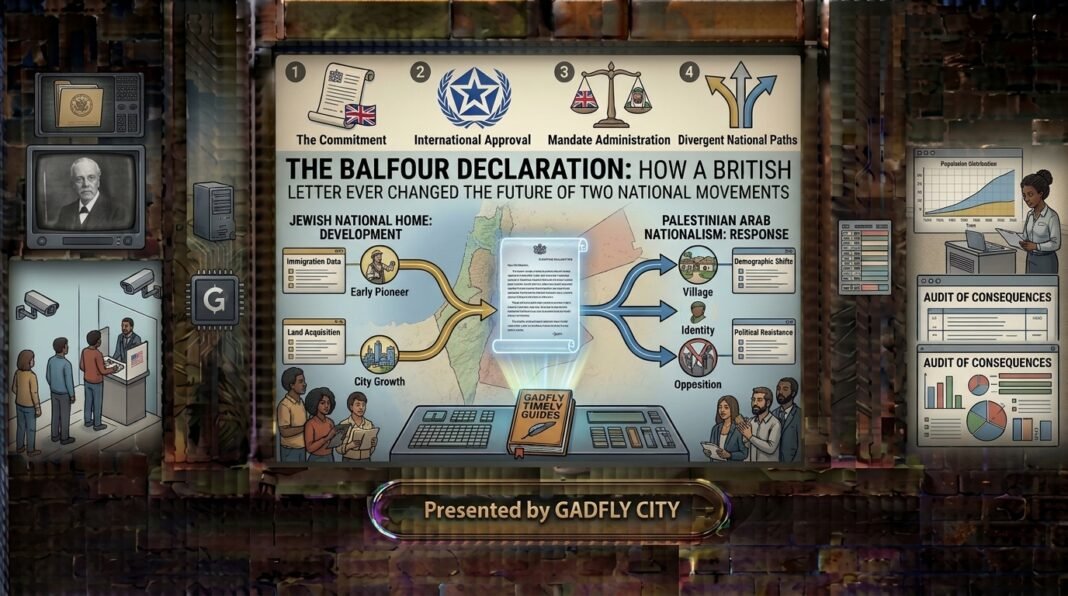
The Balfour Declaration, issued on 2 November 1917, was a British government statement supporting the establishment of a national home for the Jewish people in Palestine. Addressed to Lord Rothschild, it influenced Zionism, Palestinian nationalism, and the political developments that eventually shaped the Israeli-Palestinian conflict. At Gadfly City, we explore the history behind this turning point.
Key Points
- On 2 November 1917, the British foreign secretary, Arthur Balfour, issued the Balfour Declaration.
- During the First World War Britain had supported the setting up of a Jewish national home in Palestine.
- The declaration was molded by British war strategy, imperial interests and the Zionist movement.
- The declaration pledged to safeguard the civil and religious rights of the existing non-Jewish communities, but did not go so far as to recognize their national political aspirations.
- The British Mandate of Palestine internationalized the undertaking of the declaration.
- These rival national aspirations created tensions that continue to this day in the Middle East.
What was the Balfour Declaration and why did Britain issue it?
The Balfour Declaration was a formal declaration of British government policy in support of a Jewish national home in Palestine. It was in the form of a short diplomatic note whose implications went far beyond Britain’s immediate wartime requirements.
The letter was sent by British Foreign Secretary Arthur James Balfour on 2 November 1917 to a leading British Jew, Lionel Walter Rothschild. It requested Rothschild to communicate the government’s position to the Zionist Federation.
Its main message read:
His Majesty’s Government view with favor the establishment in Palestine of a National Home for the Jewish People.”
But the declaration came with a significant caveat. It said the civil and religious rights of the existing non-Jewish communities in Palestine and the rights and political status enjoyed by Jews in other countries should not be prejudiced.
The complete original text of the Balfour Declaration, published by the United Nations, reveals the wording that would become central to decades of political debate.
The difficulty was not simply what Britain promised. It was also what the declaration left undefined, particularly concerning the political future of Palestine’s Arab population.
Historical background: Zionism and British imperial interests
Understanding the History of the Zionist Movement
To understand the Balfour declaration it is necessary to look at the development of Zionism in the late nineteenth century.
Zionism was a Jewish national movement for a homeland for the Jews in Palestine, a land of great historic and religious significance to the Jewish people. Increasing antisemitism, discrimination and persecution in Europe added to the strength of support for the movement.
Theodor Herzl became one of its most powerful political figures. His work helped organize the First Zionist Congress, which took place in 1897 in Basel, Switzerland, and gave the movement a more structured international political identity.
By the beginning of World War I, Zionist leaders were increasingly looking for assistance from powerful governments. In the end Britain became an especially important political partner.
Chaim Weizmann , a leading Zionist scientist and leader , was instrumental in forging relationships with British political figures such as Balfour and Prime Minister David Lloyd George .
The Strategic Significance of British Support for Zionism
There was no single reason for Britain’s decision. It was a combination of wartime calculations, imperial interests, political relationships and ideological considerations.
During the First World War, Britain was at war with the Ottoman Empire, which controlled Palestine. British leaders could enhance their political standing in a strategically important region by supporting Zionist ambitions.
Palestine mattered too because of its geographic relationship with Egypt, the Suez Canal and Britain’s wider imperial communications network.
British officials also thought that by endorsing Zionism they could gain the support of influential Jewish communities for the Allied war effort, especially in the United States and Russia.
These assumptions were based upon the political thinking of the time and should not be confused with proof that Jewish communities acted as a unified political entity.
The decision was therefore part of a broader imperial calculation: Britain wished to influence the political future of a territory it expected to fall under its control.
Similar questions about the relationship between military objectives, strategic interests, and public spending appear in modern discussions of the Iran War Cost.
The Balfour Declaration 1917: A Turning Point In Middle Eastern History
Why Was The Balfour Letter So Important?
The Arthur Balfour Letter was significant as it was a powerful international government promise to the Zionist movement.
Before 1917, Zionism was a political movement seeking international recognition and support. With the declaration, a major power in the world put its aims on the record.
The document, however, did not create an independent Jewish state, determine the future boundaries of Palestine or set up an elaborate constitutional arrangement.
The language was deliberately vague as to the meaning of a Jewish national home.
This ambiguity became one of the most important problems surrounding the declaration.
The Arab Population And The Question Of Political Rights
At the time, Palestine had an Arab majority consisting of Muslim and Christian communities, alongside an established Jewish population.
These communities had their own social institutions, economic interests, cultural traditions and political ambitions.
The declaration referred to them as existing non-Jewish communities, not as a people with national political rights.
That distinction was important.
The Jewish national aspirations were given explicit political recognition, but the protection for the Arab majority was expressed mainly in terms of civil and religious rights.
Palestinian Arabs were increasingly asking how Britain could support one national movement in their homeland, but offer no corresponding recognition of their own political destiny.
The dispute became a central issue in the Palestinian national movement.
From The Declaration To The British Mandate For Palestine
But the Balfour Declaration did not instantly give Britain total power over Palestine. That came with the larger settlement after the first World war.
When the Ottoman Empire was defeated , Britain took over Palestine . Then, in July 1922, the League of Nations approved the British Mandate for Palestine, which came into effect in September 1923.
The Mandate took the principles of the Balfour Declaration and converted them into an international administrative framework.
The British were mandated to help establish a Jewish national home while protecting the civil and religious rights of all inhabitants and developing self-governing institutions.
The League of Nations Mandate for Palestine, reproduced by Yale University’s Avalon Project, provides important insight into how the declaration became part of Britain’s formal responsibilities.
But the arrangement created an awkward political situation.
Jewish institutions and immigration expanded under the Mandate. Arab political leaders became increasingly opposed to British policies and called for independence and self-determination.
A Timeline Of Major Developments
| Year | Historical Development |
| 1897 | First Zionist Congress held in Basel. |
| 1917 | Britain issues the Balfour Declaration. |
| 1920 | Britain establishes civilian administration in Palestine. |
| 1922 | League of Nations approves the British Mandate. |
| 1923 | The Mandate formally takes effect. |
| 1936–1939 | Arab Revolt challenges British rule and Zionist immigration policies. |
| 1947 | United Nations proposes partitioning Palestine. |
| 1948 | Israel declares independence, followed by war and mass Palestinian displacement. |
Israel declares independence, followed by war and mass Palestinian displacement.
The Balfour Declaration and its contribution to the Israeli-Palestinian conflict
The Israeli-Palestinian conflict was not due solely to the Balfour Declaration. But it was an important political foundation for what came after.
The fundamental problem was that there were two national movements, with opposing political goals, within the same territory.
For the Zionist movement the declaration was an international recognition of Jewish national aspirations . To the Palestinian Arabs it was a British promise made without their political consent.
During the Mandate period, Jewish immigration grew and it became more difficult to reconcile disagreements about land, political representation, economic opportunity and national sovereignty.
The Arab Revolt of 1936–1939 revealed the extent of opposition to British rule and to the policy of Zionist immigration.
Finally, Britain brought the question of Palestine to the United Nations. In 1947, the UN General Assembly adopted Resolution 181 recommending the establishment of separate Jewish and Arab states and an international administration for Jerusalem.
Jewish poltiical leadership accepted the partition recommendation . Arab leadership rejected the partition recommendation , claiming that it violated the rights of the Arab majority .
Israel declared itself independent in May of 1948. The next war caused hundreds of thousands of Palestinians to be displaced . Palestinians call this the Nakba .
One document does not allow to understand the historical consequences. The outcome was the product of many factors: the decline of the Ottoman empire, competing wartime promises, European anti-Semitism, migration, British administration, Palestinian resistance and international diplomacy.
The lasting legacy of the Balfour Declaration
More than a century later, the Balfour Declaration is still a topic of historical and political discussion.
For many Jewish communities it constitutes a major international acknowledgment of their historic connection with Palestine and of their aspirations for national self-determination.
For Palestinians it is a decision by a foreign government that supported Jewish national aspirations without adequately recognizing the political rights of the people already living in the territory.
Both perspectives are needed to explain why the declaration remains controversial.
The bigger lesson is that international agreements can have consequences far beyond what the governments that make them intend. When political commitments are made without adequate attention to the rights and aspirations of affected communities, lasting instability can be generated.
This principle remains relevant when examining modern political institutions, including the debates surrounding Voter Fraud In America, where questions of representation and political legitimacy also matter.
It is also worth examining how political influence operates in other areas of public life, from AI data center development to the political career of Collin Corbett.
Ultimately, the Balfour Declaration reminds us that history is seldom made by one decision alone. It is shaped by the promises governments make, the interests they pursue, and the people whose futures are affected by those choices.
Conclusion: One Letter, Two National Movements and an Enduring Question of History
The Balfour Declaration was only a short diplomatic letter but its political significance was enormous. It fortified the Zionist movement, impacted the British Mandate, and became part of the historical background of the Israeli-Palestinian conflict.
Its legacy cannot be understood from the point of view of nation. A fair treatment of this period has to consider the historical aspirations of the Jewish people and the demands of the Palestinian people for self determination.
Perhaps the most important lesson is that political choices should not be judged by the promises they contain, but by the lives they touch.
Frequently asked questions
1. What was the primary goal of the Balfour Declaration?
“The main aim was to express the support of the British government for the establishment of a national home for the Jewish people in Palestine , whilst asserting that the civil and religious rights of the existing non-Jewish communities should be safeguarded .
2. Who Wrote The Balfour Declaration? In 1917?
It was written on behalf of the British government by the British foreign secretary, Arthur James Balfour. He addressed it to Lionel Walter Rothschild, asking him to send it on to the Zionist Federation.
3. Why? Britain and Zionism.
The support of the British for Zionism was encouraged by a combination of wartime strategy, imperial interests, relations with Zionist leaders and the belief that the support of Zionism would improve the political standing of the Allies in the world.
4. What impact did the Balfour Declaration have on the Palestinians?
The declaration acknowledged Jewish national aspirations but negated the national political rights of the Palestinian Arab people. There was increasing opposition, political tensions and resistance to the British administration.
5. Was the Balfour Declaration the birth certificate of Israel?
Nope. The declaration did not establish a separate Jewish state. It was British support for a Jewish national home, and would later inform the British Mandate and the political developments that would lead to the establishment of Israel in 1948.
6. What is the British Mandate for Palestine?
In 1922 the League of Nations approved an international arrangement for administration known as the British Mandate. It charged Britain with the administration of Palestine and with the implementation of the policy of a Jewish national home.
7. What is controversial about the Balfour Declaration?
Still controversial because it dealt differently with the national aspirations of Jews and Palestinians. Its political consequences remain a subject of historical debate over self- determination, sovereignty and competing national rights.
Gadfly City – Moving Forward
Here at Gadfly City we believe history is more than just dates and political statements to memorize. We look at the decisions, conflicts and historical circumstances that define societies over generations. We aim to provide balanced explanations, reliable sources and thoughtful analysis that will help people access and understand complex historical and political developments. As the world around us changes we invite you to read on, to challenge the narratives and learn the background to the key issues of our time.
Sources And References
- United Nations – The Balfour Declaration, 2 November 1917
- UK Parliament – Balfour Declaration: House Of Commons Library Research Briefing
- Yale University Avalon Project – The Balfour Declaration, November 2, 1917
- Yale University Avalon Project – The Anglo-American Committee Of Inquiry: Historical Background
- United Nations – The Origins And Evolution Of The Palestine Problem, 1917–1947
- United Nations – Mandate For Palestine
- UK Parliament – The Centenary Of The Balfour Declaration