


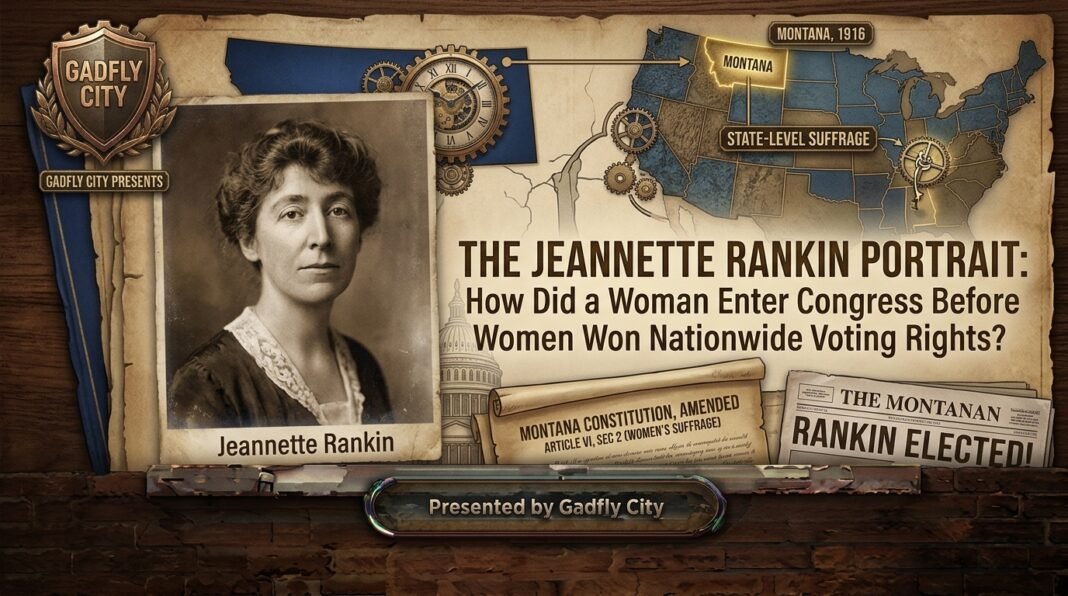
Jeannette Rankin became the first woman elected to the U.S. Congress in 1916, four years before the 19th Amendment granted nationwide women’s voting rights. The key was Montana, which had already approved women’s suffrage in 1914. Her achievement, supported by years of activism, demonstrated how state-level political rights could create opportunities for national representation. Gadfly City explores the historical forces behind this remarkable milestone.
Key Takeaways
- Jeannette Rankin became the first woman elected to the U.S. Congress in November 1916.
- Montana granted women voting rights in 1914, making her election legally possible.
- Rankin played an important role in the American women’s suffrage movement.
- She introduced legislation supporting women’s constitutional voting rights.
- She opposed American entry into both World Wars.
- Her political career was a model of the connection between women’s representation and voting rights.
- Her legacy still matters to conversations about equality, democracy and political engagement.
Jeannette Rankin Biography: First Woman to Enter the Political Arena in Congress
Jeannette Pickering Rankin was born near Missoula, Montana Territory, on June 11, 1880. She grew up on a ranch, immersed in a society where women had a role in families, businesses and communities, but little political power.
She learned about social inequality at school. She earned a biology degree from the University of Montana in 1902 and later took classes at the New York School of Philanthropy. Her early work in social services made her aware of poverty, unequal working conditions and limited opportunities for women.
These experiences eventually led her to political activism. Instead of accepting inequality as part of society, Rankin believed women needed a voice in the institutions that made decisions about their lives.
Her involvement in the women’s suffrage movement was the springboard for her political career. She worked in Washington, California and Montana helping to organize campaigns and build public support for women’s voting rights.
Voting was not simply about participating in elections for Rankin. It was about equal access to influence legislation, public policy and the future of our nation.
How Montana Women’s Suffrage Made Her Election Possible
To understand Jeannette Rankin’s entry into Congress in 1916, one must know about the American voting system in 1916.
In every state, the United States lacked a constitutional guaranty of women’s right to vote. Some states might be able to make their own rules about voting. So some women could vote, but other women could not.
This led to a significant political difference between the states.
Montana’s Decision To Grant Women The Right To Vote
Rankin was back in Montana in 1911 and got heavily involved in the suffrage movement there. She was the first woman to speak before the Montana legislature in favor of women’s right to vote.
She rallied supporters, lobbied legislators and spoke about why women deserved to be equal players in politics.
Eventually the campaign achieved a big victory. On November 3, 1914, Montana voters approved equal suffrage with approximately 53 percent voting for it.
However, Rankin was not responsible for the victory alone. Hundreds of women, local organizations, and campaigners contributed to the movement. Montana Women’s History: The Montana Suffrage Story documents the wider organizing effort.
This decision changed the political opportunities available to Montana women. They could now participate in elections and help determine who represented them.
Why The 19th Amendment Was Not Necessary For Her Election
The 19th Amendment was not ratified until August 18, 1920. Before that date, voting rights depended heavily on individual state laws.
Montana had already extended voting rights to women in 1914. Therefore, Rankin could legally campaign for Congress and receive support from newly enfranchised women.
| Important Event | Year |
| Montana grants women voting rights | 1914 |
| Jeannette Rankin wins congressional election | 1916 |
| Rankin begins her congressional term | 1917 |
| Congress approves the 19th Amendment | 1919 |
| 19th Amendment is ratified | 1920 |
This timeline explains the apparent contradiction. Rankin did not need to wait for nationwide voting rights because her home state had already recognized women’s suffrage.
The broader constitutional story is explained in the National Archives’ account of the 19th Amendment.
The First Woman In Congress: A Landmark 1916 Election
In July 1916, Jeannette Rankin announced that she would run as a Republican for one of Montana’s two at-large seats in the U.S. House.
Her campaign touched on a number of important issues, including women’s suffrage, social reform, child welfare, and better working conditions.
For Rankin, political success required something more than a popular cause. She crisscrossed Montana, meeting voters, addressing public meetings and building relationships with communities throughout the state.
Her experience as a suffrage organizer taught her how to rally people around a common cause.
She was elected in November 1916, the first woman elected to the United States Congress.
The nation was riveted on her victory. She also faced an unusually high level of scrutiny as she entered an institution that had traditionally barred women.
Rankin knew what the importance of her achievement was in history. After she was elected, she famously said:
“I may be the first woman member of Congress, but I won’t be the last.”
She officially began her congressional term on March 4, 1917, and was sworn in on April 2.
The U.S. House of Representatives’ historical biography of Jeannette Rankin provides a detailed account of her election and congressional career.
Jeannette Rankin’s Political Career and Suffrage Advocacy
Rankin’s legacy in American politics was not just being the first woman U.S. representative.
She wanted women to have more than the vote in state elections. She felt they needed constitutional protection and real representation in the national government.
Supporting Women’s Right To Vote In Congress
One of Rankin’s earliest actions in Congress was introducing legislation supporting the constitutional amendment for women’s suffrage.
This was particularly significant because she was participating in the institution responsible for debating the very political rights that had helped make her election possible.
In January 1918, Rankin also spoke in the House in support of women’s voting rights. Her position reflected a consistent principle: democratic participation should not depend on sex.
She became the only woman in Congress to vote on the resolution that eventually became the 19th Amendment.
Her work connected the state-level achievements of the suffrage movement with the national constitutional campaign.
More Than the Women’s Vote
Rankin also campaigned for social reforms, like improved working conditions and protections for women and children.
Her politics were based on the belief that representation should result in real changes for people’s lives.
This broader approach makes her story relevant to modern discussions about Democrats and American Political Representation and the development of women’s participation in political institutions.
Jeannette Rankin’s Antiwar Activism: Why Did She Oppose Both Wars?
Rankin became famous as a political trailblazer, but perhaps the most controversial aspect of her career was her stand against war.
She was a committed pacifist who believed that military conflict caused enormous human suffering and that governments should explore alternatives before committing their populations to war.
However, her antiwar position placed her in difficult situations, particularly when national security became a central political issue.
Her Opposition To World War I In 1917
Just four days after Rankin was sworn into Congress, President Woodrow Wilson requested congressional approval for American entry into World War I.
On April 6, 1917, Rankin voted against the declaration of war against Germany.
Her decision attracted considerable criticism. Some suffrage supporters worried that her opposition would damage the reputation of women seeking political equality.
Rankin reportedly explained her position by saying:
“I wish to stand for my country, but I cannot vote for war.”
Her decision was not simply an expression of political disagreement. It reflected her longstanding belief that military violence was not the appropriate solution to international disputes.
It is worth noting that Rankin’s World War I voting record was more complicated than a blanket rejection of every wartime measure. She supported certain measures assisting the war effort and later voted in favour of declaring war against Austria-Hungary.
After leaving Congress in 1919, she continued working for social causes and international peace.
Her Opposition To World War II In 1941
Rankin returned to Congress in 1941, representing Montana for a second time.
However, another international conflict soon placed her political beliefs under pressure.
Following the Japanese attack on Pearl Harbor on December 7, 1941, Congress considered a declaration of war against Japan.
On December 8, Rankin cast the only congressional vote against the declaration.
Unlike her 1917 decision, this time she stood completely alone.
The political environment was different. The Pearl Harbor attack had generated widespread public support for American military involvement, making her opposition particularly unpopular.
Her vote effectively ended her congressional career. She did not seek reelection in 1942.
The National Archives’ Jeannette Rankin exhibition documents her opposition to both World Wars and her historic place in Congress.
Her decisions also raise questions that remain relevant today: How should elected representatives balance national security, public opinion, and personal principles?
Understanding this dilemma helps readers examine other historical conflicts, including the economic and political costs of the Iran War and the relationship between government decisions and their consequences.
What Jeannette Rankin’s story tells us about women in politics
Jeannette Rankin’s significance is far more than being the first woman elected to Congress.
Her career illustrates an important principle of democratic government: political representation often emerges from small institutional changes before it becomes a national reality.
Montana gave women the vote in 1914, an opportunity not yet available nationwide.
Rankin used that opportunity to enter national politics, helping show that women could help make legislative decisions.
Her story also teaches us about the difference between the legal right to vote and meaningful representation in government.
The 19th Amendment was a landmark constitutional moment, but the passage of the amendment did not immediately remove all barriers to voting. Many African American and other minority women were unable to vote because of discrimination laws.
This distinction matters when examining the broader history of American democracy, just as understanding the relationship between historical political movements helps explain subjects such as the Balfour Declaration and competing national movements.
The same principle applies when examining modern political representation, technological policymaking, and public accountability, including debates surrounding AI data centers and their wider political implications.
Rankin’s life is a reminder that political progress does not come from one law or one election. It takes years of organizing, public debate, institutional reform and people willing to challenge existing expectations.
The Legacy of Jeannette Rankin: Why Does She Still Matter?
Rankin left Congress in 1943, but continued to fight for peace and women’s rights.
She remained active in public discussions about military intervention and social reform. In 1968, she led thousands of women in a march on Washington protesting the Vietnam War.
She died on May 18, 1973, in Carmel, California.
Today her legacy lives on in history exhibits, educational materials and a statue in the U.S. Capitol’s National Statuary Hall Collection representing the State of Montana.
What makes her legacy especially interesting is that it represents two different sorts of political courage.
First, she challenged the notion that women ought not to be in national legislatures. Second, she stood by her antiwar beliefs, even when those beliefs made her unpopular.
It’s easy to think of Rankin just as a suffrage pioneer or an anti-war politician. But it is the combination of these roles that makes her important.
She showed that to be part of a political institution does not imply acceptance of all the political positions that are set.
Her story also encourages us to question how democratic systems evolve. The history of women’s representation, the debate over Trump and modern American political leadership, and the changing influence of technology on public institutions all demonstrate that political power and participation remain subjects of continuous debate.
Perhaps the most important lesson from Jeannette Rankin is that representation is more than simply having a seat. It is also about the freedom to exercise that position in line with one’s principles.
Frequently asked question (FAQs)
1. Who is Jeannette Rankin?
Jeannette Rankin (U.S. politician and women’s rights activist from Montana) She was the first woman elected to Congress in the U.S. in 1916 and served two non-consecutive terms in the House of Representatives.
2. How Jeannette Rankin Became The First Female In Congress?
Women had been given the right to vote in Montana in 1914 and Jeannette Rankin was the first woman elected to Congress . She was successful, running as a Republican, winning a House seat in November 1916.
3. How could Jeannette Rankin vote prior to the 19th Amendment?
Montana had granted women unlimited voting rights in 1914 already. Thus Rankin was able to run for election and receive votes before the 19th Amendment provided constitutional protection nationwide in 1920.
4. What actions did Jeannette Rankin take for women’s suffrage?
She led the way on suffrage campaigns in multiple states, lobbying legislators and advocating for voting rights amendments in Congress. In her first term in Congress, she also introduced legislation to advance women’s suffrage.
5. Why Did Jeannette Rankin Vote Against WWI?
Rankin was a pacifist all his life, and he believed that war caused unnecessary suffering. In April 1917, she voted against entry into World War I against great political pressure.
6. Why Jeannette Rankin Voted Against World War II
A pacifist for many years, Rankin voted against the declaration of war when Japan attacked Pearl Harbor in December 1941. She was the only member of Congress who voted against it.
7. When was Jeannette Rankin born?
Jeannette Rankin died May 18, 1973, in Carmel, California. She remained active in peace and women’s rights campaigns for years after leaving Congress.
Summary: We Must Break Down Political Barriers
The story of Jeannette Rankin illustrates how political change can begin at the state level and then spread across the country. She was elected in 1916, shattering the mold of what women could do in government. And her antiwar position demonstrated that she was prepared to stand for unpopular principles.
At Gadfly City we feel that to know history is to see beyond the great dates and the great people that fill them. We look at the people, political decisions and historical movements that continue to impact our society today. We aim to simplify complex historical and political topics and encourage people to question, learn, and form their own opinions.
Sources And References
- U.S. House of Representatives – Jeannette Rankin: Biography And Congressional History.
- U.S. National Archives – First Congresswoman Jeannette Rankin.
- National Park Service – Jeannette Rankin: Biography And Suffrage Activism.
- Montana Women’s History – The Montana Suffrage Story.
- National Archives – 19th Amendment To The U.S. Constitution.
- U.S. Senate – Jeannette Rankin And Her Senate Campaign.
- U.S. Capitol Visitor Center – Jeannette Rankin: National Statuary Hall Collection.
- National Park Service – Jeannette Rankin: One Woman, One Vote.