

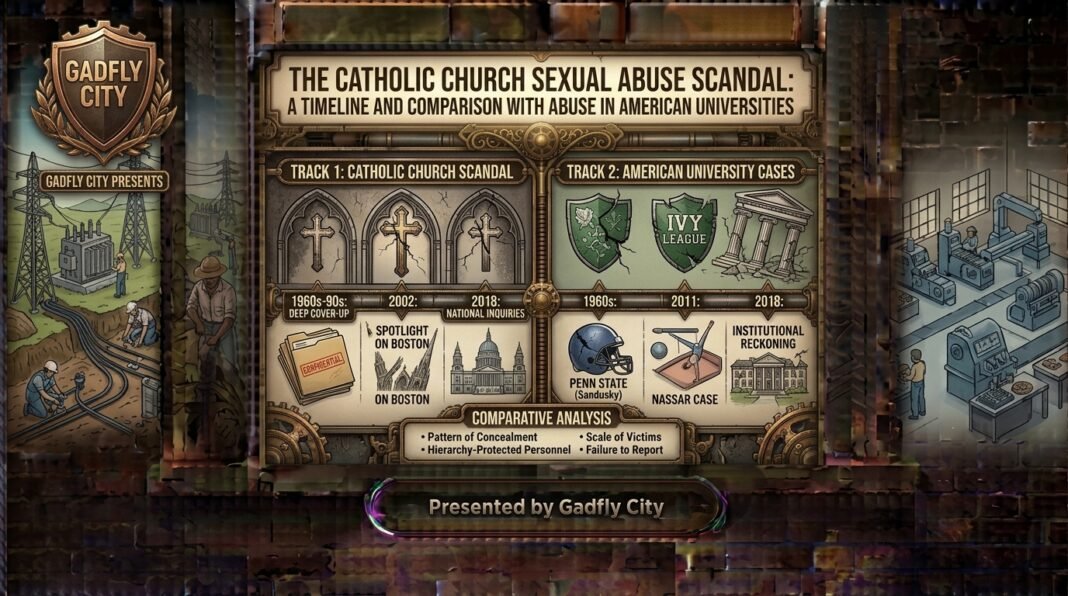
The Catholic Church Sexual Abuse Scandal exposed decades of abuse by clergy, institutional failures and efforts to protect reputations over victims. The scandal, from the early cases to the big investigations, shows how powerful institutions can facilitate misconduct. And the same failures at American universities pose important questions about reporting systems, transparency and accountability. At Gadfly City we view such institutional failures through documented evidence and historical context.
Key Takeaways
- The Catholic Church sexual abuse scandal emerged as a major national issue with revelations in the 1980s and the Boston investigations of 2002.
- Some church leaders moved accused priests rather than report allegations or properly protect children.
- The 2018 Pennsylvania grand jury report chronicled decades of institutional failure by hundreds of clergymen.
- Serious sexual abuse scandals have rocked such American universities as Penn State and Michigan State when institutions didn’t report.
- Transparency, reputation management, and survivor support have all been challenges for religious and academic institutions.
- Only independent investigations, legal accountability and accessible reporting systems can stop institutional abuse.
Timeline of Events in the Catholic Church Sexual Abuse Scandal
The Catholic Church Sexual Abuse Scandal didn’t begin in 2002. Decades earlier there had been allegations and legal proceedings but many of the incidents received little public attention.
1980s: First public disclosures
One of the earliest and most publicized American cases was that of Father Gilbert Gauthe of Louisiana. The Diocese of Lafayette put him on leave in 1983 following allegations that he had sexually abused several children. He was sentenced to jail in 1985.
The case attracted national attention to Catholic Priest Sexual Abuse and raised questions about the handling of allegations by church authorities.
In this time frame, a few dioceses started to develop policies for dealing with abuse allegations. But institutional responses tended to focus on dealing with accused clergy rather than prioritizing victims and preventing further abuse.
1990s: Mounting Legal and Institutional Pressure
Throughout the 1990’s more cases of Clergy Sexual Abuse began to emerge across the United States.
The case of the former priest James Porter in Massachusetts assumed special importance. He was accused of abusing many children over many years and eventually pled guilty to multiple criminal charges.
At this point lawsuits and public criticism were challenging the church’s response to allegations. The questions about reassignments, internal investigations, and communication between dioceses were increasingly impossible to ignore.
2002: The Boston Scandal Changes Public Consciousness
January 2002 marked a watershed month in the Catholic Church Sexual Abuse Scandal.
The Boston Globe also ran investigative pieces on the church’s handling of allegations against priests, including John Geoghan.
The report found that accused clergy had been reassigned in some cases despite earlier allegations. That meant institutional failures were broader than individual cases.
The disclosures led to criminal investigations, civil lawsuits, leadership resignations and widespread public criticism.
In June 2002, the United States Conference of Catholic Bishops introduced the Charter For The Protection Of Children And Young People, commonly known as the Dallas Charter.
It has also developed policies on allegations, cooperation with civil authorities, victim assistance, and removal of clergy who sexually abused minors .
2018: Pennsylvania grand jury investigation
Another big milestone in the Catholic Church Abuse Scandal Timeline occurred in August 2018.
A Pennsylvania grand jury report detailed allegations involving more than 300 Catholic clergy members and more than 1,000 child victims over about seven decades.
The probe detailed institutional practices such as misleading descriptions of abuse, insufficient reporting and the movement of accused clergy.
The findings revealed that the problem was bigger than individual offenders. The vulnerability of children had been exacerbated by institutional decisions and oversight failures.
There is further evidence of these practices in the investigation report by the Pennsylvania Attorney General.
How the Institutional Cover-Ups Enabled Abuse to Continue
The Catholic Church Sexual Abuse Scandal The Catholic Church Sexual Abuse Scandal raises an interesting question. How was the misconduct able to continue in an institution with an established leadership structure?
The answer is more than individual bad behavior added up.
Moving Accused Clergy Instead of Protecting Victims
A frequent institutional failure was to transfer accused priests from one parish to another or to give them other duties.
“There have been some documented cases where church authorities knew of allegations but did not take sufficient action to stop further abuse.
Transfers can create the illusion of solving a problem when the underlying risk is not being addressed. They also made it harder for families and communities to learn about the history of an accused priest.
Safeguarding Institutional Reputation
Another problem was the priority of internal reputation management over transparency.
Some dioceses used vague language to describe allegations, handled complaints in private and didn’t provide key information to civil authorities.
This pattern created a context in which institutional interests could supersede the protection of victims.
A similar concern appears in other institutional scandals, including the Binance $6.3 Billion Hack, where questions about organizational responsibility and public confidence become central to understanding institutional failures.
The situation is different, but the larger lesson is the same: public confidence depends on open answers when serious issues arise.
Sexual Abuse In American Universities: The Same Institutional Failures
The Catholic Church Sexual Abuse Scandal is not the only example of a powerful American institution failing to respond adequately to abuse allegations.
Employees, coaches, medical professionals and others in positions of authority have also been investigated at American universities.
The Jerry Sandusky Scandal At Penn State
The Penn State scandal was a major case of institutional failure in higher education.
Jerry Sandusky, a former assistant football coach, was convicted in 2012 of multiple child sexual abuse crimes.
A subsequent Freeh investigation into how the university handled the allegations found serious failures by senior leadership.
The investigation shows the importance of institutional governance, of the reporting requirements, and of the protection of the children rather than the protection of the institutional interests.
The Penn State response showed how an institution’s reputation, particularly one with a winning sports program, can complicate accountability decisions.
Michigan State’s Larry Nassar
The second high-profile case was that of Larry Nassar, former doctor for USA Gymnastics and Michigan State University.
He sexually assaulted many young athletes while posing as a medical provider. His case revealed serious failures in reporting, supervision and institutional response.
Michigan’s Attorney General announced the end of another investigation into how Michigan State handled the matter in September 2024. The review involved thousands of documents that had been withheld in the past and criticized the university’s long withholding of records that investigators said were not protected under attorney-client privilege.
The Michigan Attorney General’s investigation findings illustrate why independent oversight matters when institutions investigate their own conduct.
Comparison of Church and University Sexual Abuse Scandals
Religious institutions and universities operate differently; however, the Catholic Church Sexual Abuse Scandal and university misconduct cases show many overlapping organizational issues.
| Comparison Region | Catholic Church | American Colleges |
| Structure of Authority | Bishops, dioceses, church leaders | Administrators, Boards, Departments & Faculty |
| Failure Reporting | Sometimes allegations were handled internally. | Complaints not always handled or escalated correctly |
| Institutional shielding | Reputation and clergy management affected the response | Athletic success, institutional standing and liability can affect the responses |
| Victim Challenges | Fear, shame, religious authority and no access to justice | Power imbalances, career concerns, fear of retaliation and complex reporting processes |
| Answerability | Criminal investigations, lawsuits and church reforms | Criminal prosecutions, civil lawsuits, Title IX cases and independent investigations |
The most significant similarity is power centralization.
If the people who control the reporting avenues, the investigation and the disciplinary process are the same people, victims may find it difficult to fight against the institution that is supposed to be protecting them.
But the comparison only goes so far. Catholic dioceses are religious structures; universities are governed by other legal, administrative, and regulatory structures.
The cases should therefore be compared through institutional behavior rather than treated as identical scandals.
What Institutional Accountability Should Look Like
The Catholic Church Sexual Abuse Scandal demonstrates that internal policies alone cannot guarantee accountability.
Universities face a similar challenge. Having a reporting procedure does not automatically mean complaints will be investigated fairly or independently.
The U.S. Department of Education explains that Title IX requires covered educational institutions to address sex discrimination and maintain appropriate complaint procedures.
Its Title IX guidance on sexual harassment outlines institutional responsibilities for responding to complaints.
Accountability to be effective requires several principles:
- Independent investigations Serious allegations should be investigated by investigators independent of the head of the institution.
- Reporting Institutions should report relevant findings transparently, and with a commitment to protect the privacy of survivors.
- Protecting victims: Support and protection should be provided to whistleblowers to prevent retaliation.
- Accountability for Leaders: Leaders who ignore credible warnings or hinder investigations should be held accountable.
- Oversight from the outside. Government agencies and independent authorities should be able to effectively access relevant information.
The same principles hold in other areas of public accountability. Institutional claims should be evaluated based on verifiable evidence, independent scrutiny and transparent procedures, not mere public assurances. Discussions about Voter Fraud In America for example, illustrate why.
For example, debates about AI Data Centers demonstrate that oversight is needed because powerful actors shape public interests and operate in complex regulatory environments.
Conclusion: Accountability is more important than institutional reputation
The Catholic Church’s sexual abuse scandal and the major abuse cases at American universities teach a hard but important lesson: respected institutions are not automatically accountable institutions.
Religious authority, academic prestige, successful sports programs and established leadership structures are no substitute for independent oversight.
The history of these scandals also shows why victims must have accessible ways to report and why accusations should never be dismissed simply because they threaten an institution’s reputation.
Reforms, investigations and legal settlements can be meaningful progress, but only if institutions change their behavior.
Ultimately, institutional failures are not kept out of public view to maintain trust. You earn it by spotting them, dealing with the consequences and stopping them from happening again.
FAQs
1. When did the Catholic Church sexual abuse scandal start?
In the 1980s, the scandal became national, with cases such as Gilbert Gauthe in Louisiana. The revelations come long after claims and lawsuits of clerical abuse had been on the books.
2. What was the Catholic Church abuse scandal of 2002?
How church officials responded to allegations against priests, according to the Boston Globe. Its investigation revealed institutional failures that triggered criminal investigations, lawsuits, leadership changes and national public scrutiny.
3. WHAT IS THE PENNSYLVANIA GRAND JURY REPORT 2018?
The report detailed accusations against more than 300 Catholic clergy and more than 1,000 child victims over roughly 70 years, pointing to serious failures in institutional reporting and supervision.
4. How did the Catholic Church handle priests who were accused?
Church leaders have on occasion shifted accused priests to new parishes, offered therapy or dealt with complaints internally instead of properly reporting the allegations and preventing further abuse.
5. What were the major sexual abuse scandals at Universities in the US?
That includes high-profile cases such as the Jerry Sandusky scandal at Penn State and the Larry Nassar scandal at Michigan State. Both cited serious institutional failures of reporting, oversight and accountability.
6. The Church and University abuse scandal: What unites them?
In both instances, a combination of centralized power, inadequate reporting mechanisms, concerns about reputation, and a lack of independent scrutiny can combine to prevent institutions from acting appropriately when confronted with allegations of abuse.
7. What reforms can end institutional sexual abuse?
Independent investigations, transparent complaint processes, external oversight, support for survivors, compliance with mandatory reporting and meaningful accountability for leaders matter in reducing institutional failures.
Moving Forward With Gadfly City
At Gadfly City, we believe understanding complex public issues requires more than headlines. We examine the evidence, explore different perspectives, and connect historical events with the institutions shaping today’s society. Our goal is to make important developments easier to understand through balanced reporting, thoughtful analysis, and accessible explanations. Because meaningful accountability begins when people have the information they need to ask better questions.
Sources And References
The following sources provide historical documentation, official investigations, institutional policies, and regulatory guidance supporting the article.
- Pennsylvania Office Of The Attorney General – Investigating Grand Jury Report
- U.S. Conference Of Catholic Bishops – The Dallas Charter
- Illinois Attorney General – Report On Catholic Clergy Child Sexual Abuse
- U.S. Department Of Education – Sexual Harassment: It’s Not Academic
- Michigan Attorney General – Investigation Into Michigan State University’s Handling Of The Larry Nassar Matter
- University Of Maryland – Report Of The Special Investigative Counsel Regarding Penn State And Jerry Sandusky
- Massachusetts Attorney General – Investigation Into Catholic Dioceses In Massachusetts
- U.S. Conference Of Catholic Bishops – Charter For The Protection Of Children And Young People, Revised June 2026