

Why Is Jesse Jackson Important? His Impact on American Politics and Civil Rights
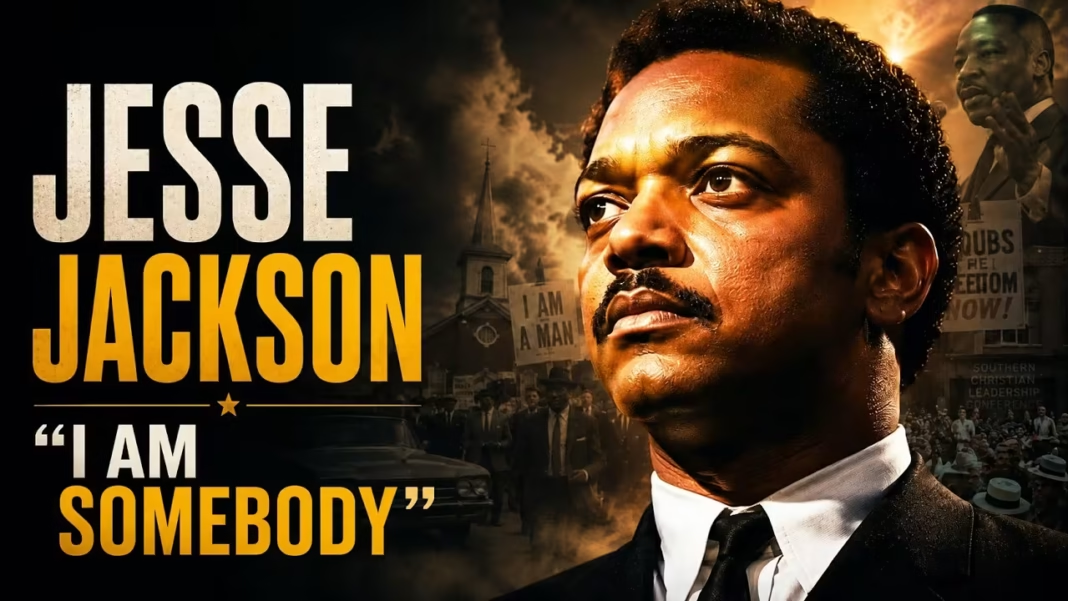
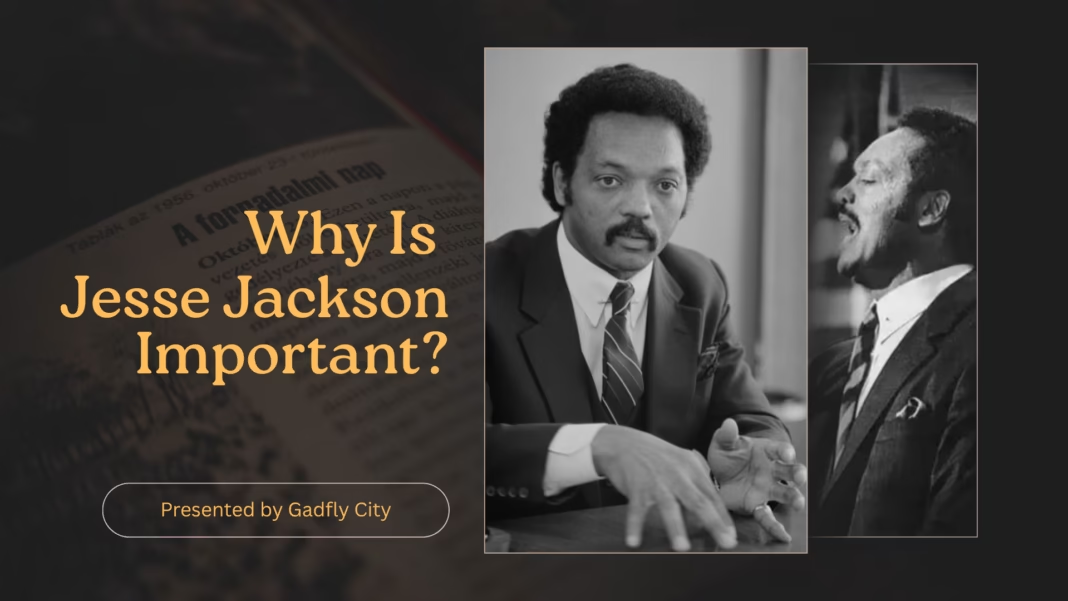
Ever wondered why is Jesse Jackson important? Jesse Jackson is important because he helped move Black civil-rights activism into national electoral politics and coalition-building, changing who American democracy could include even though he never became president. He led economic boycotts through Operation Breadbasket and Operation PUSH, forcing major companies to open jobs and contracts to Black communities.
He then built the Rainbow Coalition, a multiracial, working-class political network that treated different groups as partners instead of separate voting blocs. His 1984 and 1988 Democratic presidential campaigns mobilized millions of new voters, pushed the party left on racial and economic justice, and showed that a Black candidate could seriously compete for a major-party nomination.
Add his international human-rights diplomacy and long-term influence on figures like Barack Obama, and Jackson’s importance lies in how he expanded the idea of who American politics is for.
Read about What did Jesse Jackson Accomplish.
Why Is Jesse Jackson Important? The Short Answer
Jesse Jackson matters for several linked reasons:
- He helped carry the nonviolent civil-rights tradition into economic campaigns against corporations and then into national electoral politics.
- Through Operation Breadbasket and Operation PUSH, he pressured companies to hire Black workers, invest in Black neighborhoods, and sign “economic covenants” with community leaders.
- His Rainbow Coalition reframed Democratic politics around multiracial, working-class alliances instead of narrow demographic slices.
- His 1984 and 1988 presidential campaigns won millions of votes, forced debate on poverty, apartheid, and voting rights, and expanded Black and progressive representation.
- He became a visible international mediator, negotiating the release of American hostages in Syria, Cuba, Iraq, and Yugoslavia.
- He influenced how later Democrats, including Barack Obama, thought about coalition-building, race, and economic justice.
Gadfly City’s view is that Jesse Jackson’s greatest achievement was not winning the presidency. It was changing American politics without winning it.
Jesse Jackson’s Role in the Civil Rights Movement
How Jesse Jackson Worked With Martin Luther King Jr.
Jackson entered national civil-rights work in the mid‑1960s by joining Martin Luther King Jr.’s Southern Christian Leadership Conference (SCLC). In 1966, King and strategist James Bevel chose him to lead the Chicago branch of Operation Breadbasket, SCLC’s economic arm, and he soon became its national director. While King focused on dismantling legal segregation and securing voting rights, Jackson concentrated on economic discrimination in Northern cities—where Black people could vote but still lacked jobs and fair treatment from businesses.
What often gets lost is that Jackson learned coalition-building and moral language directly inside King’s organization but then applied those tools to economic campaigns and later electoral politics. Gadfly City’s view is that this bridge—from King’s marches to Jackson’s negotiations and campaigns—is a key reason why Jesse Jackson is important historically.
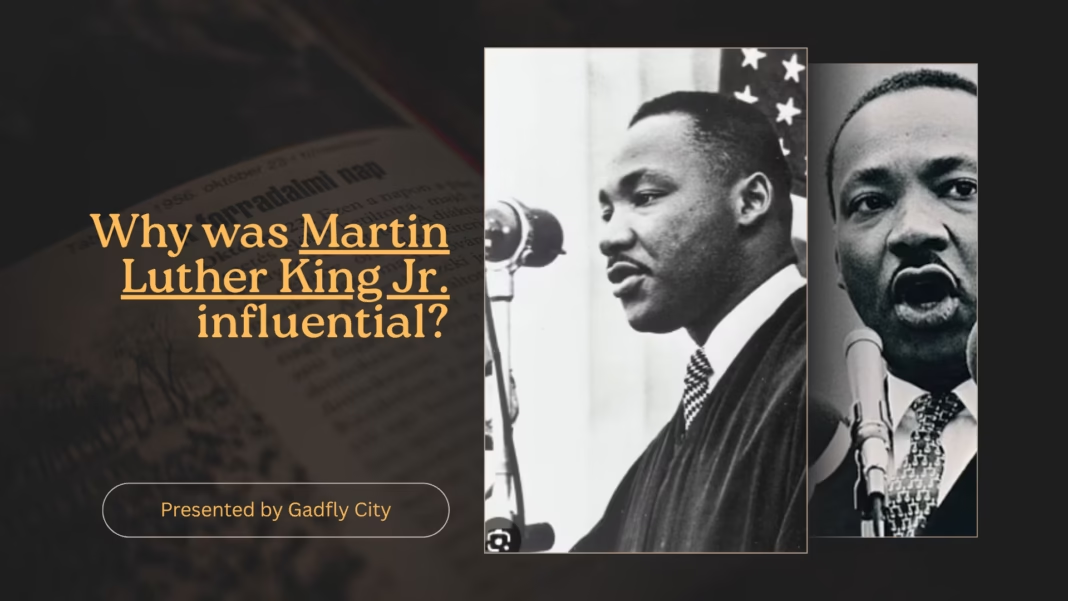
Read about Why Was Martin Luther King Jr. Influential? and what was the reason for civil rights movement?
What Made Jesse Jackson Different From Other Civil Rights Leaders?
Many civil-rights leaders stayed focused on protest, lawsuits, or local office; Jackson tried to turn movement energy into national presidential bids. Unlike some of his peers, he was willing to negotiate directly with corporations, foreign governments, and Democratic Party leaders, even when that meant internal conflict. His style blended pulpit oratory with hard bargaining, which made him both inspirational and controversial inside the movement and the broader public.
The more important point is that Jackson insisted Black political power meant more than voting—it meant shaping national platforms, delegate rules, and foreign policy debates. That insistence helped push Black leadership from the margins of the Democratic Party toward its center in the 1980s and 1990s.
Why Operation Breadbasket Mattered
Operation Breadbasket started as a job-placement program within SCLC but, under Jackson, became a tool for economic leverage. Jackson and local clergy used organized boycotts and negotiations to pressure Chicago businesses to hire Black workers, buy from Black-owned firms, and invest in Black neighborhoods.
This matters because it linked civil rights to economic power: instead of just demanding legal equality, Jackson argued that justice required paychecks, contracts, and corporate accountability. Scholars of Breadbasket and later Operation PUSH show that these campaigns won concrete hiring agreements and helped normalize the idea that civil-rights work could target boardrooms as well as courthouses.
Why Was the Rainbow Coalition Important?
What Was the Rainbow Coalition?
Jackson launched the National Rainbow Coalition in 1984, alongside his first presidential campaign. It was designed as a political vehicle bringing together African Americans, Latinos, white progressives, labor activists, family farmers, poor and working‑class voters, and other marginalized groups. Instead of treating each community as a separate “interest group,” the Rainbow Coalition tried to unite them around shared issues like economic inequality, peace, and voting rights.
Jackson’s famous “Rainbow Coalition” speech at the 1984 Democratic National Convention laid out this vision: a diverse alliance demanding jobs, education, and fairness, not just symbolic representation. Gadfly City’s view is that this speech helped mainstream the idea that multiracial, multi‑issue coalitions could drive national campaigns—not just single-issue movements.
Who Did Jesse Jackson Bring Into the Rainbow Coalition?
The Rainbow Coalition reached beyond traditional civil-rights networks. It sought support from labor unions, peace activists, feminists, LGBTQ advocates, family farmers, and poor white communities who felt locked out of Reagan-era prosperity. It also appealed to immigrants and racial minorities who had been ignored in national campaigns, including Hispanics, Asian Americans, Native Americans, and Middle Eastern Americans.
What often gets overlooked is how much organizing went into this project: local Rainbow chapters formed in cities and states, working on voter registration, issue campaigns, and down-ballot races. Those chapters helped elect progressive mayors and state legislators, including Black officials such as David Dinkins in New York, according to historians of the Rainbow movement.
Why the Rainbow Coalition Changed American Politics
The Rainbow Coalition mattered because it treated marginalized communities as a potential governing majority rather than as outreach targets. Jackson’s campaigns argued that if these groups voted together, they could reshape the Democratic Party’s agenda on jobs, health care, and foreign policy.
This approach influenced later progressive politics, where building “movements of movements” became a common strategy. Analysts of Jackson’s campaigns note that he helped normalize multiracial coalitions and convinced national Democrats that they needed to take racial and economic justice seriously to win. Gadfly City’s view is that this coalition model is one of the clearest answers to “why is Jesse Jackson important” today.
Was the Rainbow Coalition Successful?
The Rainbow Coalition had real successes and clear limits. It mobilized millions of voters, helped elect progressive officials, and pushed the party’s discourse toward anti-apartheid sanctions, voting rights enforcement, and economic justice. It created an organizational home for people who wanted both civil-rights activism and engagement inside Democratic primaries.
But internal disputes, leadership concentration, and the shift of national politics toward centrist “New Democrat” strategies in the 1990s weakened the Rainbow structure. Critics argued that the organization became too focused on Jackson’s campaigns and too top‑down, losing some of its grassroots energy after 1988. Gadfly City’s view is that the Rainbow Coalition succeeded in changing the conversation about coalitions, even if it fell short of becoming a lasting mass-membership party on its own.
Why Were Jesse Jackson’s 1984 and 1988 Presidential Campaigns Important?
Jesse Jackson’s 1984 Presidential Campaign
Jackson’s 1984 run made him one of the first Black candidates to mount a serious nationwide campaign for a major-party presidential nomination. In the Democratic primaries he won about 3.28 million votes—roughly 18.1 percent of the total—and carried the District of Columbia and Louisiana. He finished third behind Walter Mondale and Gary Hart but forced the party to confront issues of poverty, racism, and foreign policy.
His 1984 campaign’s deeper importance lay in symbolic empowerment and infrastructure: for many Black and poor voters, seeing someone like Jackson compete seriously for the nomination encouraged belief that national politics could be theirs too. Gadfly City’s view is that these votes and delegates were less about Jackson’s personal ambition and more about proving a broad progressive coalition could show up at the ballot box.
Jesse Jackson’s 1988 Presidential Campaign
Jackson’s 1988 campaign was even stronger. He won about 6.73 million primary votes—around 29 percent—and roughly 1,056 convention delegates, finishing as runner‑up to Michael Dukakis. He carried several primaries and caucuses, including contests in the Deep South and Midwest, showing that a Black candidate with a left‑leaning platform could attract support across race lines.
During 1988 Jackson at times led in polls and briefly looked like a serious contender for the nomination, which pushed Dukakis to address issues that Jackson’s coalition raised. What often gets lost is that Jackson’s strong finish affected Democratic rules and expectations about diversity, helping strengthen calls for better representation of Black voters and low‑income communities inside the party.
Did Jesse Jackson Almost Become President?
Jackson never came close to winning the presidency in the sense of securing a general-election nomination or majority of Democratic delegates. In 1984 he finished third at the convention, and in 1988 Dukakis still won a clear delegate majority despite Jackson’s strong showing.
However, his campaigns did something different: they showed that a Black candidate with a bold economic and foreign-policy agenda could win states, millions of votes, and national media attention. Gadfly City’s view is that Jackson’s importance comes less from “almost becoming president” and more from making presidential politics look possible for later Black and progressive candidates.
How Jesse Jackson Changed the Democratic Party
Jesse Jackson and Black Voter Mobilization
Jackson’s organizing and campaigns were built around the Voting Rights Act and the idea that unleashing Black turnout could transform Southern and national politics. He repeatedly highlighted tactics like dual registration, gerrymandering, and runoff elections that diluted Black votes, and demanded their removal.
His campaigns invested heavily in voter registration and education in Black communities and among other marginalized groups. Analysts note that this sustained work helped build the base for later waves of Black elected officials and stronger participation in Democratic primaries and general elections.
Jesse Jackson and Multiracial Political Coalitions
The Rainbow Coalition pushed Democrats to think in terms of multiracial, working‑class alliances. Jackson argued that Black voters, Latinos, union members, poor whites, and peace activists shared common interests on wages, health care, education, and foreign policy.
This matters because it nudged the party away from simply assembling demographic “silos” and toward coalition language that later candidates—from progressive city mayors to national figures—would echo. Gadfly City’s view is that “Jesse Jackson importance” is tightly tied to this coalition concept, which remains central in modern Democratic politics.
How Jackson Influenced Future Democratic Candidates
Jackson’s campaigns and Rainbow/PUSH work helped pave the way for a broader range of candidates—Black, Latino, women, and openly progressive—to seek major office. Researchers note that Jackson’s model of a Black presidential contender with multiracial support influenced conversations around later figures like Barack Obama, Kamala Harris, and Bernie Sanders, even if their strategies differed.
His insistence on linking racial justice, economic inequality, and foreign-policy critique also shaped the themes of later progressive campaigns. The real significance is that he helped normalize the idea that campaigns could talk about structural racism, poverty, and anti‑apartheid sanctions in the same breath—and still compete in mainstream primaries.
Jesse Jackson’s Influence on Barack Obama
Major news outlets and scholars argue that Jackson’s campaigns “paved the way” for Obama by proving that a Black candidate could be viable in national Democratic politics. The BBC notes that Jackson was the first African American to make the jump from movement leadership to major‑party presidential politics with significant ballot success. CBS Chicago similarly highlights his role in shaping the field Obama later entered.
At the same time, studies point out differences: Obama ran as a more centrist, explicitly post‑racial candidate, while Jackson centered class, race, and movement alliances. Gadfly City’s view is that Jackson did not script Obama’s campaign, but he changed the political imagination and party rules enough that Obama’s path became thinkable.
Jesse Jackson Was More Than a Presidential Candidate
Operation PUSH and Economic Justice
After leaving SCLC’s Operation Breadbasket in 1971, Jackson founded Operation PUSH—People United to Save (later Serve) Humanity—in Chicago. PUSH focused on economic justice: negotiating with corporations, pushing for minority hiring, supporting Black-owned businesses, and using boycotts as leverage.
Jackson’s economic activism helped define a model where civil-rights organizations demanded specific jobs, contracts, and investment, not just anti-discrimination laws. This approach influenced later campaigns for corporate diversity and community reinvestment, and it provided the organizational base for his Rainbow and presidential efforts.
Jesse Jackson and Voting Rights
Jackson treated voting rights as both legal and practical work. He campaigned against the obstacles that still limited Black and poor voters—like confusing registration systems and schemes that diluted voting power. His platform made enforcement of the Voting Rights Act and expansion of representation central goals.
He also turned these issues into presidential-level talking points, forcing the Democratic Party to take voter suppression seriously in primary debates. Gadfly City’s view is that Jackson’s importance includes making voting rights a mainstream campaign issue, not just a legal concern argued in courtrooms.
Jesse Jackson and International Human Rights
Jackson’s international work is a major but sometimes overlooked part of his legacy. In late 1983 and early 1984, he led a “mission of mercy” to Syria that won the release of U.S. Navy Lt. Robert Goodman, a downed pilot—an effort Ronald Reagan publicly praised. He later negotiated the release of American and Cuban prisoners from Cuba and helped free hostages and prisoners in Iraq, Kuwait, Gambia, and Yugoslavia.
He also became a vocal opponent of apartheid, meeting with the South African ambassador and urging tougher sanctions and solidarity with detained religious leaders. These actions showed that civil-rights leaders could engage in informal diplomacy and connect domestic justice campaigns to global human-rights struggles.
What Did Jesse Jackson Actually Change?
Using a before → Jackson’s approach → long‑term effect framework helps answer why Jesse Jackson is important beyond symbolism.
Gadfly City’s view is that Jackson’s biggest contribution may have been turning civil-rights energy into concrete changes in corporate behavior, voting rules, and coalition thinking inside the Democratic Party.
Why Is Jesse Jackson Important to Black History?
Jackson stands in Black history as a bridge figure between King’s era and Obama’s. He continued the struggle for civil rights by attacking economic discrimination, challenging party rules, and mobilizing Black voters into national campaigns.
He also expanded Black political participation by running for president twice, proving that national campaigns could be tools of movement-building, not just personal ambition. Scholars and journalists often describe him as one of the most influential Black leaders in the period between King’s assassination and Obama’s election, which underscores why Jesse Jackson is important to Black political history.
Jesse Jackson’s Most Important Achievements
Gadfly City’s view is that Jackson’s most important achievements cluster around seven themes:
- Continuing the civil-rights struggle by linking it to economic justice and electoral politics through Breadbasket, PUSH, and Rainbow.
- Building the Rainbow Coalition, which modeled multiracial, working‑class alliances as a path to national power.
- Mobilizing voters, especially Black and poor communities, into Democratic primaries and general elections.
- Running major presidential campaigns in 1984 and 1988 that changed expectations about who could compete for the nomination.
- Fighting economic discrimination through boycotts, covenants, and negotiation with major corporations.
- Expanding political representation, helping create space for more Black and progressive officeholders and campaigns.
- Advocating for international human rights by securing hostage releases and pressing anti‑apartheid sanctions and diplomatic engagement.
These achievements, taken together, explain why Jesse Jackson’s legacy reaches far beyond his own electoral wins and losses.
Was Jesse Jackson Controversial?
Jackson was important and controversial. Inside SCLC, his assertive style and organizational choices led to clashes with Ralph Abernathy and others, culminating in his suspension and departure to form Operation PUSH. Some activists criticized his focus on negotiating with corporations and working inside the Democratic Party rather than building an independent political vehicle.
The Rainbow Coalition itself faced internal disputes over strategy and structure. Critics argued that decision‑making became too centralized around Jackson, and the organization lost momentum after the 1988 campaign. Jackson also drew sharp criticism for remarks like calling New York “Hymietown” in an off‑the‑record conversation, which damaged relations with parts of the Jewish community and raised questions about his rhetoric.
He faced political attacks from conservatives and moderates who saw his foreign-policy positions and economic demands as too radical. Gadfly City’s view is that acknowledging these controversies is essential: Jackson’s importance comes with real limits and missteps, which makes his political impact more serious, not less.
Jesse Jackson vs. Martin Luther King Jr.: What Was the Difference?
Jackson and King shared roots in Black church leadership and nonviolent civil rights, but they worked in different eras and roles. King’s main work focused on dismantling Jim Crow in the South and securing federal civil-rights and voting-rights laws, using marches, boycotts, and landmark speeches.
Jackson entered the movement under King but concentrated on Northern economic campaigns, then moved into national presidential politics after King’s assassination. King did not run for president; Jackson did, twice, making civil-rights and economic justice central issues on the primary stage.
In coalition building, King forged alliances with labor, liberal whites, and religious groups mainly around legal equality; Jackson expanded that model into a Rainbow Coalition that explicitly embraced multiracial, working‑class electoral power. The real significance is that Jackson adapted parts of King’s organizing tradition to a late‑20th‑century environment where the battle moved from lunch counters to boardrooms and convention floors.
Why Does Jesse Jackson Still Matter Today?
Jackson’s ideas remain visible in modern coalition politics, voter mobilization, and debates over economic justice. Today’s multiracial electoral strategies—whether in progressive city campaigns or national efforts—reflect the Rainbow Coalition’s insight that marginalized groups can form a political majority when they act together.
His emphasis on voter registration and turnout resonates in current fights against voter suppression and for stronger protections, especially in Southern and swing states. His economic justice frame—linking jobs, wages, and corporate accountability to civil rights—shows up in campaigns demanding living wages, diversity, and equitable investment.
Many commentators also connect Jackson’s legacy to the rise of Black political representation, including Obama and other Black leaders who operate in spaces Jackson helped open. Gadfly City’s view is that you can’t fully understand modern progressive and Democratic politics without seeing Jackson’s imprint on coalition thinking and participation.
Why Is Jesse Jackson Important After His Death?
Jesse Jackson died in Chicago in February 2026 at age 84, prompting widespread reflections on his role between King and Obama. Obituaries and tributes described him as one of the most influential Black figures in the decades after King’s assassination and before Obama’s election.
His death renewed interest in the long arc of his work—from bread-and-butter economic demands in Chicago to Rainbow coalition building, presidential runs, and international diplomacy. For many younger readers and activists, revisiting his story highlights how much current debates about voting rights, police reform, coalition politics, and foreign policy build on ground Jackson helped prepare.
Gadfly City’s Take: Jesse Jackson’s Real Legacy
Gadfly City’s view is that Jesse Jackson’s biggest legacy is not that he came close to becoming America’s first Black president. It is that he changed what a national political coalition could look like. His work suggested that civil-rights organizing, economic activism, and electoral campaigns were not separate lanes but parts of a single fight over who counts in American democracy.
By turning boycott tactics into negotiations with corporations, turning SCLC organizing into Operation PUSH and Rainbow, and turning movement demands into presidential platforms, Jackson showed how participation could move from the streets to the convention floor without losing its moral edge. His campaigns demonstrated that millions of people who had been treated as “outsiders” in politics could show up, vote, and demand representation in delegate rules, party platforms, and foreign-policy debates.
The more important point is this: Jackson did not need to hold the Oval Office to alter the rules, language, and expectations of American politics. His life asks a different question than “Did he win?”—it asks how far civil-rights values can travel into economic power, coalition building, and national campaigns without losing their core. That is why “why is Jesse Jackson important” is not just a question about one man, but about what we think politics is for.
Frequently Asked Questions About Jesse Jackson
Why is Jesse Jackson famous?
Jesse Jackson is famous as a civil-rights leader who moved from working with Martin Luther King Jr. into leading economic justice campaigns and running for president. He became widely known for founding Operation PUSH, building the Rainbow Coalition, and mounting two nationwide Democratic presidential bids in 1984 and 1988.
Why is Jesse Jackson important?
Jesse Jackson is important because he expanded civil rights into economic activism and multiracial electoral politics, helping reshape the Democratic Party’s agenda. His campaigns mobilized millions of new voters, challenged corporate and foreign-policy practices, and influenced how later leaders approached coalition-building and representation.
What did Jesse Jackson accomplish?
Jackson helped secure corporate hiring and investment agreements for Black communities, built Operation PUSH and the Rainbow Coalition, and won millions of votes in two Democratic presidential campaigns. He also played key roles in international diplomacy, negotiating hostage releases and pressing for sanctions against apartheid South Africa.
What was Jesse Jackson’s Rainbow Coalition?
The Rainbow Coalition was Jackson’s multiracial political network that united African Americans, Latinos, poor whites, labor activists, and other marginalized groups around shared economic and justice issues. It aimed to turn these communities into a governing majority that could reshape Democratic platforms and national policy.
What did Jesse Jackson do for civil rights?
Jackson built on King’s legacy by targeting economic discrimination through Operation Breadbasket and PUSH, winning jobs and contracts for Black communities. He also made voting rights and representation central to his campaigns, demanding enforcement of the Voting Rights Act and greater party inclusion for Black and poor voters.
Did Jesse Jackson run for president?
Yes. Jackson ran for the Democratic presidential nomination in 1984 and 1988. In both campaigns he toured nationwide, debated other major candidates, and brought civil-rights and economic-justice issues directly into the presidential contest.
Did Jesse Jackson ever win the Democratic nomination?
No. Jackson did not win the Democratic nomination in either campaign. He finished third in 1984 and second in 1988, with Dukakis ultimately becoming the 1988 nominee. His impact came from mobilizing voters and influencing party debates, not from securing the nomination itself.
How did Jesse Jackson influence Barack Obama?
Jackson influenced Obama indirectly by proving that a Black candidate could run a serious, nationwide presidential campaign inside the Democratic Party. Commentators and scholars argue that his Rainbow Coalition and voter mobilization helped pave the way for Obama’s later victory, even though Obama adopted a different, more centrist and post‑racial style.
What did Jesse Jackson do besides politics?
Beyond electoral politics, Jackson led Operation PUSH and Rainbow/PUSH, negotiated international hostage releases, spoke out against apartheid, and remained a prominent preacher and civil-rights advocate. He also supported education and self‑esteem campaigns in Black communities and continued public speaking and organizing well into the 2000s.
Why is Jesse Jackson important to Black history?
Jackson is important to Black history because he helped carry the movement from legal desegregation into economic justice and national electoral politics. He stands between King and Obama as a figure who tested the boundaries of Black leadership inside major-party presidential politics and expanded expectations of representation.
What is Jesse Jackson’s legacy?
Jackson’s legacy is a mix of civil-rights continuity, economic activism, multiracial coalition-building, voter mobilization, and international human-rights advocacy. Gadfly City’s view is that his real legacy lies in demonstrating that politics could be built around marginalized communities acting together, even without winning the presidency.
Sources & Referrences
- https://en.wikipedia.org/wiki/Jesse_Jackson
- https://www.ebsco.com/research-starters/history/rainbow-coalition
- https://www.marxists.org/history/erol/ncm-7/lrs-rainbow.htm
- https://www.cbsnews.com/chicago/news/jesse-jackson-chicago-rainbow-push-operation-breadbasket/
- https://en.wikipedia.org/wiki/1984_Democratic_Party_presidential_primaries
- https://teachingamericanhistory.org/document/the-rainbow-coalition-speech-to-the-democratic-national-convention/
- https://en.wikipedia.org/wiki/1988_Democratic_Party_presidential_primaries
- https://en.wikipedia.org/wiki/Jesse_Jackson_1988_presidential_campaign
- https://www.reaganlibrary.gov/archives/speech/statement-release-syria-navy-lieutenant-robert-o-goodman-jr
- https://www.govinfo.gov/content/pkg/CRECB-1999-pt6/html/CRECB-1999-pt6-Pg8334-2.htm
- https://www.bbc.com/news/articles/cx77214zz9eo
- https://www.ebsco.com/articles/history/3a326fc7-cdf7-5cfa-8b8d-75d8f39cc32b/we-the-people-can-win/
- https://www.cbsnews.com/chicago/news/rev-jesse-jackson-presidential-campaigns-1984-1988/
- https://en.wikipedia.org/wiki/Rainbow/PUSH
- https://newlaborforum.cuny.edu/2018/01/17/is-now-the-time-to-break-with-the-democrats-a-debate/
- https://washingtonsocialist.mdcdsa.org/ws-articles/2026-02-jesse-jackson-rainbow-coalition
- https://www.stripes.com/history/2026-02-18/jesse-jackson-service-members-rescue-20794862.html
- https://www.bbc.co.uk/news/articles/cwykn2endnyo
- https://digitalcommons.unomaha.edu/blackstudfacpub/67/
- https://citizennewspapergroup.com/news/2026/feb/25/from-breadbasket-to-the-rainbow/
- https://newpol.org/jesse-jackson-for-president-1984-and-1988/
- https://ajhs.org/conflict-in-the-choir-reverend-jesse-jackson-and-the-jewish-community/
- https://www.commentary.org/articles/arch-puddington-2/jesse-jackson-the-blacks-american-foreign-policy/
- https://www.ebsco.com/research-starters/history/jesse-jackson
- https://muse.jhu.edu/book/51223/
- https://pure.royalholloway.ac.uk/ws/files/17598699/PhD_2_postviva_final.pdf
- https://pressbooks.nvcc.edu/ushistory2/chapter/jackson-rainbow-coalition-speech/
- https://www.latimes.com/archives/la-xpm-1988-03-02-mn-308-story.html
- https://www.marxists.org/history/erol/ncm-7/lom-build-rainbow-89.htm
- https://en.wikipedia.org/wiki/Jesse_Jackson_1984_presidential_campaign
- https://www.nytimes.com/1984/05/06/us/jackson-takes-louisiana-vote-in-low-turnout.html
- https://academic.oup.com/psq/article/133/1/176/6848174?guestAccessKey=
- https://www.nytimes.com/1988/05/05/us/jackson-searching-to-amend-his-strategy-he-says-delegate-rules-have-been-unfair.html
- https://digitalcommons.library.umaine.edu/cgi/viewcontent.cgi?article=1050&context=honors
- https://is.muni.cz/el/fss/podzim2015/POL018/um/Nov3L_National_Convention_Delegate_Selection_Reforms.pdf
- https://www.wikiwand.com/en/articles/1988_Democratic_Party_presidential_primaries
- https://academic.oup.com/illinois-scholarship-online/book/22640
- https://academic.oup.com/book/25829/chapter-abstract/193470137?redirectedFrom=fulltext&login=false
- https://repository.lsu.edu/cgi/viewcontent.cgi?article=5049&context=gradschool_theses
- http://web.stanford.edu/group/tomzgroup/pmwiki/uploads/3062-1984-01-06-FoF-a-JHS.pdf
- https://www.bbc.com/news/magazine-24081498
- https://www.cbsnews.com/chicago/news/30-years-later-jackson-reunites-with-released-air-force-pilot/
- https://www.nytimes.com/live/2026/02/17/us/jesse-jackson-dead
- https://againstthecurrent.org/atc015/will-the-rainbow-face-reality/
- https://nonsite.org/jesse-jacksons-crossover-moment-and-the-dilettantish-turn-in-the-postwar-u-s-left-in-memoriam/
- https://en.wikipedia.org/wiki/McGovern–Fraser_Commission
- https://en.wikipedia.org/wiki/1984_United_States_presidential_election
- https://wikipedia.nucleos.com/viewer/wikipedia_en_all/A/1984_Democratic_Party_presidential_primaries
- https://academic.oup.com/reference/62284/reference-article/552007652?searchresult=1
- https://www.upi.com/Archives/1984/07/17/Following-is-the-text-of-Jesse-Jacksons-speech-to/9698458884800/
- https://pressbooks.nvcc.edu/ushistory/chapter/jackson-rainbow-coalition-speech/
- https://1619education.org/sites/default/files/2022-03/Jesse Jackson Speech.pdf
- https://en.wikipedia.org/wiki/1988_New_Jersey_Democratic_presidential_primary
- https://www.nytimes.com/1988/07/20/us/democrats-atlanta-excerpts-jackson-s-speech-pushing-party-find-common-ground.html
- https://www.wikiwand.com/en/articles/1988_United_States_presidential_election_in_Louisiana
- https://en.wikipedia.org/wiki/1988_United_States_presidential_election
- https://www.theguardian.com/us-news/2026/feb/22/jesse-jackson-global-hero-legacy-of-activism
- https://en.wikipedia.org/wiki/Jesse_Jackson_Jr.
- https://www.upi.com/Archives/1984/01/03/President-Reagan-said-today-he-spoke-with-the-Rev/6841441954000/
- https://www.chicagotribune.com/2014/01/04/pilot-jesse-jackson-mark-anniversary-of-pilots-release-from-syrian-captors-3/
- https://www.thenation.com/article/archive/rainbows-gravity/
- https://jointcenter.org/wp-content/uploads/2026/03/TheRecordWeKept_Part2_FirstCampaignsReckoning.pdf
- https://dh.howard.edu/cgi/viewcontent.cgi?article=1390&context=newdirections
- https://escholarship.org/content/qt66h3h9zh/qt66h3h9zh_noSplash_4b009feab34ea204617915a1d9db9a06.pdf?t=nrwros
- https://www.aaihs.org/reconsidering-jesse-jackson-the-caricature-the-person-the-politician-part-1/
- https://scholarscompass.vcu.edu/cgi/viewcontent.cgi?article=1345&context=esr
- https://teachingamericanhistory.org/document/mandate-for-reform/
- https://repository.law.umich.edu/cgi/viewcontent.cgi?article=2052&context=mjlr
- https://www.uakron.edu/bliss/docs/state-of-the-parties-documents/Farmerconferencedraft.pdf