

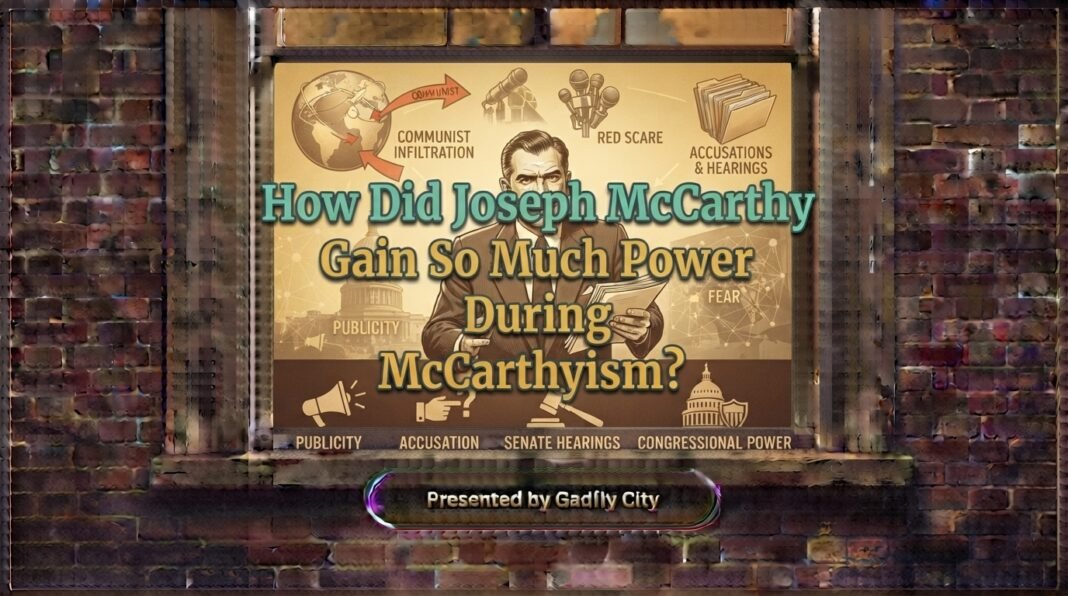
The story of Joseph McCarthy Power is not simply about one senator making controversial accusations. His rise was shaped by the political climate of early Cold War America, public anxiety about communism, congressional authority, media attention, and McCarthy’s ability to turn those conditions into influence. In February 1950, McCarthy became a national figure after claiming that Communist agents were working inside the U.S. government. His allegations quickly attracted enormous attention, even though the specific claims were challenged and investigated.
Understanding Joseph McCarthy Power therefore requires looking beyond McCarthy himself. The important question is not only what he said, but why his accusations gained such a large audience and why other political institutions struggled to restrain him.
The Cold War Created A Climate Of Fear
One major reason behind Joseph McCarthy Power was the broader atmosphere of the early Cold War.
After World War II, relations between the United States and Soviet Union deteriorated rapidly. Communist governments expanded their influence in Eastern Europe, China became communist in 1949, and the Soviet Union successfully tested an atomic bomb that same year. The Korean War then began in June 1950.
Americans were already concerned about espionage and Communist influence before McCarthy became nationally famous. Congressional investigations, loyalty programs, prosecutions, and organizations such as the House Un-American Activities Committee had already made communism a major political issue. The Library of Congress notes that McCarthy’s campaign developed alongside existing anti-communist investigations and Cold War fears.
This environment made accusations of Communist infiltration politically powerful. McCarthy did not create every fear surrounding communism, but he found a way to attach his political identity to those fears.
The 1950 Wheeling Speech Changed His National Profile
The turning point came on February 9, 1950, when McCarthy delivered a speech in Wheeling, West Virginia.
He claimed that he possessed a list containing the names of Communists working in the State Department. The number he cited became one of the most famous elements of his career, although the number and nature of the supposed list changed in subsequent versions of his allegations. The Senate Historical Office records the speech as the moment when McCarthy moved from being a relatively obscure senator to a national political figure.
This is central to understanding Joseph McCarthy Power. A relatively simple political message—Communists had supposedly infiltrated the government—was easy for newspapers, politicians, and the public to understand.
McCarthy also understood that accusations could generate more attention than technical policy arguments. Each new allegation created another reason for journalists and political opponents to discuss him.
Publicity Turned Accusations Into Political Influence
Another important part of Joseph McCarthy Power was his relationship with the media.
McCarthy’s accusations were highly public. He repeatedly made claims about Communist influence in government agencies and other institutions, generating newspaper coverage and public debate. The Senate’s historical record describes how he continued this campaign after his initial rise to national attention.
The result was a feedback loop.
McCarthy made an accusation. The accusation received attention. The attention increased his national profile. His increased profile made his next accusation more newsworthy.
This meant that political influence did not depend entirely on proving each allegation. Public attention itself became a source of power.
His Senate Position Gave Him Institutional Authority
Publicity alone could not explain Joseph McCarthy Power. His position inside the Senate mattered enormously.
McCarthy had been elected to the Senate in 1946. His influence increased significantly in 1953 when he became chairman of the Senate Permanent Subcommittee on Investigations. That position gave him a formal platform for investigating alleged subversion and espionage.
The distinction is important.
Before gaining this institutional position, McCarthy could make accusations. As chairman, he could use congressional hearings and investigations to question witnesses and demand information.
According to the Senate Historical Office, McCarthy’s subcommittee conducted numerous hearings and questioned hundreds of witnesses in public and closed sessions.
That combination of institutional authority and publicity made his influence considerably stronger.
Investigations Made His Claims Look More Official
Congressional investigations carried an appearance of legitimacy.
When a senator questioned witnesses in an official hearing, the proceedings looked very different from an ordinary political speech. The setting included government officials, transcripts, attorneys, committee procedures, and the authority of the Senate.
This helped explain another dimension of Joseph McCarthy Power: his accusations were presented through institutions that Americans generally associated with serious government oversight.
However, an investigation itself did not establish that an accusation was true. The Senate’s later examination of McCarthy’s conduct illustrates why procedures and evidence matter when governmental power is used against individuals.
This distinction remains useful when studying the period today: institutional authority can increase the impact of an allegation without automatically validating the allegation.
Political Opposition Was Initially Difficult
McCarthy also benefited from the difficulty his opponents faced in confronting him.
Some senators criticized his methods early. Senator Margaret Chase Smith, for example, delivered her famous “Declaration of Conscience” in June 1950, questioning McCarthy’s accusations and warning about the political use of fear and unsupported claims.
But opposition did not immediately eliminate his influence.
Part of the problem was political risk. Challenging an anti-communist campaign could itself become politically dangerous when concerns about Soviet espionage and national security were widespread.
McCarthy could therefore frame criticism of his methods as opposition to his broader anti-communist mission. That helped make his political position more difficult to challenge.
Why The Army-McCarthy Hearings Changed Everything
The limits of Joseph McCarthy Power became much clearer in 1954.
A dispute involving McCarthy and the U.S. Army developed into the nationally televised Army-McCarthy hearings. The hearings exposed a much larger audience to McCarthy’s methods of questioning and confrontation.
The Senate records that the hearings were broadcast nationally and contributed to McCarthy’s declining public standing.
Television changed the nature of the evidence available to the public.
People no longer had to rely only on newspaper descriptions of congressional proceedings. They could watch the exchanges themselves.
That mattered because political communication is partly about presentation. Once viewers could observe the proceedings directly, McCarthy’s approach became harder to separate from the accusations he was making.
The Senate’s historical account also records how the hearings contributed to the decline of his national popularity.
Senate Censure Finally Curtailed His Influence
The final institutional break came in December 1954.
The Senate investigated McCarthy’s conduct and ultimately censured him. The official Senate record states that the Senate voted on December 2, 1954, and censured McCarthy for conduct considered contrary to senatorial traditions.
This demonstrates an important principle about Joseph McCarthy Power: his influence depended on several institutions working together—his Senate position, committee authority, public attention, political allies, and the broader Cold War environment.
Once those supports weakened, his ability to dominate the national conversation declined.
His story can therefore be understood less as a case of unlimited individual power and more as an example of how political influence can emerge when institutional authority, public fear, media attention, and political incentives reinforce one another.
What Actually Made Joseph McCarthy So Powerful?
The rise of Joseph McCarthy Power can be understood through five connected factors:
- Cold War anxiety: Fear of Soviet expansion and Communist influence created a receptive political environment.
- A simple political message: His allegations were easy to communicate and understand.
- Media attention: Repeated accusations generated continued coverage.
- Institutional authority: His Senate position and later committee chairmanship gave his claims an official platform.
- Political resistance: Opponents initially faced difficulties challenging anti-communist accusations without appearing weak on national security.
None of these factors operated independently. Together, they created a system in which McCarthy could convert controversy into political visibility and visibility into influence.
The Larger Lesson Of McCarthyism
The history of Joseph McCarthy Power also connects to the larger history of the Cold War. Understanding the tensions between the United States and Soviet Union helps explain why accusations of Communist infiltration could carry so much weight.
For additional context, see our analysis of Who Was Primarily Responsible For The Cold War? and our discussion of Who Won The Cold War? A Complete Analysis Of The Key Factors.
It is also useful to remember that the United States was dealing with a genuine international rivalry. The existence of real Cold War tensions did not automatically make every domestic accusation accurate.
That distinction is one of the most important lessons from McCarthyism. A legitimate national-security concern can coexist with inaccurate claims, excessive investigations, or improper use of political authority.
Conclusion
Joseph McCarthy Power grew because several conditions came together at the same time. Cold War fears created public concern about communism. McCarthy transformed those concerns into a simple political message. The media amplified his accusations, while his Senate position gave them institutional visibility. His committee chairmanship later provided even greater authority.
His decline followed a similar pattern in reverse. The Army-McCarthy hearings exposed his methods to a national television audience, political support weakened, and the Senate eventually censured him.
The deeper lesson is not simply that one politician became powerful. It is that political power often develops through systems rather than through personality alone. Fear, institutions, incentives, publicity, and public trust can reinforce one another. When those relationships change, political influence can change with them.
Frequently Asked Questions
How Did Joseph McCarthy Gain Power?
Joseph McCarthy gained power by combining anti-communist rhetoric with Senate authority, media attention, and congressional investigations. The Cold War created an environment where allegations of Communist infiltration attracted significant public and political attention.
Why Did People Believe Joseph McCarthy?
Some Americans found McCarthy’s claims credible because concerns about Soviet espionage and Communist expansion were genuine. His Senate position and public investigations also gave his accusations an appearance of official authority.
What Made Joseph McCarthy Famous?
McCarthy became nationally famous after his February 1950 speech in Wheeling, West Virginia, in which he claimed to possess a list of Communists working in the State Department. The speech received extensive national attention.
When Did Joseph McCarthy Gain The Most Power?
McCarthy’s influence expanded significantly after he became chairman of the Senate Permanent Subcommittee on Investigations in 1953. The position gave him an institutional platform for highly publicized investi
Sources And References
- U.S. Senate – Joseph R. McCarthy: A Featured Biography
- U.S. Senate – McCarthy And Army-McCarthy Hearings
- U.S. Senate – The Censure Case Of Joseph McCarthy
- U.S. Senate – “A Declaration Of Conscience”
- U.S. Senate – “Communists In Government Service,” McCarthy Says
- Library Of Congress – Red Scare
A Note From Gadfly City
We believe history becomes more useful when we slow down and examine how events actually developed. At Gadfly City, we can look at the evidence, understand the competing forces, and leave room for readers to form their own conclusions. For more historical context, explore U.S. Independence: 10 Dates That Explain How America Became Independent.