


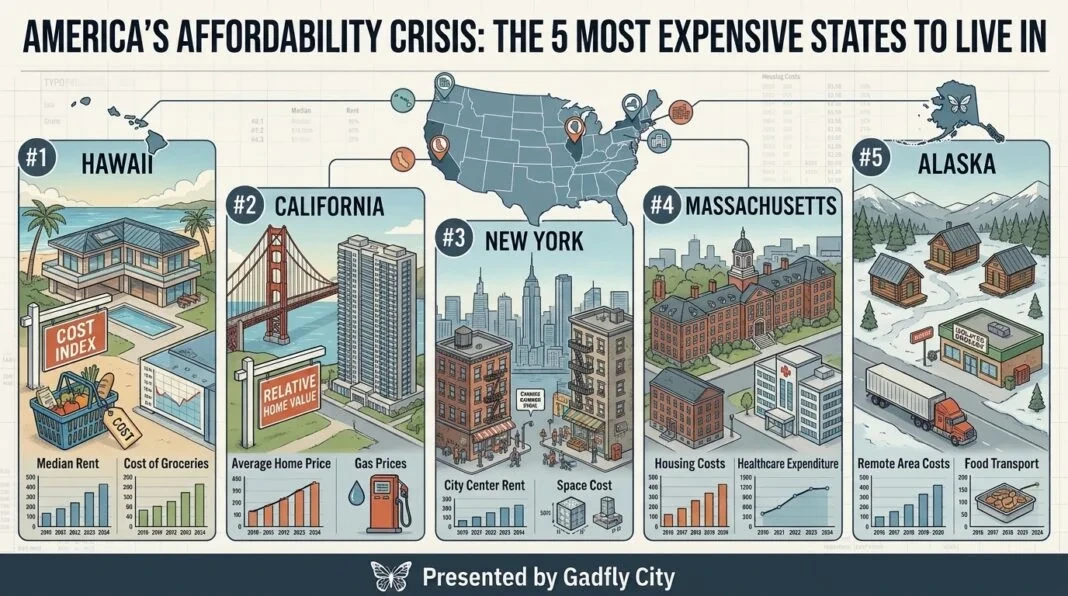
The most expensive states to live in are Hawaii, Massachusetts, California, New York, and Alaska, according to MERIC’s third-quarter 2026 cost-of-living index. Expensive housing, groceries, transportation, and healthcare make everyday life harder to manage, even for working households. Understanding these differences helps Americans make informed decisions about where to live. At Gadfly City, we explore the economic and political developments behind these growing affordability challenges.
Key Takeaways
- Hawaii is the priciest state, led chiefly by housing, utilities and transportation costs.
- Massachusetts and California are having huge problems with housing costs.
- New York and Alaska have high overall living expenses for different economic reasons .
- Housing continues to be one of the largest expenses in American household budgets.
- Inflation impacts everyday purchases, particularly food, energy and transportation.
- The Urban Institute’s American Affordability Tracker allows readers to compare financial pressures across states.
Getting to Know America’s Deepening Affordability Crisis
The US affordability crisis is more than simply rising prices. This is about the relationship between the income of a household and the cost of maintaining a reasonable standard of living. If you have a family that makes a higher salary in an expensive state you might have less money left over after paying your rent, utilities, groceries, transportation and insurance than a family that makes less in another state.
Average annual consumer spending in 2025 was $81,905, up 4.3% from 2024, the Bureau of Labor Statistics reported. Housing accounted for 33.9% of average spending, and transportation was 16.5%.
That’s why the cost of living by state deserves more attention than salary numbers. More money in your paycheck doesn’t always mean more financial security if the cost of necessities rises too.
Top 5 Most Expensive States to Live
MERIC’s third-quarter 2026 Cost of Living Index is a useful comparison of prices in participating cities and metropolitan areas within each state. The national average is set at 100, meaning a higher index indicates more expensive everyday living costs.
The following ranking excludes Washington, D.C., because it is not a state.
| Rank | State | Cost Of Living Index |
| 1 | Hawaii | 186.0 |
| 2 | Massachusetts | 148.6 |
| 3 | California | 137.9 |
| 4 | New York | 127.2 |
| 5 | Alaska | 127.1 |
Source: MERIC, Third Quarter 2026. Index values use the US average of 100.
1. Hawaii
Hawaii is still the most expensive state to live in, with a cost of living index of 186.0. This means its overall measured living costs are substantially above the national average.
Geography is a big part of it. Because Hawaii depends on imports, transportation and supply-chain costs have a lot to do with retail prices. “Another big challenge is housing because the availability of land, construction costs and demand affect the costs of property.
Utilities are part of the problem, too. Electricity and other utilities can take a large percentage of monthly income.
For residents, the problem is balancing high daily costs of living with job openings and pay rates. Saving money can be tough, even for households with jobs that feel secure.
2 .Massachusetts
Massachusetts is second, with an index of 148.6. Housing is a big part of it, particularly around Boston and other job centers.
The state attracts professionals in healthcare, education, technology and research industries. But a strong demand for housing in desirable locations can drive rents and property prices up.
Another important consideration is healthcare. Massachusetts has a large healthcare industry, but even with access to good services, not all households can easily afford the premiums, deductibles and out-of-pocket costs.
People who live outside the major employment centers can often lower their housing costs, but commuting may add to the costs.
3. Calfornia
California was third with an index of 137.9. One of the biggest factors driving up the cost of living is the high cost of housing.
In cities such as San Francisco, Los Angeles and San Diego, demand for housing is high. In some markets, limited housing availability, restrictions on construction and competition for desirable locations challenge affordability.
Transportation can be expensive too. Many people rely on private vehicles as a means of transport, especially in places where public transport is poor in connecting residential and workplace areas.
There are considerable economic opportunities in California, especially in technology, entertainment and professional services. But the higher pay can be eaten up by the high cost of housing, insurance, taxes and the everyday necessities.
4. New York City
New York came in fourth with an index of 127.2. The cost of living in the state varies greatly between New York City and the smaller communities.
In New York City, the cost of housing is especially high, and transportation, child care and everyday services can add to the pressure. Public transportation may mean no need for a car, but commuting costs and the cost of living near jobs are still important factors.
Outside the city, residents can find more affordable housing. But jobs, services and transport can vary greatly.
This makes New York an interesting example of why statewide averages may not reflect an individual’s actual cost of living.
5. Alaska
Finally we have Alaska with an index of 127.1. Geographic isolation gives it a different affordability challenge than the densely populated coastal states.
Many products need to travel long distances to get to local stores. So transportation, fuel and supply-chain costs can affect grocery and household prices.”
The heating and electricity are also important due to the geographic and climate conditions of the state. “People living in remote communities may have to pay extra for health care, education and other essential services.
Alaska has some of its own unique employment and natural resources, but because of its location, the cost of living is something that many families cannot escape from day-to-day.
Why Housing, Groceries, Transportation Are Increasing Living Costs
Housing is usually the first cost that determines if a household is financially comfortable. When a large share of income is spent on rent or mortgage payments, families have less flexibility to cope with emergencies, healthcare bills and savings.
The 2025 expenditure figures from the Bureau of Labor Statistics make it clear that housing deserves a special look. Approximately one-third of the average consumer budget (33.9% of average household expenditures).
Then there’s the grocery issue. Food prices are important for every household, but the impact varies by location, supply chains and access to affordable retailers. Transportation adds to the stress through fuel, vehicle maintenance, insurance and the costs of commuting.
Healthcare can get messy. Insurance premiums, prescriptions and doctor visits can all contribute to unforeseen costs, especially for families without full coverage.
And these costs interact too. You could move further away from a costly city and pay lower rent. However, you would have a longer drive to work, which could increase your cost of fuel and vehicle maintenance. The cheapest place to live is not always the cheapest overall.
How Inflation in America Makes Affordability Harder
Inflation in America affects more than the price displayed on a grocery receipt. It gradually changes how much income households need to maintain their existing lifestyles.
The main difference is between inflation and the cost of living. Inflation is a measure of how prices are changing over time, and cost-of-living comparisons are about how expensive different places are compared to each other.
Average household expenditures increased 4.3% in 2025, the Bureau of Labor Statistics reported, compared to a 2.6% increase in the Consumer Price Index. These measures are not interchangeable, but they do show why households may feel financial pressure even when headline inflation looks tame.
Energy prices, housing and grocery costs can affect states differently. International conflict and uncertainty in energy markets, for example, can drive up fuel and transportation costs. Readers interested in this connection can explore our coverage of the Iran War Cost.
How to Compare Affordability in Your State
A statewide ranking is a useful starting point, but it should not be the only factor behind a relocation or financial decision.
The Urban Institute’s American Affordability Tracker is a valuable resource for examining household finances and essential expenses. Updated on October 26, 2026, the tracker brings together information about housing, healthcare, childcare, energy, gas, earnings, and financial strain.
Readers can use it to understand how affordability pressures change over time, and to compare trends across states and congressional districts.
It’s also worth remembering that the most expensive state isn’t necessarily the least affordable for all households. The final calculation depends on income, family size, availability of jobs, type of housing and access to public services.
Final Words
The five most expensive states to live in show that economic opportunity and affordability don’t always line up. Hawaii, Massachusetts, California, New York and Alaska all have varying economic structures but each offers challenges that can make planning for everyday finances a challenge.
The best way to judge this is to look at living costs against realistic household income, rather than looking at salaries or rankings in isolation. A place that looks expensive on paper can still save some households money, while a place that looks affordable may come with hidden transportation or health care costs.
At the end of the day, financial stability is more than simply making more money. It’s about having enough left over after the essentials are met to save, to plan and to enjoy life.
FAQs – Frequently Asked Questions
1. What are the 5 most expensive states to live in?
According to MERIC’s Cost of Living Index for the third quarter of 2026, the five most expensive states in the U.S. are Hawaii, Massachusetts, California, New York and Alaska.
2. Why Is Hawaii the Costliest State?
Hawaii has a very high cost of living overall due to: – Geographic isolation – Imported goods – Limited housing availability – Transportation costs – High utility costs
3. Does More Money Equal More Affordability?
Not necessarily. Many times the higher salaries are offset by the cost of housing, health care, transportation, taxes, and other everyday items that leave households with less disposable income.
4. How does inflation impact the cost of living?
Inflation is when prices of goods and services go up over time. As the cost of necessities rises faster than household earnings, families have less money to spend and face greater financial strain.
5. How Do I Compare Cost of Living State by State?
The Urban Institute’s American Affordability Tracker offers data on housing, health care, energy, childcare, earnings and financial strain to help readers examine affordability trends.
6. Is New York More Expensive Than California?
Yes, California is ranked higher than New York in the MERIC third quarter 2026 overall cost of living index. But costs vary widely from city to city, or from community to community.
Keep Informed
To understand America’s affordability crisis, we need to look beyond the headlines to the economic choices, public policies and day-to-day costs that shape how families manage their money. Gadfly City offers clear explanations, relevant research, and balanced perspectives to help readers understand the issues shaping the country. Read our latest coverage, question the numbers and stay current as America’s economy continues to evolve.