


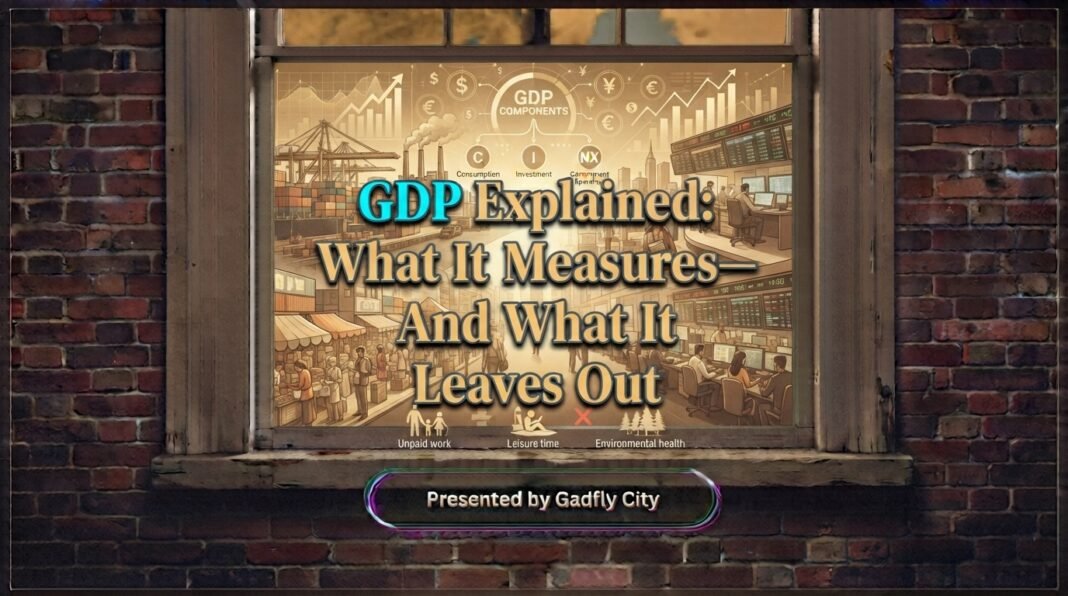
If you have ever wondered what is GDP, the simplest answer is this: GDP, or Gross Domestic Product, measures the monetary value of final goods and services produced within a country over a specific period. It is one of the most widely used indicators for understanding the scale and direction of an economy. But what is GDP really telling us about everyday economic life? The answer is useful, but narrower than many people assume.
GDP is primarily a measure of economic output. It can show whether production is expanding or contracting, which parts of an economy are contributing to growth, and how economic activity changes over time. However, GDP does not tell us everything about household finances, wealth, inequality, unpaid work, environmental conditions, or overall quality of life. Understanding both sides makes GDP easier to interpret.
What Is GDP And Why Does It Matter?
So, what is GDP in practical terms? It is a way of putting a monetary value on the final goods and services produced within a country’s borders during a particular period, usually a quarter or a year.
The word “final” matters because economists want to avoid counting the same production multiple times. If a bakery buys flour to make bread, the value of the flour is already reflected in the value of the final bread. Counting both independently would exaggerate economic output.
The U.S. Bureau of Economic Analysis describes GDP as the value of final goods and services produced within the economy.
This is why what is GDP is not simply a question about how much money changes hands. GDP is designed to capture production and the economic value associated with that production.
How GDP Measures Economic Production
There are three broad ways economists can look at GDP: production, income, and expenditure. In principle, these approaches describe the same economic activity from different angles.
The expenditure approach is often expressed as:
GDP = C + I + G + (X − M)
Here, C represents consumer spending, I represents business investment, G represents government spending on goods and services and investment, X represents exports, and M represents imports. Imports are subtracted because they were produced outside the domestic economy.
This formula also explains why GDP can change even when households are not suddenly spending more. Business investment, government activity, or exports can also affect total output.
Nominal GDP And Real GDP
Another important distinction is between nominal and real GDP.
Nominal GDP uses current prices. If prices rise, the monetary value of production can increase even when the physical amount of goods and services produced has not changed much.
Real GDP adjusts for price changes so economists can better assess changes in actual production. The distinction matters because an economy can appear larger in monetary terms partly because prices have increased.
This is also why understanding what is GDP requires some awareness of inflation. A rising GDP figure does not automatically mean that households can buy more with their income.
For a broader explanation of how changing prices affect everyday purchasing power, see Why Does Inflation Make Your Paycheck Feel Smaller?.
What Goes Into GDP?
GDP captures a wide range of economic activity. Consumer purchases can contribute to GDP, as can business investment, government-provided services, exports, construction, manufacturing, transportation, technology, healthcare, and many other forms of production.
Government services can also be included even when there is no conventional market price. National accounts therefore use methods to estimate the value of certain services that are not directly sold in markets.
The important point is that GDP focuses on production, rather than simply counting personal income or the amount of money people have in their bank accounts.
That distinction becomes especially important when people try to use GDP as a shortcut for answering questions about living standards.
Why GDP Per Capita Matters
A country’s total GDP tells us the size of its economy, but it does not account for population size.
That is where GDP per capita becomes useful. It divides GDP by the population, giving a rough measure of economic output per person.
Imagine two countries producing the same total economic output. If one has twice the population, its GDP per capita will be lower. This helps provide additional context when comparing economies of different sizes.
However, GDP per capita is still an average. It does not tell us how income or economic resources are distributed among households.
A country can have relatively high GDP per capita while some households have considerably fewer economic resources than others. The OECD notes that GDP per capita remains important for assessing economic conditions but needs to be complemented by other measures when evaluating broader well-being.
What GDP Leaves Out
The biggest misunderstanding about what is GDP comes from treating it as a complete scorecard for society.
GDP is useful precisely because it has a defined purpose. But that purpose also creates boundaries.
GDP Is Not A Household Wealth Score
GDP measures production during a period. Household wealth measures accumulated assets and liabilities.
A country’s GDP can increase without every household becoming wealthier. Similarly, someone can have substantial personal wealth even if their country’s GDP growth is weak during a particular year.
GDP therefore should not be interpreted as the amount of money available to households.
It also does not directly show how much disposable income families have after taxes, housing costs, debt payments, and other expenses.
GDP Does Not Show Income Distribution
GDP combines economic activity across an entire economy. It does not tell us who receives the income generated by that activity.
Two countries could have similar GDP figures but very different distributions of income and wealth.
This is one reason economists and policymakers use additional indicators when studying inequality, household resources, and living conditions.
GDP Does Not Fully Capture Quality Of Life
So, what is GDP able to say about quality of life? It can provide important economic context, but it cannot answer the whole question.
Health, education outcomes, leisure time, personal safety, environmental conditions, social relationships, and life satisfaction involve dimensions that GDP does not directly measure.
The OECD specifically notes that GDP can miss important aspects of people’s lives, including who benefits from growth and whether economic progress is sustainable.
Unpaid Work Can Be Difficult To Capture
Consider someone caring for children, preparing meals, cleaning a home, or helping an elderly relative without receiving payment.
That work can have substantial value to a household, yet much unpaid household activity is not recorded in GDP because it does not pass through conventional market transactions. The IMF similarly notes that unpaid household and volunteer work is generally outside standard GDP measurement.
This does not mean such work is unimportant. It means GDP has a particular measurement framework.
Why A Growing GDP Can Still Feel Different For Households
A useful way to interpret GDP is to separate the economy’s production story from the household’s financial story.
GDP might rise because businesses produce more goods and services. But households may simultaneously face higher housing costs, food prices, debt payments, or other expenses.
This is why a person can hear that the economy is growing while personally feeling financially constrained.
Inflation is one part of that explanation. Distribution, employment conditions, taxes, household debt, and changes in purchasing power can also affect how economic growth is experienced.
For another perspective on large-scale economic stability and its consequences, see What Would Happen If The US Economy Collapsed?.
GDP Is Best Used As One Part Of A Larger Picture
So, what is GDP best used for?
It is particularly useful for examining the size and direction of economic production. Economists can use GDP to study growth, recessions, changes across industries, and differences in economic activity over time.
But GDP becomes less informative when it is asked to answer questions it was not designed to answer.
A more complete economic picture can combine GDP with measures of household income, wealth, employment, inflation, inequality, health, education, environmental conditions, and subjective well-being.
The OECD’s work on measuring well-being similarly argues for looking beyond GDP when assessing broader social progress.
This distinction is important because better measurement does not necessarily mean abandoning GDP. It means using the right measurement for the question being asked.
The Simple Way To Remember GDP
If you remember only one idea from this GDP explained guide, make it this:
GDP measures economic production, not the complete economic experience of people.
It tells us about the value of goods and services produced within an economy. It can help identify whether economic activity is expanding or contracting. GDP per capita can provide additional context about output relative to population.
But GDP does not directly measure household wealth, income equality, personal happiness, environmental quality, unpaid household work, or every factor that shapes living standards.
That is the real answer to what is GDP: it is a powerful economic measurement tool with a clearly defined job.
And like any measurement tool, its usefulness depends on using it for the question it was designed to answer.
Frequently Asked Questions About GDP
What Is GDP In Simple Terms?
GDP is the total monetary value of final goods and services produced within a country’s borders during a specific period. It is commonly used to measure the size and growth of economic activity.
What Does GDP Measure?
GDP measures the value of final goods and services produced within an economy. It can help show changes in economic output over time and identify how different parts of an economy contribute to production.
Why Is GDP Important?
GDP provides a standardized way to monitor economic activity and growth. Governments, businesses, economists, and researchers use GDP alongside other indicators when studying economic conditions and making decisions.
What Is The Difference Between GDP And GDP Per Capita?
GDP measures the total economic output of a country, while GDP per capita divides GDP by population. Per-capita figures provide additional context by relating economic output to the number of people.
Does GDP Measure Wealth?
No. GDP measures production during a particular period rather than accumulated household or national wealth. Wealth depends on assets, liabilities, savings, property, investments, and other accumulated resources.
Does GDP Measure Quality Of Life?
GDP does not directly measure quality of life. Health, education, safety, leisure, environmental conditions, inequality, and life satisfaction require additional measures to create a broader picture of well-being.
Can GDP Increase While People Feel Poorer?
Yes. GDP can increase while households experience higher living costs, unequal income gains, debt pressures, or other financial challenges. Economic output and individual financial circumstances are related but not identical.
Why Is Real GDP Used?
Real GDP adjusts for changes in prices, making it more useful for examining changes in actual economic production over time. Without adjusting for inflation, rising prices can make nominal GDP appear larger.
Is GDP The Same As Economic Growth?
Not exactly. GDP is a measure of economic output, while economic growth generally refers to an increase in real GDP over time. Growth therefore describes a change in the measured level of output.
A Broader Way To Read Economic Numbers
Numbers such as GDP can make complicated economies feel easier to understand. But the number itself is only the beginning of the conversation.
When we read GDP alongside inflation, household income, employment, wealth distribution, and quality-of-life measures, the economic picture becomes more complete. For historical context on how economic strength can interact with major geopolitical events, explore Who Won The Cold War? A Complete Analysis Of The Key Factors.
At Gadfly City, we aim to keep that broader perspective at the center of our Money Talks content, explaining economic ideas in plain language so we can understand not only what the numbers say, but also what they leave out.
The most useful economic statistic is rarely the one that answers every question. It is the one that helps us ask the next question more intelligently.
Sources And References
- U.S. Bureau Of Economic Analysis – Gross Domestic Product
- U.S. Bureau Of Economic Analysis – What Is GDP?
- U.S. Bureau Of Economic Analysis – The Expenditures Approach To Measuring GDP
- International Monetary Fund – Gross Domestic Product: An Economy’s All
- OECD – Well-Being And Beyond GDP
- OECD – For Good Measure: Advancing Research On Well-Being Metrics Beyond GDP
- World Bank / OECD – How’s Life? Measuring Well-Being