


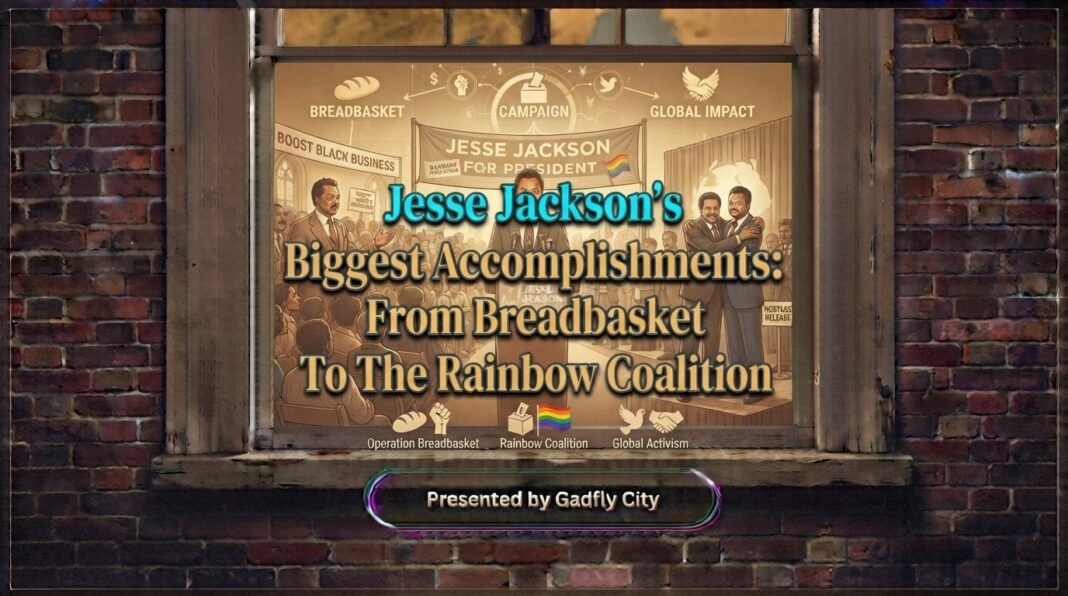
Understanding Jesse Jackson accomplishments means looking beyond presidential campaigns and speeches. His career connected civil rights activism with economic organizing, voter mobilization, coalition building, and international diplomacy. From Operation Breadbasket to Operation PUSH and the Rainbow Coalition, Jackson developed organizations and political strategies that sought to turn community participation into practical influence.
His public career also grew from his work with Martin Luther King Jr. and the Southern Christian Leadership Conference (SCLC). For broader background, see our guide on Why Is Jesse Jackson Important, which explains how his activism developed within the wider civil rights movement.
From Operation Breadbasket To Economic Organizing
One of the most important Jesse Jackson accomplishments came through Operation Breadbasket, an SCLC economic program that Jackson helped lead in Chicago beginning in 1966.
The basic idea was straightforward. Businesses that depended heavily on African American consumers were pressured to provide fair employment opportunities and support economic activity within Black communities. Organizers gathered employment information, negotiated with companies, and used selective boycotts when negotiations failed.
According to the Martin Luther King Jr. Research And Education Institute, Chicago’s program secured thousands of jobs and generated additional income for the Black community. The important lesson was organizational rather than simply numerical: consumer spending could become leverage for negotiating economic change.
This approach helps explain why Jesse Jackson accomplishments cannot be separated from economic empowerment. He treated employment, business practices, banking, advertising, and community investment as connected parts of civil rights.
Building Operation PUSH
After leaving SCLC in 1971, Jackson founded Operation PUSH, originally known as People United to Save Humanity. The organization extended some of the economic principles developed through Breadbasket while broadening its work into education, political participation, employment, and social justice.
The PBS American Experience account of Operation PUSH shows how the organization became involved in grassroots political organizing in Chicago. PUSH supported voter-registration efforts and helped create an organizing infrastructure that connected local concerns with national political questions.
One example was the campaign surrounding Harold Washington’s successful run for Chicago mayor in 1983. Community organizers set a target of registering 50,000 new voters and ultimately registered roughly twice that number. Jackson’s involvement demonstrated how voter registration could operate as a practical organizing tool rather than simply an election-season activity.
This is another central part of Jesse Jackson accomplishments: building institutions that could remain active between major elections.
Creating The Rainbow Coalition
The Rainbow Coalition represented another major development in Jackson’s career. During his 1984 presidential campaign, Jackson attempted to build a political coalition that extended beyond Black voters.
His campaign presented a broader alliance involving African Americans, Hispanic Americans, Asian Americans, Native Americans, farmers, labor interests, young people, women, disabled Americans, and other groups. In his 1984 convention speech, Jackson described America as a “quilt” made up of different communities connected by common interests.
The significance of the Rainbow Coalition was therefore organizational as well as rhetorical. Jackson attempted to demonstrate that groups with different experiences could coordinate around issues such as employment, voting rights, economic opportunity, and political representation.
The approach also had limitations. Building a coalition across many communities meant managing different priorities, histories, and political expectations. Jackson’s campaign attracted broad support in some constituencies while also facing criticism and controversies, including his 1984 remarks that damaged relationships with some Jewish voters. PBS documents both the coalition-building effort and the disputes surrounding it.
For readers looking at the broader record, our article What Did Jesse Jackson Accomplish provides additional context on the milestones that shaped his career.
The 1984 Presidential Campaign
The 1984 campaign was one of the defining Jesse Jackson accomplishments because it brought his organizing model onto the national political stage.
Jackson sought the Democratic presidential nomination and finished third in the party’s primary contest. Stanford’s Martin Luther King Jr. Research and Education Institute records that he received approximately 3.5 million votes and helped register about one million new voters.
The campaign established an important political framework. Instead of treating African American voters as a single voting bloc, Jackson presented a coalition-based approach that attempted to connect racial justice with economic and social issues affecting other communities.
The Library of Congress collection also preserves campaign material from the 1984 race, providing primary-source evidence of how Jackson’s presidential campaign was presented to voters.
The 1988 Campaign And Voter Mobilization
The 1988 presidential campaign expanded on the organizing structure developed four years earlier. Jackson again sought the Democratic nomination and won primaries and caucuses in 11 states, according to PBS and other historical accounts.
The campaign demonstrated that the Rainbow Coalition concept could operate across different regions and demographic groups. Jackson continued emphasizing voter participation, economic issues, civil rights, and coalition politics.
His 1988 convention speech also showed how the language of coalition building had become central to his political identity. He presented the convention as a gathering of communities with different backgrounds but shared political interests.
These campaigns are among the most frequently discussed Jesse Jackson accomplishments, although they should be understood separately from electoral victory. Jackson did not win the Democratic nomination in either 1984 or 1988. His historical significance instead includes the organizational networks, voter participation, and coalition politics developed through those campaigns.
Diplomacy And International Negotiations
Another part of Jesse Jackson accomplishments came outside domestic electoral politics. During the 1980s and 1990s, Jackson undertook several independent diplomatic missions involving Americans and other prisoners held overseas.
In 1984, he traveled to Syria and helped secure the release of U.S. pilot Robert Goodman. Later, he participated in efforts involving Americans held in Cuba and hostages in Iraq and Kuwait. HISTORY documents these missions as part of his broader international work.
These activities were sometimes controversial because Jackson’s independent diplomacy could differ from the approach of the U.S. government. Nevertheless, they became a recognizable part of his public career and expanded his role beyond domestic civil rights organizing.
The Limits Of His Impact
A balanced account of Jesse Jackson accomplishments also needs to recognize what his organizations and campaigns did not accomplish.
Jackson never won the Democratic presidential nomination. His campaigns also faced internal disagreements, political controversies, and criticism from people who questioned his strategies or positions.
Likewise, coalition building does not automatically produce lasting agreement. The groups represented by the Rainbow Coalition had different economic interests, political priorities, and experiences with American institutions. Maintaining such a coalition required continual negotiation.
Yet the organizational model remained important. In 1996, the National Rainbow Coalition and Operation PUSH merged to form the Rainbow/PUSH Coalition. The Clinton White House archives later described Jackson’s work through organizations including PUSH and the National Rainbow Coalition as focused on expanding opportunities for minorities and encouraging youth responsibility.
Why Jesse Jackson’s Accomplishments Still Matter
The larger story behind Jesse Jackson accomplishments is a progression from economic pressure to institutional organization, then from institutional organization to national coalition politics.
Operation Breadbasket showed how organized consumers could pressure businesses. Operation PUSH expanded that organizing philosophy into a broader institution. The Rainbow Coalition attempted to connect different communities through a shared political framework. The 1984 and 1988 campaigns then carried that framework into national politics.
Readers interested in his relationship with the earlier civil rights movement can also explore Why Was Martin Luther King Jr. Influential? for context on the movement that shaped Jackson’s early career.
Ultimately, the most useful way to understand Jesse Jackson accomplishments is not to reduce them to a list of victories. His career illustrates how movements can evolve: protest can become economic organizing, economic organizing can become institution building, and institutions can become political coalitions. The results were mixed and sometimes contested, but the organizing framework itself became an important part of modern American political history.
Read More From Gadfly City
If you want to understand the wider history behind Jackson’s career, we can explore how civil rights organizing, economic empowerment, voter registration, and coalition politics developed across different periods. Read more historical stories from Gadfly City and continue connecting individual leaders with the movements and institutions around them.
Sources And References
- Martin Luther King Jr. Research And Education Institute – Jesse Jackson
- Martin Luther King Jr. Research And Education Institute – Operation Breadbasket
- PBS American Experience – Operation PUSH
- PBS FRONTLINE – Jesse Jackson Biographical Chronology
- PBS FRONTLINE – Jesse Jackson 1984 Speech
- PBS FRONTLINE – Jesse Jackson 1988 Speech
- Library Of Congress – Vote Jesse Jackson ’84 For President
- HISTORY – Jesse Jackson
- Clinton White House Archives – Presidential Medal Of Freedom Statement