


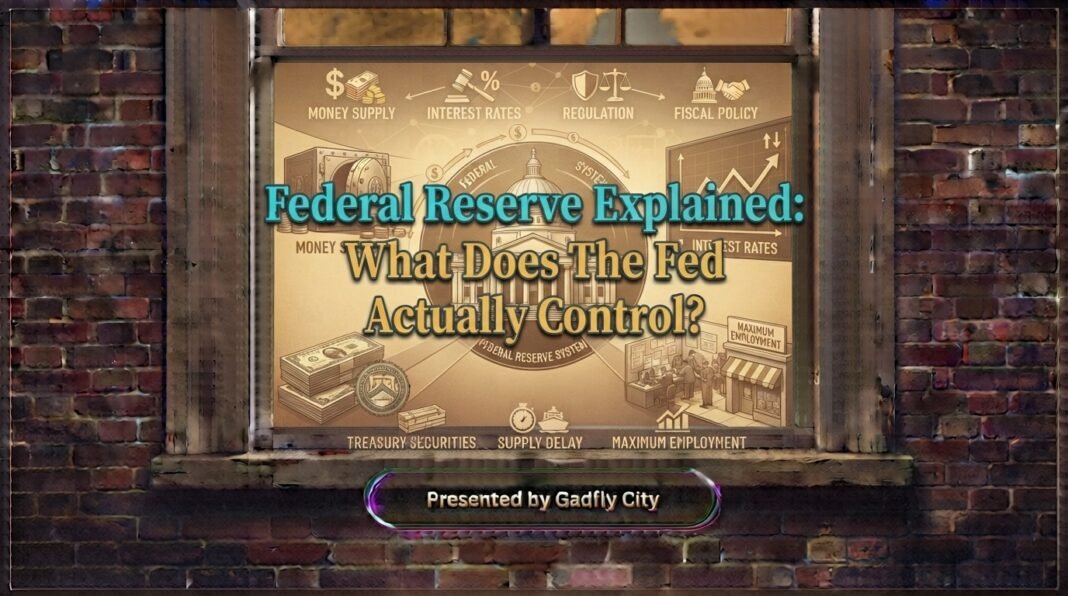
If you have ever wondered what does the Federal Reserve do, the simplest answer is this: the Fed is the central bank of the United States, and it influences the cost and availability of money and credit across the economy. It does this mainly through monetary policy, while also supervising certain financial institutions and helping maintain financial stability.
That sounds straightforward until you ask a more practical question: What does the Federal Reserve actually control? The answer is more limited than many people assume. The Fed can influence interest rates and financial conditions, but it cannot directly set your salary, determine grocery prices, control government spending, or guarantee that the economy grows at a particular pace.
Understanding that distinction makes monetary policy much easier to follow.
What Does The Federal Reserve Do?
The Federal Reserve, commonly called the Fed, is the central bank of the United States. Congress gave it responsibilities that include conducting monetary policy, supervising and regulating certain financial institutions, maintaining financial stability, and providing certain financial services to the banking system and government.
When people ask what does the Federal Reserve do, however, they are usually asking about monetary policy. This is where the Fed’s influence is most visible to households and businesses.
The central idea is simple: the Fed changes financial conditions to influence economic activity, employment, and inflation.
When borrowing becomes more expensive, households and businesses may reduce spending and investment. When borrowing becomes cheaper, they may have greater incentive to borrow, spend, and invest.
This chain takes time, and it is not mechanical. Many forces outside the Fed also affect the economy.
The Fed’s Dual Mandate
A useful way to understand what does the Federal Reserve do is to start with its dual mandate.
Congress has assigned the Federal Reserve the goals of maximum employment and stable prices. These objectives are commonly referred to as the Fed’s dual mandate.
The Fed therefore watches both sides of the economy.
If inflation is persistently too high, tighter monetary policy can reduce demand by making borrowing more expensive. If economic activity and employment are weakening, the Fed can move toward easier monetary conditions when appropriate.
This does not mean the Fed can simply choose any level of inflation or employment. Economic conditions depend on many factors, including productivity, energy prices, consumer behavior, global events, fiscal policy, and financial conditions.
For a broader look at how rising prices affect ordinary households, see our explanation of Why Does Inflation Make Your Paycheck Feel Smaller?.
How The Fed Controls Interest Rates
One of the clearest answers to what does the Federal Reserve do is that it sets the target range for the federal funds rate through the Federal Open Market Committee, or FOMC.
The federal funds rate is the rate at which banks lend balances to one another overnight.
The Fed does not directly set every interest rate consumers encounter. Instead, it influences a key short-term rate, which then affects broader financial conditions.
When The Fed Raises Rates
Suppose the Fed raises its target range.
Higher short-term interest rates can feed into other borrowing costs. Businesses may face more expensive financing, consumers may pay more for certain forms of credit, and financial markets may adjust their expectations.
The basic economic logic is:
Higher policy rates → tighter financial conditions → less borrowing and spending → weaker demand → reduced inflation pressure.
That process is neither immediate nor guaranteed, but it explains why interest rates are central to Fed policy.
When The Fed Lowers Rates
The reverse can happen when the Fed lowers its target range.
Cheaper short-term borrowing can make some loans more attractive. Businesses may find investment easier to finance, while households may have greater incentive to borrow or spend.
The simplified chain becomes:
Lower policy rates → easier financial conditions → more borrowing and spending → stronger demand → potential support for employment and economic activity.
The Fed itself emphasizes that monetary policy affects the economy through broader financial conditions rather than through one direct lever.
What Are Financial Conditions?
Financial conditions are broader than the federal funds rate.
They include factors such as borrowing costs, credit availability, financial market conditions, and other measures that affect how easily households and businesses can obtain financing.
This distinction matters because the Fed does not operate the economy with a single interest-rate switch.
A change in the policy rate can influence other interest rates and financial markets, but the size and speed of those effects can vary.
For example, a household considering a mortgage does not borrow directly at the federal funds rate. A business does not automatically receive a loan at the Fed’s target rate either.
Instead, the policy rate influences the broader financial environment in which banks, lenders, investors, businesses, and households make decisions.
The Fed Also Supervises Banks
Another important part of what does the Federal Reserve do is bank supervision and regulation.
The Fed supervises certain banks and financial institutions to promote safety and soundness. It examines institutions, monitors risks, develops regulations within its legal authority, and can require corrective action when supervised institutions do not adequately manage certain risks.
This function is different from monetary policy.
Monetary policy focuses on economy-wide financial conditions. Supervision focuses more directly on the safety and resilience of financial institutions.
The distinction becomes especially important during periods of financial stress because problems at individual institutions can sometimes create broader risks for the financial system.
The Fed And Financial Stability
The Federal Reserve also has responsibilities related to financial stability.
Financial institutions are interconnected. A serious problem at one institution can potentially affect other institutions, markets, businesses, and households.
This is why the Fed monitors financial risks beyond simply asking whether inflation is rising or falling.
Its financial-stability role is another reason what does the Federal Reserve do cannot be reduced to “setting interest rates.”
The Fed also participates in the operation and oversight of important parts of the U.S. payments and financial system.
For a broader explanation of severe economic disruption, you can also read What Would Happen If The US Economy Collapsed?.
What The Fed Does Not Directly Control
This is arguably the most important part of understanding what does the Federal Reserve do.
The Fed influences the economy, but it does not directly control everything that affects Americans’ financial lives.
The Fed Does Not Set Government Spending
Fiscal policy is different from monetary policy.
Congress and the Administration determine federal tax and spending policy. The Fed does not decide how much the federal government spends or what tax rates Congress establishes.
That means a major government spending decision can affect the economy even though the decision itself does not come from the Federal Reserve.
The Fed Does Not Set Your Wage
The Fed can influence labor-market conditions through monetary policy, but it does not determine what individual workers earn.
Your wage can depend on your skills, occupation, employer, location, productivity, labor-market demand, and many other factors.
The Fed Does Not Directly Set Grocery Prices
Food prices can respond to supply conditions, weather, transportation costs, energy prices, global commodity markets, business costs, and consumer demand.
Monetary policy can influence overall demand and inflation, but the Fed cannot simply instruct supermarkets to charge less for a particular product.
This is why understanding what does the Federal Reserve do requires separating influence from direct control.
A Simple Framework For Understanding The Fed
When you hear that the Fed “raised rates,” think about the following sequence:
Fed decision → financial conditions → borrowing and spending decisions → economic activity → employment and inflation.
The further you move along that chain, the less direct the Fed’s control becomes.
The Fed directly determines some policy instruments. It influences financial conditions. It affects economic behavior. But it does not command the final economic outcome.
That distinction is useful when interpreting headlines about monetary policy because a Fed decision is a policy action, not a guaranteed prediction of what will happen next.
Why The Fed’s Decisions Matter
So, what does the Federal Reserve do in practical terms?
It uses monetary policy to influence financial conditions in pursuit of maximum employment and stable prices. It supervises certain financial institutions, works to support financial-system stability, and provides important financial and payment services.
But the Fed operates within a much larger economic system.
Interest rates matter, but so do government policy, business investment, consumer behavior, global trade, technology, productivity, commodity markets, and unexpected events.
Understanding those relationships is more useful than thinking of the Fed as an institution that controls the entire economy.
For historical context on the broader relationship between monetary power, the U.S. financial system, and global economic influence, explore Who Won The Cold War? A Complete Analysis Of The Key Factors.
Frequently Asked Questions
What Does The Federal Reserve Do?
The Federal Reserve conducts U.S. monetary policy, supervises certain financial institutions, supports financial stability, and provides financial services. Its monetary-policy responsibilities focus primarily on maximum employment and stable prices.
Does The Federal Reserve Control Interest Rates?
The Federal Reserve controls its target range for the federal funds rate through the FOMC. It does not directly set every consumer or business interest rate, but its decisions influence broader borrowing costs.
What Is The Fed’s Dual Mandate?
The Fed’s dual mandate refers to maximum employment and stable prices. These goals guide monetary policy decisions, although the Fed cannot directly control either employment or inflation.
Does The Fed Control Inflation?
The Fed can influence inflation through monetary policy, particularly by changing financial conditions and demand. However, inflation also depends on supply conditions, global events, commodity prices, and other factors.
Does The Fed Control Government Spending?
No. Government spending and taxation are part of fiscal policy and are determined by Congress and the Administration. The Federal Reserve conducts monetary policy separately from those fiscal decisions.
Why Does The Fed Raise Interest Rates?
The Fed may raise interest rates when tighter financial conditions are appropriate, including when inflation is too high. Higher borrowing costs can reduce demand and help ease inflationary pressure over time.
Who Decides Federal Reserve Monetary Policy?
The Federal Open Market Committee, or FOMC, determines the appropriate stance of U.S. monetary policy. It considers economic and financial information when deciding the target range for the federal funds rate.
Does The Fed Control The Stock Market?
No. The Federal Reserve does not control stock prices. Its policy decisions can influence financial conditions and investor expectations, but stock prices are determined by market forces and many other factors.
Final Thoughts
The most useful way to think about what does the Federal Reserve do is to separate control, influence, and outcome.
The Fed directly controls certain policy instruments. It influences borrowing costs and financial conditions. Those conditions influence decisions made by households, businesses, banks, and investors. The eventual economic outcome, however, depends on far more than the Fed alone.
That is why monetary policy is less like steering a car along a predetermined road and more like adjusting the pressure on a large economic system whose response takes time.
At GadflyCity, we believe understanding that distinction makes economic news easier to interpret. Explore our other U.S. economy explainers, including Why Does Inflation Make Your Paycheck Feel Smaller?, and keep following the chain from policy decisions to the real-world effects people experience.
Sources And References
- Federal Reserve – What Is The Purpose Of The Federal Reserve System?
- Federal Reserve – Monetary Policy: What Are Its Goals? How Does It Work?
- Federal Reserve – The Fed Explained: Monetary Policy
- Federal Reserve – How Does The Federal Reserve Affect Inflation And Employment?
- Federal Reserve – Monetary Policy And Fiscal Policy
- Federal Reserve – Supervision And Regulation
- Federal Reserve – Understanding Federal Reserve Supervision
- Federal Reserve – Policy Tools
- Federal Reserve – Federal Open Market Committee