

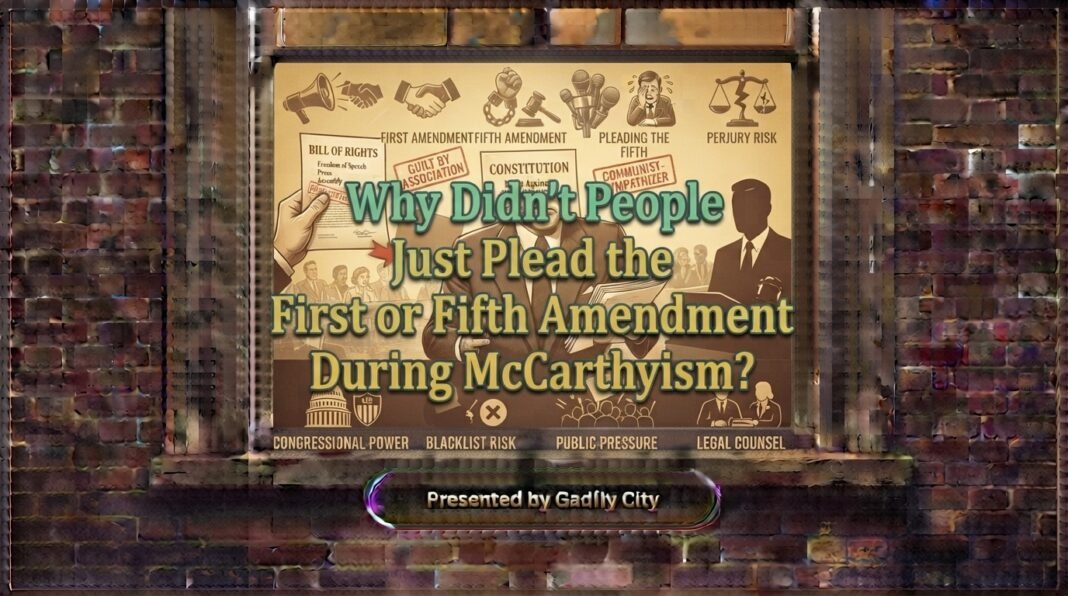
The question of Fifth Amendment During McCarthyism seems straightforward today: if someone was questioned about alleged Communist associations, why not simply refuse to answer? The answer is that constitutional rights existed, but using them in the political and legal environment of the 1950s was more complicated than saying, “I plead the Fifth.”
During the Red Scare, congressional committees questioned government employees, academics, writers, union members, and other private citizens about alleged Communist connections. Senator Joseph McCarthy’s Senate investigations and the House Un-American Activities Committee (HUAC) operated in a climate where accusations themselves could carry serious professional and social consequences.
To understand why witnesses did not simply invoke constitutional protections, it helps to separate three questions: What did the First Amendment protect? What did the Fifth Amendment protect? And what could happen after a witness refused to answer?
What Did The Fifth Amendment Protect?
The Fifth Amendment includes the protection against compelled self-incrimination. In simple terms, a person generally cannot be forced to provide testimony that could incriminate them in a criminal matter. Congress’s Constitution Annotated explains that this protection has deep roots in the principle that a person should not be compelled to accuse themselves.
That distinction matters because the Fifth Amendment was not a general right to refuse every question.
A witness could not necessarily respond to every politically uncomfortable question by saying, “I plead the Fifth.” The privilege was connected to the possibility that an answer could expose the witness to criminal prosecution.
This became particularly important during Fifth Amendment During McCarthyism because many questions concerned political associations, meetings, organizations, and other people.
The Fifth Amendment Was Not An Admission Of Guilt
One of the most important misconceptions about Fifth Amendment During McCarthyism is that invoking the privilege automatically meant the witness was guilty.
That was not the constitutional principle. In Slochower v. Board of Higher Education, the Supreme Court explained that the privilege could protect an innocent person who might become entangled in ambiguous circumstances. The Court specifically rejected treating the exercise of the privilege as equivalent to a confession of guilt.
This is important because some officials during the McCarthy era publicly treated Fifth Amendment claims as suspicious. Senate historical records document McCarthy’s characterization of witnesses who invoked the privilege as “Fifth-Amendment Communists.”
So there was a gap between the constitutional principle and the political interpretation sometimes placed upon it.
Why Not Just Plead The First Amendment?
The First Amendment presented a different problem.
It protects freedoms including speech, religion, press, assembly, and petition. But that did not mean a witness could automatically refuse every question about political associations during a congressional investigation.
The question was whether the particular inquiry interfered with a protected constitutional activity and whether Congress had legitimate authority to ask the question.
Some witnesses did attempt to rely on the First Amendment. In Emspak v. United States, for example, Julius Emspak told HUAC that he was relying primarily on the First Amendment and the Fifth Amendment. The Supreme Court held that a witness did not need to use a precise legal formula to invoke the Fifth Amendment privilege.
That case illustrates why Fifth Amendment During McCarthyism cannot be understood simply as a matter of knowing the words “I plead the Fifth.” The legal effectiveness of an objection could depend on what the witness was refusing to answer and the constitutional basis for that refusal.
What Happened If A Witness Refused?
This is where the situation became much more serious.
Congressional committees had investigative powers, and witnesses could be subpoenaed. Refusing to answer could lead to a contempt-of-Congress prosecution.
In 1955, the Supreme Court decided Quinn v. United States, Emspak v. United States, and Bart v. United States, involving witnesses who had refused to answer HUAC questions while relying on the Fifth Amendment. The Court recognized that witnesses could invoke the privilege in congressional investigations.
But that did not mean every refusal automatically succeeded.
The committee could challenge whether a particular question was relevant to its authorized investigation. Later, in Watkins v. United States in 1957, the Supreme Court reversed Watkins’s contempt conviction because he had not been adequately informed of the subject matter of the HUAC investigation, making it impossible to determine whether particular questions were pertinent.
The broader lesson is that constitutional protection was not a magic phrase. It operated within a larger legal process.
Why Did People Sometimes Answer Anyway?
There was also a practical reason: refusing to answer could itself become damaging.
A person might believe that answering was safer than refusing because the questions concerned old associations, acquaintances, political meetings, or organizations that were not themselves crimes. A witness might also fear professional consequences, public accusations, or being portrayed as disloyal.
The Senate’s published McCarthy hearing transcripts show how witnesses and lawyers navigated these questions in real time. Some witnesses invoked the Fifth Amendment, while others attempted to answer questions without making categorical statements that could later create legal problems.
That makes Fifth Amendment During McCarthyism partly a story about the difference between having a constitutional right and knowing how that right would operate under pressure.
A useful way to understand the period is to separate the legal decision from the personal calculation. A witness could ask: What exactly is being asked? Could my answer expose me to prosecution? Is the committee’s question within its authority? What happens if I refuse? And what happens if I answer incorrectly?
Each answer could produce a different consequence.
The Political Climate Made Constitutional Rights Harder To Use
The surrounding Cold War environment also mattered.
The United States was dealing with genuine international tensions involving the Soviet Union, Communist governments, espionage concerns, and competing political systems. These circumstances created the background in which domestic investigations gained attention.
For broader context, see Who Was Primarily Responsible For The Cold War? and Who Won The Cold War? A Complete Analysis Of The Key Factors.
Understanding that background does not mean every accusation made during the period was accurate. The historical record shows that McCarthy’s investigations generated serious controversies over evidence, procedure, and treatment of witnesses. The Senate ultimately censured McCarthy in December 1954.
The constitutional debate therefore existed inside a much larger political struggle.
Did The First And Fifth Amendments Eventually Help?
Yes, but their role was more specific than the modern phrase “pleading the Fifth” might suggest.
The Fifth Amendment provided an important protection against compelled self-incrimination. Supreme Court decisions during the 1950s increasingly clarified that congressional investigations were not outside constitutional limits. Slochower, Quinn, Emspak, Bart, and later Watkins helped establish boundaries around the government’s investigative power.
The First Amendment was also relevant because questions about political beliefs and associations could implicate freedom of speech and association. But the existence of those freedoms did not automatically give every witness a blanket right to decline every question.
That distinction explains why Fifth Amendment During McCarthyism is more complicated than the popular image of a witness simply refusing to speak.
What Can We Learn From The McCarthy Era?
The most useful lesson is that constitutional rights are not merely words someone can repeat when circumstances become difficult.
Rights work through institutions, courts, procedures, and legal interpretations. During McCarthyism, witnesses had constitutional protections, but they also faced committees with investigative authority, contempt proceedings, public scrutiny, and uncertain consequences.
The history of Fifth Amendment During McCarthyism therefore shows why constitutional literacy matters. Knowing that a right exists is different from understanding when it applies, how it must be asserted, and what other legal questions surround it.
That principle reaches back to the foundations of American government. The constitutional development behind individual liberties can also be explored through U.S. Independence: 10 Dates That Explain How America Became Independent.
For readers interested in the broader historical connection, the Cold War context provides another useful lens. Political fear, international conflict, domestic investigations, and constitutional protections did not exist separately; they interacted with one another.
The Bottom Line
So, why didn’t people simply plead the First or Fifth Amendment?
Some did.
The problem was that invoking a constitutional protection did not automatically end an investigation. The First Amendment did not create a universal right to refuse congressional questions, while the Fifth Amendment generally focused on protection against compelled self-incrimination. Witnesses also had to deal with subpoenas, contempt proceedings, professional consequences, and an intensely political environment.
The history of Fifth Amendment During McCarthyism is ultimately a reminder that civil liberties are most meaningful when we understand their limits as carefully as their promises.
At Gadfly City, we can continue examining that history by connecting constitutional principles with the events that shaped them. Our U.S. Independence: 10 Dates That Explain How America Became Independent provides another starting point for understanding how American ideas about liberty and government developed over time.
FAQs
1. Why Was The Fifth Amendment Important During McCarthyism?
The Fifth Amendment protected witnesses against compelled self-incrimination. During McCarthy-era investigations, it became particularly important when questions about political associations could potentially expose witnesses to criminal consequences.
2. Did Pleading The Fifth Mean Someone Was A Communist?
No. Invoking the Fifth Amendment was not legally equivalent to admitting guilt. Supreme Court decisions recognized that innocent people could reasonably invoke the privilege when answers might create legal danger.
3. Could People Refuse Questions Under The First Amendment?
Not automatically. First Amendment protections for speech and association could be relevant, but they did not create a blanket right to refuse every question asked during a congressional investigation.
4. Could Congress Punish Someone For Refusing To Answer?
Congress could pursue contempt proceedings when witnesses refused to answer questions that were legally enforceable. However, courts later placed important limits on congressional investigative authority and the questions committees could compel.
5. Did The Supreme Court Support Witnesses During McCarthyism?
The Supreme Court issued several important decisions during the 1950s that clarified constitutional protections for witnesses, including Quinn, Emspak, Bart, Slochower, and Watkins.
6. Why Was Pleading The Fifth Still Risky?
The legal privilege did not necessarily prevent political or professional consequences. Witnesses could face public suspicion, employment problems, or continued investigation even when exercising a constitutional protection.
7. What Did Watkins v. United States Change?
The 1957 decision emphasized that congressional investigators had to establish the pertinence of questions to an authorized investigation. The ruling placed an important procedural limit on HUAC’s questioning powers.
Sources And References
- U.S. Constitution Annotated – Historical Background On Self-Incrimination
- U.S. Senate – McCarthy And Army-McCarthy Hearings
- U.S. Senate – The Censure Case Of Joseph McCarthy Of Wisconsin
- U.S. Senate – Historic McCarthy Hearing Transcripts
- Supreme Court – Slochower v. Board Of Higher Education
- Supreme Court – Emspak v. United States
- Cornell Law School – Limits Of Congressional Investigations And Individual Constitutional Rights
- Supreme Court – United States Reports, Including Watkins Doctrine