

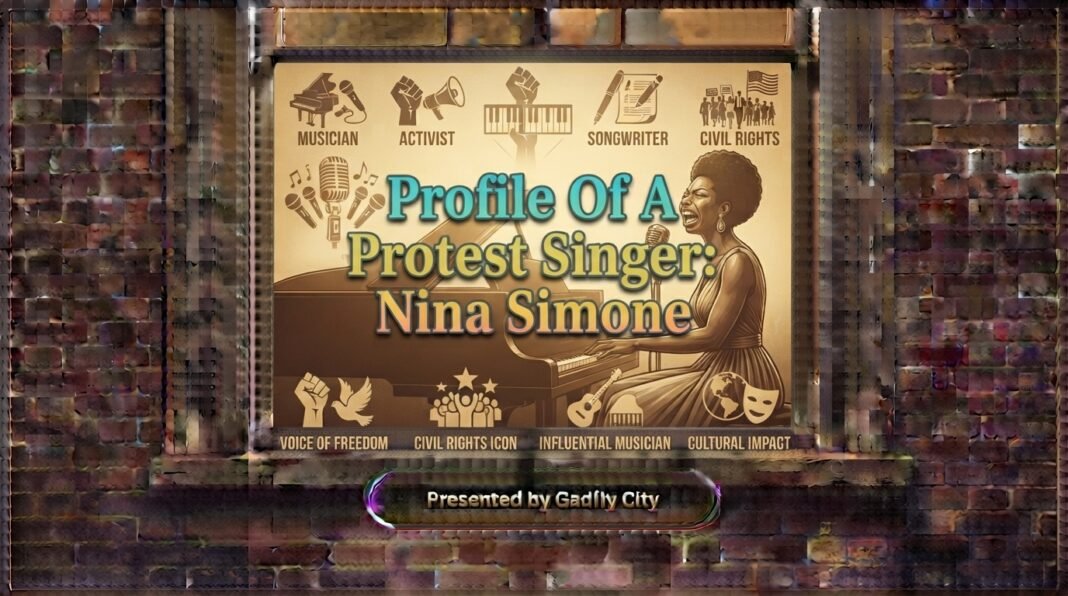
Nina Simone was more than a singer who happened to write political songs. She was a classically trained pianist, songwriter, performer, and activist who gradually transformed her personal experiences with racism into some of the most direct music of the American Civil Rights era. To understand Nina Simone, it helps to look beyond the label of “protest singer” and examine how her musical ambitions, anger, identity, and political convictions became inseparable.
Born Eunice Kathleen Waymon in Tryon, North Carolina, in 1933, Nina Simone initially imagined a very different career. She wanted to become a classical concert pianist. Her early training was serious, and she eventually studied with teachers connected to Philadelphia’s classical music scene. Her experience of pursuing that dream, however, exposed her to racial barriers that would influence the artist she eventually became.
From Classical Pianist To Nina Simone
The story of Nina Simone begins with the piano. As a child, she demonstrated exceptional musical ability and received financial support from people in her community to continue her studies. Her ambition was not initially to become a jazz or soul performer. Classical music was the path she wanted.
That distinction matters because the sophistication of her piano playing remained central to her career. When circumstances pushed her toward performing popular music, she did not abandon her classical foundation. Instead, she combined it with jazz, blues, gospel, folk, soul, and other influences.
According to the Smithsonian’s National Museum of African American History and Culture, Simone believed that she had been denied admission to the Curtis Institute of Music because she was Black. Whether viewed through the specific details of that rejection or the broader racial barriers surrounding classical music, the experience became part of the racial consciousness that shaped her later work.
She eventually began performing in a New Jersey bar to finance her musical studies. It was during this period that Eunice Waymon became Nina Simone. The name helped separate her professional life from her family life, but it soon became attached to an artist with an unmistakable identity.
Why Nina Simone Became A Protest Singer
Nina Simone did not begin her career exclusively as a political musician. Her early recordings included romantic songs, jazz standards, blues, and popular material. Her breakthrough came through music such as “I Loves You, Porgy,” while her debut album Little Girl Blue established her as a distinctive performer.
The transformation came as the political reality around her became impossible to separate from her artistic life.
The early 1960s were marked by violent confrontations over racial equality. The murder of civil rights activist Medgar Evers and the bombing of the Sixteenth Street Baptist Church in Birmingham, which killed four Black girls, deeply affected Simone. These events helped push her toward increasingly direct political songwriting.
This period connects closely with the broader Civil Rights Movement and the leadership of figures such as Martin Luther King Jr. Readers interested in that historical context can also explore Why Was Martin Luther King Jr. Influential? to understand the movement surrounding Simone’s music.
“Mississippi Goddam” And The Sound Of Anger
If one song explains why Nina Simone became such an important protest singer, it is “Mississippi Goddam.”
Written in response to racial violence, including the murder of Medgar Evers and the Birmingham church bombing, the song deliberately rejected the idea that protest music needed to sound gentle or inspirational. Its musical character was surprisingly lively, while its subject was furious.
That contrast was part of its power.
The Library of Congress describes “Mississippi Goddam” as one of the most important songs to emerge from the Civil Rights era. The song addressed racial violence directly rather than hiding behind abstraction, and its controversial title also affected its radio reception. The recording was later selected for the National Recording Registry.
For Nina Simone, the song was not simply an artistic statement. It was a response to events she considered intolerable. She continued changing references in the song during performances as new events unfolded, including references to Selma and the assassination of Martin Luther King Jr.
That practice reveals something important about Simone’s protest music: it was not detached commentary. It was designed to exist inside history as history was happening.
Music As A Form Of Political Identity
The strength of Nina Simone was not limited to anger. Her protest music also explored Black identity, dignity, freedom, grief, and self-definition.
Songs such as “To Be Young, Gifted and Black” became especially important because they shifted the focus from describing oppression toward affirming Black identity. The Library of Congress identifies Simone as one of the musical figures who documented pride, identity, and racism during the Civil Rights era.
The song also reflected Simone’s relationship with writer Lorraine Hansberry, whose work and friendship influenced her political consciousness. In this sense, Nina Simone was not simply singing about political events. She was exploring what it meant to live with race, identity, creativity, and injustice at the same time.
This broader struggle for racial equality can also be understood through the political activism associated with figures such as Jesse Jackson. Our guide on Why Is Jesse Jackson Important provides another perspective on the development of Black political leadership.
Nina Simone Was More Than Her Protest Songs
It can be tempting to reduce Nina Simone to “Mississippi Goddam” and other Civil Rights anthems. That would miss much of what made her distinctive.
She was a musician with an unusually broad vocabulary. Her work moved between jazz, blues, gospel, folk, soul, classical music, and popular song. The Rock & Roll Hall of Fame notes that her genre-spanning approach made her sound difficult to place within a single category.
Her performance style was equally important. She could be intimate and restrained in one moment and forceful in another. Her piano was not merely accompaniment; it often functioned as another voice in the performance.
This combination explains why Nina Simone continues to be discussed as both a musician and an activist. Her politics did not sit separately from her art. They became part of how she interpreted songs, arranged music, and addressed audiences.
The Personal Cost Of Speaking So Directly
Political art can create consequences, and Nina Simone experienced them in her career.
She became increasingly dissatisfied with the music industry and believed that her political activism affected how she was treated commercially. In 1970, she left the United States and spent years living in different countries, including locations in Europe, Africa, and the Caribbean. She eventually returned to the United States in the 1990s in connection with efforts to reclaim royalties.
Her later life therefore complicates the simple image of a triumphant protest singer. Nina Simone was enormously influential, but influence did not make her career easy. Her story includes artistic achievement, political commitment, professional frustration, displacement, and a complicated relationship with the country whose racial history had shaped so much of her music.
Her connection to other Black historical figures also provides useful context. For example, discussions of resistance and liberation surrounding figures such as Harriet Tubman help place Simone within a much longer American tradition of challenging racial oppression. Readers can explore the Harriet Tubman $20 Bill Update (2026) for that broader historical perspective.
Why Nina Simone Still Matters
Nina Simone died in France on April 21, 2003, at the age of 70. Her musical legacy, however, continued to grow. She was inducted into the Rock & Roll Hall of Fame in 2018, recognizing a career that crossed musical categories and connected artistic expression with activism.
Her influence is easier to understand when we stop treating protest music as a separate musical genre. Simone demonstrated that almost any musical form could become political when the artist used it to confront the realities of their time.
That may be the most useful way to understand Nina Simone today. She was not simply a singer who protested. She was an artist who refused to separate music from the world around her.
Frequently Asked Questions About Nina Simone
Was Nina Simone A Protest Singer?
Yes. Nina Simone became one of the most prominent musical voices of the Civil Rights era, particularly through songs addressing racial violence, Black identity, political frustration, and the struggle for racial equality.
What Is Nina Simone Best Known For?
Nina Simone is known for combining exceptional piano playing with jazz, blues, gospel, soul, folk, and classical influences. She is particularly remembered for protest songs such as “Mississippi Goddam” and “To Be Young, Gifted and Black.”
Why Did Nina Simone Write “Mississippi Goddam”?
Nina Simone wrote “Mississippi Goddam” in response to racial violence, including the murder of Medgar Evers and the bombing of the Sixteenth Street Baptist Church in Birmingham that killed four Black girls.
Was Nina Simone Involved In The Civil Rights Movement?
Yes. Nina Simone became closely associated with the Civil Rights Movement and used performances and songwriting to address racial injustice, Black identity, and political change during the 1960s.
What Was Nina Simone’s Original Career Goal?
Before becoming famous as a singer, Nina Simone wanted to become a classical concert pianist. Her classical training remained an important part of her distinctive musical style throughout her later career.
A Lasting Lesson From Nina Simone
The story of Nina Simone leaves us with a simple but difficult idea: art does not always have to make people comfortable.
Sometimes its purpose is to make an experience impossible to ignore.
Simone’s music remains important because she did not treat politics as something outside her artistic identity. She allowed the events around her to change what she played, how she performed, and what she was willing to say. That approach made her work more complicated, but it also made it more honest.
At Gadfly City, we believe history becomes more meaningful when we examine the people behind the familiar names, the decisions behind the movements, and the experiences behind the cultural moments. Explore our wider collection of historical stories and Civil Rights-era figures to understand how individual voices can become part of a much larger history.
Sources And References
- National Museum of African American History and Culture – Nina Simone
- Library of Congress – “Mississippi Goddam”
- Library of Congress – Jazz Singers Exhibition
- Library of Congress – National Recording Registry
- Rock & Roll Hall of Fame – Nina Simone
- Smithsonian Magazine – Nina Simone And The Civil Rights Era
- Library of Congress – Long Black Freedom Struggle Resources