


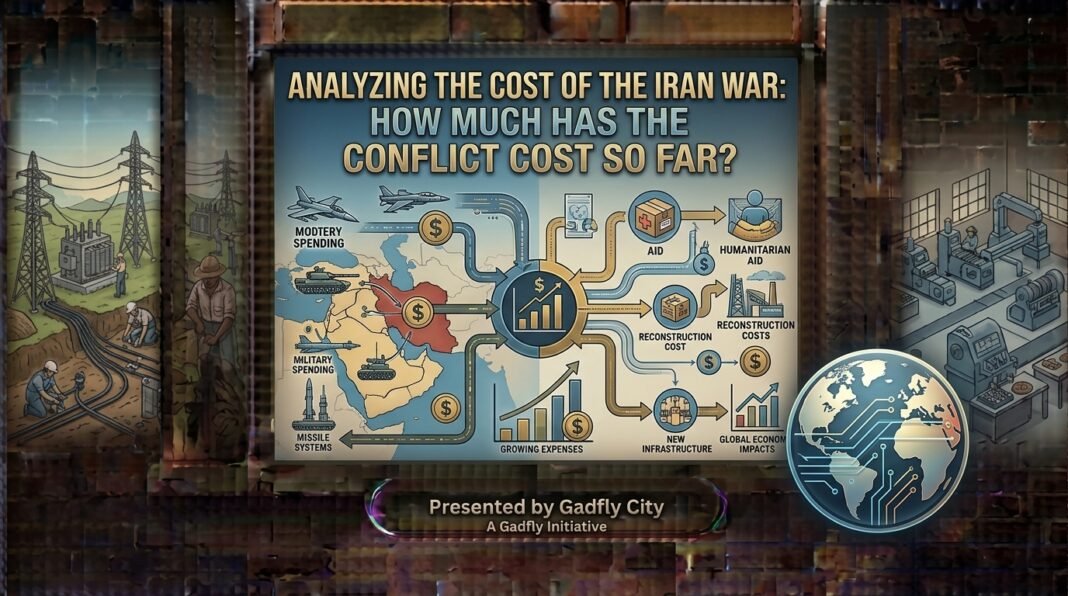
Pentagon figures submitted to Congress show the price tag for the Iran War has climbed to more than $47 billion in projected US military costs as of Oct. 16, 2026. But that means costs of replacing, not money already spent.As Gadfly City examines, understanding the actual financial burden requires separating operational spending, weapons, equipment losses, and wider economic consequences.
Key Takeaways
- The Pentagon estimated the military cost at about $47.1 billion by Oct. 16, 2026.
- Incremental military operating expenses: $11.9 billion.
- Approximately $29 billion is associated with replacing expended ammunition and missiles.
- Another $6.1 billion is estimated for replacing damaged or lost military equipment.
- The estimate does not fully account for damage to US military bases and infrastructure.
- Higher energy prices, inflation, shipping disruptions, and replacement procurement create additional economic costs.
- The headline Iran War Cost should not be confused with actual cash payments already made.
What Is The Actual Iran War Cost So Far?
The most important distinction is between money the US military has already incurred and the estimated cost of replacing everything consumed or damaged during combat.
According to a Pentagon estimate provided to Congress, the Iran War Cost reached approximately $47.1 billion by October 16, 2026. This is the latest detailed figure available in the reporting reviewed for this article.
The breakdown reported by Stars and Stripes is particularly useful:
| Expense Category | Estimated Cost |
| Operational and personnel expenses | $11.9 billion |
| Replacement of expended munitions | $29 billion |
| Replacement of lost or damaged equipment | $6.1 billion |
| Total Estimated Cost | $47.1 billion |
However, these figures need some explanation. The $11.9 billion represents military expenses incurred during the conflict. The $29 billion and $6.1 billion figures represent estimated replacement requirements that remain unfunded.
In other words, the $47.1 billion figure does not mean the US Treasury has already transferred that entire amount to cover the war. It represents a broader financial estimate that combines incurred expenses with the estimated cost of replacing military resources.
That distinction changes how the Iran War Cost should be understood. A government can consume billions of dollars in weapons and equipment today while paying to manufacture and replace them over several years.
Why Was The $40 Billion Iran War Cost Estimate So Important?
The oft-cited $40 billion figure was generated by the Congressional Budget Office (CBO), which released its assessment on September 15, 2026.
By August 1, 2026, the CBO estimated that US military operations against Iran had cost roughly $38 billion. The evaluation took into account munitions expended, equipment losses, additional flying hours, operational costs and higher fuel prices.
The estimate also suggested that continuing operations could cost the Department of Defense another $2 billion to $3 billion per month, depending on the intensity of the fighting.
Congressional Budget Office
This explains why the $40 billion figure became widely discussed. It was a reasonable approximation of the military cost at that particular stage, rather than a final calculation of the entire conflict.
By October 16, the Pentagon’s estimate had increased to $47.1 billion.
There is another important limitation. The CBO explained that the Department of Defense did not respond to its requests for information. Consequently, the agency relied on government databases and public reporting, making its estimate subject to considerable uncertainty.
For readers evaluating the Iran War Cost, the lesson is simple: every estimate needs a date, a definition of included expenses, and an explanation of what remains outside the calculation.
Breaking Down The Major Iran War Military Expenses
1. Direct Military Operations And Personnel
Military operations involve considerably more than launching missiles or conducting airstrikes.
The US must pay for personnel support, aircraft operations, naval deployments, fuel, maintenance, medical services, transportation, and supplies.
The Pentagon’s reported $11.9 billion in incurred expenses includes these operational requirements.
The October estimate put the cost of personnel support, airlift and other Air Force costs at about $7.6 billion. Army costs were around $2 billion and Navy operations and flight costs were roughly $1.4 billion.
Other costs included special operations air lift, transportation support, maintenance and medical services.
These costs are part of why US Spending on Iran War continues despite the decline in the intensity of the combat. It costs a lot of money to keep troops and equipment in the field.
2. Replacement of Arms and Munitions
Ammunition and weapons replacement is the largest component of the reported Iran War Cost.
Some $29 billion is set aside for replacement of used munitions such as missiles, bombs and other weapons.
This is an important financial difference, as military weapons are not reusable in the same way as an aircraft carrier, a transport vehicle or other equipment.
Each missile launched takes away an item from the military inventory. Replacement requires manufacturing capacity, raw materials, specialist labor, testing and transportation.
The financial impact doesn’t end with the purchase price. The use by a military of large numbers of advanced weapons in a short period of time requires balancing immediate operational requirements against future defense commitments.
The Congressional Research Service has examined these concerns in its report on US military operations against Iran and munitions availability.
3. Damage and Losses to Aircraft, Equipment and Infrastructure
The Pentagon estimates that replacing lost or damaged equipment and military platforms will cost about $6.1 billion.
This may include aircraft, radar systems, military vehicles, communications equipment, and other operational assets.
But the cost of replacing equipment is only one side of the financial equation.
Military bases and infrastructure damaged during attacks may require separate assessments, engineering work, reconstruction, and additional security arrangements.
Importantly, the $47.1 billion estimate does not include the full cost of damage to US military facilities across the region. The Pentagon was still assessing those losses when the estimate was reported.
Therefore, the final Iran War Cost could increase even without a major escalation in military operations.
How Much Has The US Actually Spent Versus What It Still Needs?
One of the most confusing aspects of Pentagon War Spending is the difference between incurred costs, replacement requirements, and congressional funding requests.
The figures below illustrate various stages of government spending.
As an example, in June 2026 the Trump administration requested an additional $67.1 billion in funding for the Department of Defense as part of a larger $87.6 billion request for supplemental funds.
It was for funding operational expenses, military readiness, weapon replacement and other defense needs. It was a request for more money, not proof that the government had already spent that much.
The Congressional Research Service has also examined the FY2026 supplemental funding request and military munitions requirements.
The difference can be seen in terms of three financial stages:
- Obligations: Money or things spent already or recorded for military operations.
- Replacement needs: Projected funds needed to replace expended weapons and replace damaged equipment.
- Supplemental appropriations: Requests for additional money from Congress to fund these requirements.
This distinction is important because combining the funding request with the $47.1 billion estimate would give a misleading total. The two figures are for the same purpose and should not be regarded as separate war costs.
Iran War’s Economic Impact Far Beyond Pentagon Spending
Military spending is only one of the financial consequences. The broader Economic Impact of Iran War can affect sectors such as businesses, households, international trade, and government budgets.
1. Energy security and oil prices
The Strait of Hormuz is one of the world’s most important energy transportation routes.
The International Energy Agency estimated in 2025 that around 20 million barrels of crude oil and petroleum products flowed daily through the Strait. That was about a quarter of the world’s oil trade by sea.
When military tensions disrupt shipping through this narrow passage, energy markets react to the possibility of less supply.
The fallout can extend beyond the oil industry. Higher petroleum prices increase the cost of transportation, manufacturing, electricity and distribution.
For a clearer understanding of this exposure, the International Energy Agency’s Strait of Hormuz factsheet explains why disruptions in this region can affect international energy markets.
2. Inflation And Household Expenses
Higher fuel prices are seldom confined to the energy sector.
A delivery company pays more for diesel fuel. An airline has higher jet fuel costs. Higher transportation and production costs for manufacturers.
“Some of these additional costs will eventually be passed on to consumers.”
CBO said the conflict could push up the overall Personal Consumption Expenditures (PCE) inflation rate by 0.5 percentage points in the first quarter of 2027 from its February 2026 forecast.
Energy prices were also estimated to have contributed 2.3 percentage points to the annualized inflation rate in Q2 2026.
These figures indicate the possible impact of the Iran War Cost on households with no direct link to military operations.
Congressional Budget Office
3. Business Operations & International Investment
Energy uncertainty can also impact business decisions.
Companies reliant on overseas shipping, imported parts, or energy-intensive manufacturing or aviation could see costs rise.
Even technology businesses are not completely insulated. Large-scale AI data centers require reliable electricity, cooling infrastructure, equipment, and transportation networks.
Companies might rethink expansion plans, operating budgets, and investment priorities due to unpredictable energy prices.
But not all companies are affected equally. Companies with long-term contracts for energy, or diversified supply chains, may be less exposed than those reliant on volatile spot markets.
How much will the next months of the Iran war cost?
There are three main factors that will determine the future Iran War Cost: the level of military operations, the cost of replacing weapons and the condition of regional infrastructure.
The CBO’s September assessment estimated that relatively low-intensity operations could cost another $2 billion monthly. More intense operations could increase the monthly expense to approximately $3 billion.
These were scenario-based estimates, not guaranteed future spending levels.
There is also a longer term defense consideration. Replacing advanced missiles and other military equipment takes time, not just money. Production capacity, specialized components and testing requirements can all slow replenishment.
The opportunity cost is just as important. The resources devoted to one military operation cannot be devoted at the same time to all other defense requirements.
This is a difficult allocation decision for policymakers. The administration has to balance immediate operational needs with other national security priorities.
The political debate surrounding Trump’s policies and political decisions also illustrates why military spending is not simply a defence department issue. It involves congressional oversight, public accountability, budget priorities, and the long-term management of federal debt.
How to read the real cost of the Iran war
No single number can capture all the financial consequences of a military conflict.
The most reliable way is to separate out direct military costs from the need to replace assets and from wider economic effects.
The Pentagon’s $47.1 billion estimate is a useful starting point, but it is not a complete economic assessment.
The $38 billion CBO estimate is an independent estimate with a different reporting date and methodology. The International Energy Agency also provides context for understanding energy market risks.
These sources should be considered together rather than combined into one headline figure.
It is also important to recognise that the economic consequences of war are not always immediately visible. Equipment shortages, higher borrowing requirements, disrupted trade, and increased production costs can continue long after the most intense military operations have ended.
Ultimately, the real financial question is not simply how much the United States has spent. It is what those resources could otherwise have supported, how quickly military inventories can recover, and whether the strategic outcomes justify the long-term financial burden.
Frequently asked questions about the cost of the Iran war
1. How Much Has The Iran War Cost The US Up To Now?
The Pentagon estimated the cost to the U.S. military at approximately $47.1 billion as of Oct. 16, 2026. This includes operating costs and the estimated cost of replacing spent weapons and damaged equipment.
2. Was it really $47 Billion The U.S. Spent On The Iran War?
Not completely. Of this amount, some $11.9 billion is costs incurred for military operations, and $35.1 billion relates to estimated replacement requirements for unfunded munitions and equipment.
3. Why is the war in Iran so expensive?
The largest costs are replacement missiles and ammunition, aircraft operations, military personnel, naval deployments, transportation, fuel, maintenance and damaged equipment. The largest estimated cost is for weapons replacement.
4. What was the original price tag for the Iran war, $40 billion?
That much-discussed figure came from the CBO’s September 2026 estimate, which said there would be about $38 billion in military costs through August 1. Later Pentagon estimates put the figure at $47.1 billion.
5. Does the Iran War influence oil prices?
Yes. Disruptions in and around the Strait of Hormuz can reduce energy shipments, increase supply uncertainty and raise global oil prices. Higher fuel costs can lead to higher transport, manufacturing and consumer prices.
6. Are damaged US military bases included in the $47.1 billion estimate?
No. The Pentagon’s October 2026 estimate did not account for the full cost of repairing damaged military facilities and infrastructure from Iranian attacks. We were still looking at those expenses.
7. Will the Iran War Bill Keep Climbing?
It might. The financial burden may increase due to military operations, weapons replacement, infrastructure repair, and higher logistical expenses. The actual level will depend on the length and intensity of the conflict.
Final Thoughts: What is the true financial burden
The cost of the Iran War is more than a defense budget calculation It reflects a mix of immediate military costs, future replacement liabilities, economic dislocation and public finance strain.
The $47.1 billion estimate gives a useful picture of the fiscal commitment as of October 2026 but the full economic implications are uncertain.
The lesson for anyone with an interest in international politics and economics is to look beyond the headline figures. Understanding what has already been spent, what still needs to be funded and who ultimately pays the economic price gives a much clearer picture of the real cost of conflict.
At Gadfly City, we believe informed discussions begin with transparent numbers, reliable sources, and the willingness to examine different perspectives. We continue to explore the political and economic decisions shaping the world so readers can understand not only what is happening, but why it matters.
Sources And References
- Congressional Budget Office – Estimating the Cost of Combat Operations Against Iran
- Stars and Stripes – Pentagon Puts Cost of Iran War at $47 Billion
- Congressional Research Service – US Conflict With Iran
- Congressional Research Service – US Military Operations Against Iran: Munitions and Missile Defense
- International Energy Agency – Strait of Hormuz
- Center for Strategic and International Studies – The War May Be Ending. What Did Epic Fury Cost?
- US Senate Budget Committee – CBO Report on Iran War Costs
- Reuters – US Costs of Iran War Rise to Over $47 Billion