

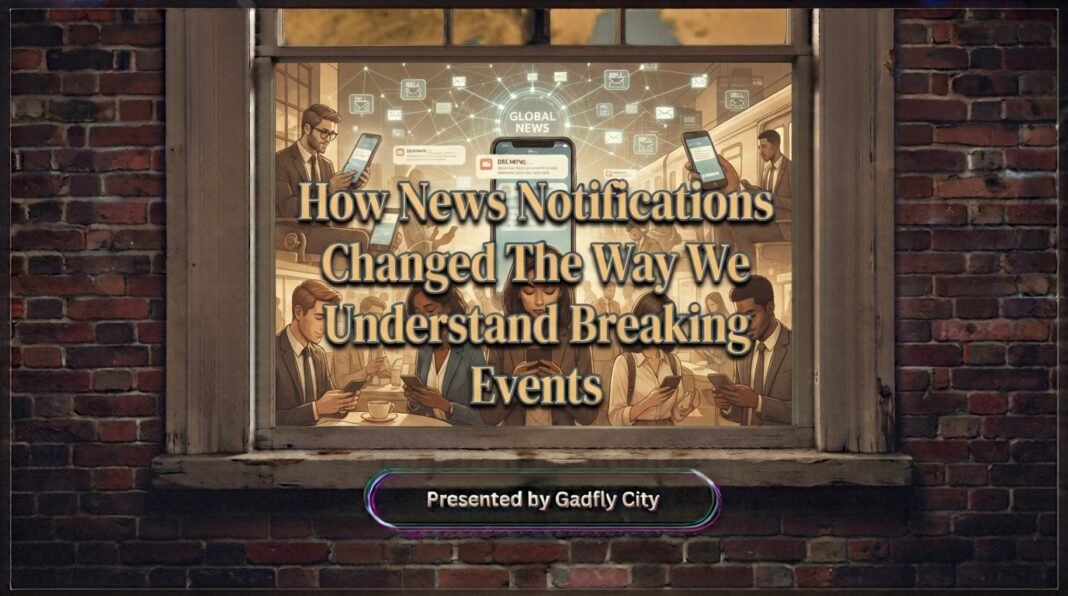
When a major event happens, news notifications can reach us before we have even opened a news website. A short alert can tell us that an earthquake has struck, a government has announced a major decision, or a conflict has suddenly escalated. This speed has changed not only how quickly we receive breaking news, but also how we begin to understand it.
The important distinction is that receiving information quickly is not the same as understanding it completely. A notification is usually designed to tell us that something happened, not to explain why it happened, what happened before it, or what may happen next. That difference sits at the heart of modern news consumption.
From Scheduled News To Constant Updates
For much of the broadcast era, people encountered news at particular moments: a newspaper arrived in the morning, a television bulletin aired in the evening, or a radio programme interrupted regular programming for an important development.
Smartphones changed that rhythm. News no longer has to wait for a programme or publication cycle. A publisher can send an update directly to a person’s lock screen whenever editors consider an event important.
The Reuters Institute’s 2025 Digital News Report describes mobile notifications as one of several increasingly important gateways to news, alongside search, social media, and aggregators. It also notes that news alerts have become particularly important in countries where smartphones are a dominant route to the internet. Reuters Institute’s Digital News Report 2025 provides broader context on this shift.
This creates a different relationship with the news. Instead of asking, “What is in today’s newspaper?”, we increasingly ask, “What just happened?”
The Speed Versus Context Problem
A notification has a difficult job. It must communicate something meaningful in very few words.
Imagine an alert saying that a country’s central bank has changed interest rates. The notification may be accurate, but it cannot easily explain the previous rate, the economic reasoning behind the decision, its possible effects on borrowing, or what economists disagree about.
The same problem appears during geopolitical crises. An alert about an attack, military movement, or diplomatic statement may describe a new development without explaining the history that led to it.
For example, readers interested in economic developments may encounter a notification about rising prices and then look for broader explanations such as why inflation makes your paycheck feel smaller. A notification can begin the journey; context is what helps complete it.
This is why speed and understanding should not be treated as the same thing. The first alert may be useful precisely because it is fast. The later article, official document, interview, or analysis may be useful because it adds context.
When Notification Overload Changes Attention
The second major change is volume.
One news alert may be useful. Several alerts from different applications can become difficult to distinguish. A phone may simultaneously deliver breaking news, sports updates, political developments, financial headlines, weather warnings, and social-media activity.
The Reuters Institute reported in 2025 that many people have either never received news alerts or have disabled them, with some respondents saying alerts were too numerous, distracting, or irrelevant. The researchers describe this as a balancing problem for publishers: alerts can keep audiences informed, but excessive alerts can encourage people to turn them off.
This does not mean that every notification is harmful. It means that attention is limited.
The practical question therefore becomes: Which information deserves immediate attention, and which information can wait?
That question is particularly important during a major crisis, when dozens of updates may describe the same developing situation from slightly different angles.
Breaking News Is Often An Incomplete Story
Breaking news has another characteristic that is easy to forget: the first version of an event may not be the final version.
Early reports can change as journalists receive official statements, speak with witnesses, inspect documents, or confirm visual material. A developing story may therefore contain uncertainty that becomes clearer later.
Professional news organisations build verification into this process. The Associated Press, for example, describes using documents, on-the-record sources, metadata, location information, reverse-image searches, and other methods to authenticate information and user-generated material. Its verification process also continues as stories develop. AP’s verification practices explain why verification can take place across multiple stages rather than at one single moment.
For readers, the lesson is simple: an early notification should often be treated as an opening update rather than a complete account.
Social Media Adds Another Layer
News notifications do not operate alone. Social platforms have become major gateways through which people encounter information.
The Reuters Institute’s 2025 research found that online news consumption is increasingly fragmented across social and video platforms, with Facebook, YouTube, Instagram, TikTok, X, and other networks playing different roles across markets.
This creates a subtle problem.
A notification from a newsroom usually represents an editorial decision. A social-media post may represent an individual’s observation, interpretation, reaction, or speculation. Both can appear on the same screen within seconds.
That makes the source more important than the speed of the message.
A dramatic post may receive widespread attention before its underlying claim has been independently established. UNESCO’s guidance on journalism and disinformation emphasises media and information literacy, fact-checking, and social-media verification as important parts of navigating this environment. UNESCO’s journalism and disinformation handbook offers a useful framework for understanding these verification challenges.
Confirmation Bias Can Make A Fast Story Feel Complete
Another challenge is confirmation bias: the tendency to give greater attention or credibility to information that fits what we already believe.
This matters because breaking news often arrives without enough context to challenge our assumptions.
Suppose someone already has a strong opinion about a country, political group, company, or economic policy. A short notification that appears to support that opinion may feel immediately convincing. The person may then share it or search for commentary that reinforces the initial interpretation.
The problem is not necessarily the notification itself. The problem is stopping at the first interpretation.
A more reliable habit is to ask: What do I know, what do I not know, and what would I need to verify before reaching a conclusion?
This distinction becomes especially important with high-stakes stories such as those discussed in what would happen if the U.S. economy collapsed, where hypothetical scenarios can easily be confused with actual events.
A Better Way To Consume Breaking News
The goal does not have to be avoiding news notifications altogether. A more practical approach is to give different stages of information different levels of attention.
Step 1: Read The Alert Literally
Start with what the notification actually says.
Do not automatically add assumptions about motive, consequences, responsibility, or future developments.
Step 2: Open The Full Story
If the event matters to you, read beyond the notification. Look for the date, location, named sources, confirmed facts, and any indication that the story is still developing.
Step 3: Check Another Reliable Source
For significant claims, compare reporting from another established source or check the relevant official institution.
This does not mean every story requires an hour of research. The amount of verification should match the importance of the claim.
Step 4: Separate Facts From Interpretation
Ask which parts describe what happened and which parts explain what someone thinks the event means.
That distinction becomes particularly useful with geopolitical stories. For example, an article discussing whether the U.S. could beat Iran in a war deals with a complex hypothetical question, while a notification about a specific military event would concern a particular factual development. Keeping those categories separate prevents analysis from being mistaken for established fact.
Step 5: Wait When The Story Is Still Developing
Sometimes the most useful action is simply to wait for additional verified information.
A developing story can become clearer as eyewitness accounts, official statements, documents, photographs, and independent reporting become available.
The Future Of News Notifications
News notifications are likely to remain part of digital news consumption because they solve a genuine problem: people cannot continuously monitor every event in the world.
But the technology also creates a new responsibility for readers. Faster information requires better habits for judging context, source quality, uncertainty, and relevance.
The Reuters Institute’s recent research captures this tension well: notifications can create a direct connection between publishers and audiences, while excessive or irrelevant alerts can lead people to disengage from them.
The deeper change is therefore not simply that news became faster. News became more continuous.
That changes how we encounter events. We may see the first sentence before we understand the story, the reaction before the evidence, and the interpretation before the context.
The healthiest response is not to reject speed or to trust it blindly. It is to understand what speed can give us, and what it cannot.
Frequently Asked Questions
What Are News Notifications?
News notifications are alerts sent by news apps, publishers, or aggregators to inform users about new or developing stories. They can provide immediate updates about breaking events but usually offer limited context.
How Have News Notifications Changed News Consumption?
News notifications have shifted news consumption from scheduled updates toward continuous access. Instead of actively visiting a news source at a particular time, readers can encounter developments throughout the day.
Why Can Breaking News Lack Context?
Breaking news develops while journalists are still gathering information. Early reports may contain confirmed facts but lack historical background, independent verification, or a complete explanation of what caused an event.
What Is Notification Overload?
Notification overload occurs when people receive more alerts than they can reasonably process or consider relevant. In news consumption, excessive alerts can make important updates harder to distinguish from routine information.
How Can Readers Verify Breaking News?
Readers can open the full report, identify its sources, compare significant claims with another reliable source, check official information, and distinguish confirmed facts from commentary or speculation.
Does Social Media Make Breaking News Faster?
Social media can make information circulate extremely quickly because eyewitnesses, journalists, organisations, and ordinary users can publish simultaneously. However, speed of circulation does not establish whether a claim is accurate.
Follow Gadfly City For Context Beyond The Headline
At Gadfly City, we believe understanding an event requires more than seeing the first headline or notification. We aim to provide clear explanations that connect current events with the economic, historical, social, and geopolitical context behind them.
Our goal is simple: help readers slow down when necessary, ask better questions, and understand the story beyond the first few seconds of attention. Explore more analysis from Gadfly City and follow the context behind the headlines, not just the alerts.