


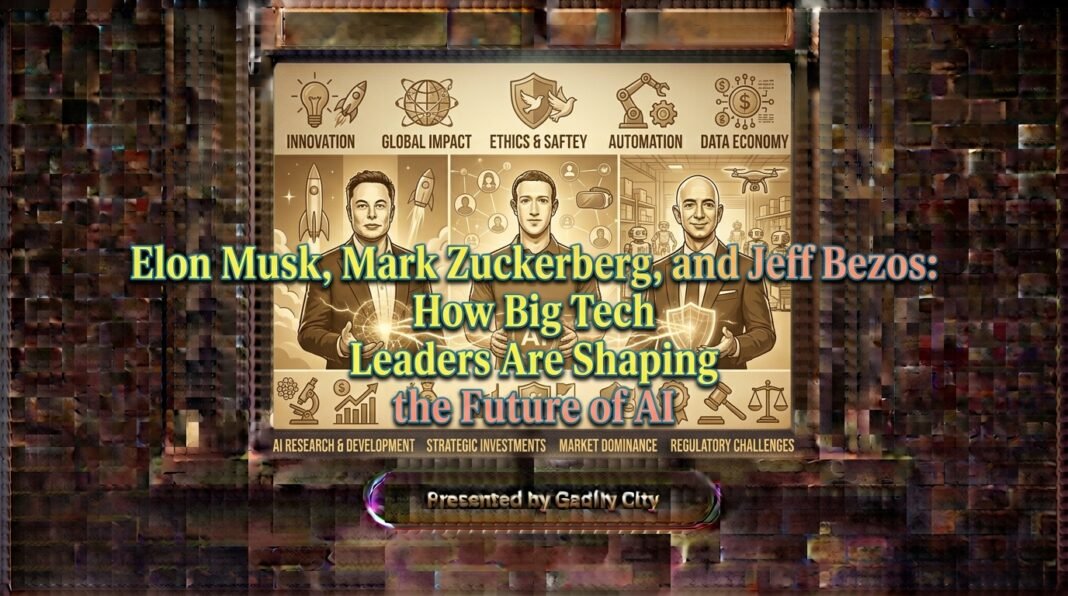
The Future of AI is being shaped by technology leaders who control enormous computing resources, digital platforms, and investment budgets. Elon Musk is pursuing AI-powered robotics and autonomous systems, Mark Zuckerberg is expanding AI across social platforms, and Jeff Bezos has influenced the industry through Amazon’s technology ecosystem and long-term investment in innovation. Their decisions will affect how people work, businesses compete, and society manages emerging risks.
How Three Technology Leaders Are Shaping the Future of AI
Artificial intelligence is no longer limited to research laboratories or experimental software. It is becoming part of everyday communication, business operations, transportation, and online services.
The 2026 AI Index Report from Stanford University’s Institute for Human-Centered Artificial Intelligence highlights the scale of this transition. Global corporate AI investment more than doubled in 2025, while AI adoption continued to expand across organizations.
Against this background, Musk, Zuckerberg, and Bezos offer three useful perspectives on the Future of AI: building intelligent machines, integrating AI into existing digital ecosystems, and developing the infrastructure required to deliver AI at scale.
Their approaches differ, but all three illustrate an important principle: AI’s influence depends not only on how intelligent a system becomes, but also on where it is deployed and who controls access to it.
1. Elon Musk: Bringing AI Into the Physical World
Elon Musk’s approach to AI extends beyond conversational assistants and digital productivity tools. Through Tesla, his companies are developing technologies associated with autonomous driving, robotics, and machine intelligence operating in physical environments.
Tesla’s official AI and Robotics overview describes its work on autonomous vehicles and the Optimus humanoid robot.
From Software Intelligence to Autonomous Machines
Traditional software primarily processes information on computers and mobile devices. Physical AI must also interpret its surroundings, make decisions under changing conditions, and interact with the real world.
For example, a robot working in a warehouse must recognize objects, navigate obstacles, and perform tasks safely. An autonomous vehicle must interpret road conditions and respond appropriately to other road users.
These applications illustrate one possible direction for the Future of AI: systems that do more than generate information and instead perform physical tasks.
However, technical progress does not automatically translate into reliable deployment. Safety testing, hardware costs, regulatory approval, and performance in unpredictable environments remain important considerations.
What Musk’s Approach Could Mean for Workers
If autonomous systems become sufficiently reliable and affordable, businesses could automate certain repetitive or hazardous tasks. This might improve productivity and reduce some workplace risks.
The outcome for workers is less straightforward. Automation could eliminate particular tasks while creating demand for technicians, engineers, supervisors, and other specialized roles.
The central question is not simply whether robots can perform human tasks. It is whether businesses can deploy them economically and how workers and communities adapt to the resulting changes.
2. Mark Zuckerberg: Making AI Part of Everyday Digital Life
Mark Zuckerberg’s strategy focuses heavily on integrating AI into the digital platforms people already use.
Through Meta, AI development connects with Facebook, Instagram, WhatsApp, digital advertising, and AI-powered assistants. This gives Meta opportunities to distribute AI features through established services rather than requiring users to adopt entirely new platforms.
Meta’s official AI announcements also highlight its efforts to bring AI tools to businesses and developers.
Why Distribution Matters as Much as Intelligence
Consider two AI products with similar capabilities. One requires users to create a new account and learn a separate interface. The other is available within an application they already use daily.
The second product may reach more people simply because accessing it requires less effort.
This is an important factor in the Future of AI. Better technology matters, but distribution, convenience, and integration can determine whether people actually use it.
Meta’s approach could make AI assistants more accessible for communication, content creation, customer support, and business activities.
The Trade-Off Between Convenience and Privacy
Integrating AI into social platforms also raises questions about personal information, data handling, and the influence of automated recommendations.
An assistant becomes more useful when it understands a user’s needs. However, personalization must be balanced against meaningful privacy protections and informed consent.
Businesses and individuals should therefore evaluate not only what an AI assistant can do, but also what information it accesses, how that information is used, and what controls users have.
This balance will influence whether people trust AI enough to make it part of their daily lives.
3. Jeff Bezos: The Infrastructure Behind the Future of AI
Jeff Bezos’s influence on the Future of AI requires a distinction: he founded Amazon, but he is not its current chief executive. Andy Jassy leads Amazon, while Bezos’s broader legacy includes helping establish the cloud computing ecosystem through which many modern AI services operate.
Amazon Web Services (AWS) provides computing infrastructure, storage, and AI development services to businesses and developers.
According to Amazon’s official overview of its AI work, the company applies AI across customer experiences, cloud services, and warehouse operations.
Why Computing Infrastructure Matters
Advanced AI requires substantial computing power, specialized chips, data storage, and reliable electricity. Developing a model is only one part of the process; operating it for millions of users requires infrastructure that can handle demand consistently.
Cloud computing allows businesses to access computing resources without building every part of that infrastructure themselves.
This can lower the barrier to experimenting with AI, particularly for companies that lack the capital or technical resources to establish their own large-scale computing facilities.
However, infrastructure is expensive. Companies must balance the cost of chips, electricity, and data centers against the revenue or productivity improvements their AI services generate.
These investments also connect to broader economic questions, including economic shifts caused by rapid technological development.
Why Bezos’s Legacy Still Matters
Amazon’s cloud business demonstrates how infrastructure can influence an entire technology industry.
A startup may develop a useful AI application without owning a data center or designing its own chips. Instead, it can rent computing capacity and pay for the resources it uses.
This model supports experimentation, but it also creates dependencies on infrastructure providers.
Consequently, the Future of AI will be influenced not only by the companies developing models, but also by those controlling the computing resources needed to train and operate them.
Comparing Their Approaches to the Future of AI
Although their interests overlap, these three technology leaders illustrate different ways of building influence in the AI economy.
| Technology Leader | Primary Area Of Influence | Potential Impact |
| Elon Musk | Robotics, autonomous systems, and physical AI | Automation of physical tasks and transportation |
| Mark Zuckerberg | Social platforms, AI assistants, and digital services | Wider access to AI-powered communication and business tools |
| Jeff Bezos | Amazon’s technology legacy and cloud computing ecosystem | Infrastructure that enables businesses to develop and operate AI |
These categories are not exclusive. Their companies operate across multiple technology areas, and their strategies can change as the market develops.
The comparison nevertheless reveals a useful distinction: AI development, AI distribution, and AI infrastructure are interconnected, but each creates different opportunities and risks.
The Biggest Challenges Facing AI Development
The Future of AI will depend on more than technological breakthroughs. Three challenges deserve particular attention.
1. Job Displacement And Economic Adjustment
AI can help employees complete tasks faster, but automation may also reduce demand for certain types of work.
The overall economic effect will depend on how quickly businesses adopt the technology, whether new roles emerge, and how effectively workers can retrain.
For households, these changes may influence wages, employment opportunities, and purchasing power. Understanding broader consumer economic impacts can help place technological change within the larger financial picture.
2. Energy Demand And Infrastructure Costs
Training and operating AI systems requires computing resources, and large data centers need substantial electricity and cooling capacity.
As demand grows, companies must consider energy availability, operating costs, and the environmental consequences of their infrastructure decisions.
Global supply chains also matter because advanced computing depends on semiconductor manufacturing, equipment, and international trade. These dependencies connect AI expansion with wider geopolitical dynamics in global infrastructure.
3. Accountability And Regulation
AI systems can produce inaccurate information, reinforce existing biases, or make consequential decisions without sufficient transparency.
Companies therefore need processes for testing, monitoring, and correcting their systems. Governments must also consider how existing laws apply and where additional protections may be necessary.
The goal should be to support useful innovation without treating commercial success as a substitute for public accountability.
What The Future Of AI Means For Businesses And Individuals
For businesses, the most practical approach is to identify specific problems AI can solve rather than adopting tools simply because competitors are doing so.
A company might use AI to summarize customer inquiries, analyze documents, or assist employees with repetitive administrative work. Each application should be evaluated against its costs, accuracy, security requirements, and measurable results.
Individuals can take a similar approach by learning how AI tools work, checking important outputs, and developing skills that complement automation.
The Future of AI will not be determined by technology leaders alone. Employees, consumers, researchers, policymakers, and smaller businesses will influence how these systems are used and which applications succeed.
Ultimately, Musk’s robotics ambitions, Zuckerberg’s digital distribution strategy, and the infrastructure associated with Bezos’s business legacy reveal different parts of the same transformation.
The most important question is not which billionaire will win the AI race. It is whether the resulting technology will create lasting value, distribute its benefits fairly, and remain accountable to the people who depend on it.
Frequently Asked Questions
1. How Are Elon Musk, Mark Zuckerberg, And Jeff Bezos Influencing The Future Of AI?
Musk focuses on robotics and autonomous systems, Zuckerberg integrates AI into digital platforms, and Bezos’s legacy includes Amazon’s cloud computing ecosystem. Their respective areas of influence help shape AI development, accessibility, and infrastructure.
2. Who Is Leading The Future Of AI?
No single technology leader controls the entire AI industry. Progress depends on researchers, technology companies, infrastructure providers, startups, governments, and users who influence how AI systems are developed and adopted.
3. How Could AI Affect Jobs In The United States?
AI could automate repetitive tasks, improve productivity, and create demand for new technical skills. Its overall employment impact will depend on adoption rates, business decisions, workforce training, and the emergence of new occupations.
4. Why Is Cloud Computing Important For AI Development?
Cloud computing gives businesses access to computing power, storage, and AI tools without requiring them to build extensive infrastructure. This can reduce initial costs and help organizations develop and deploy AI applications more efficiently.
5. What Are The Biggest Risks Associated With The Future Of AI?
Major risks include privacy violations, inaccurate outputs, biased decisions, job displacement, cybersecurity threats, and concentrated technological power. Effective safeguards, transparent practices, and appropriate regulation can help address these challenges.
Final Thoughts: Building A Future Where AI Serves People
At Gadfly City, we believe understanding technological change requires looking beyond bold predictions and headline-making investments. By examining the business decisions, economic consequences, and public responsibilities behind AI, we can make better-informed judgments about what comes next. Explore more insights from Gadfly City to understand how technology, business, and economic developments may shape the opportunities and challenges ahead.
Sources And References
- Stanford HAI – 2026 AI Index Report: Economy
- Stanford HAI – 2026 AI Index Report
- Tesla – Official AI And Robotics Overview
- Meta – Launching Meta Enterprise Platform
- Meta – The Biggest News From Connect 2026
- Amazon – Artificial Intelligence: Official Overview
- Amazon – CEO Andy Jassy’s 2025 Letter To Shareholders