


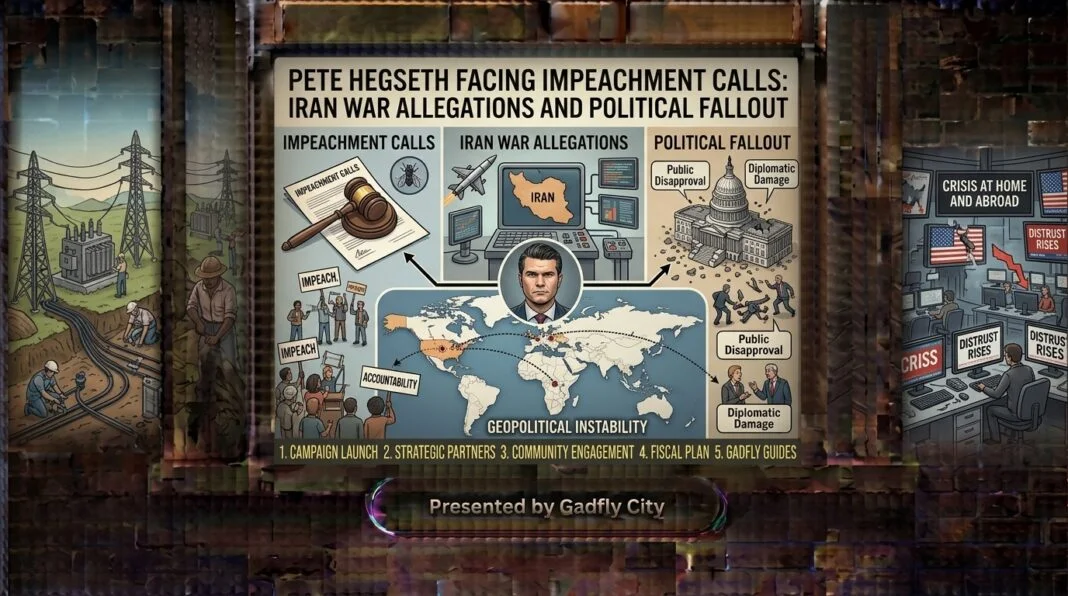
The Pete Hegseth impeachment controversy intensified in November 2026 after Republican Representative Thomas Massie introduced eight articles of impeachment against the Defense Secretary over his handling of the Iran war and other military actions. The move has created fresh pressure on the Trump administration, raising questions about executive authority, military accountability, and the future of Pentagon leadership, as covered by Gadfly City.
Important Takeaways
- Thomas Massie introduced eight articles of impeachment targeting Pete Hegseth.
- The allegations concern mostly the Iran war, congressional authorization, protection of civilians and military accountability.
- Other Democrats, including Hakeem Jeffries, have said they support impeachment.
- The Trump administration has defended Hegseth and called the impeachment effort political.
- Even if the House votes to impeach, it would not automatically remove Hegseth from his position.
- The controversy could damage public confidence in the administration and shape political debates after the 2026 midterm elections.
Why Is Pete Hegseth Being Impeached?
The latest bid to impeach Pete Hegseth is from Republican Representative Thomas Massie of Kentucky. Massie re-introduced eight articles of impeachment on November 9, 2026, charging that Hegseth’s conduct as Secretary of Defense had crossed constitutional and legal boundaries.
This is significant because Massie is not a Democratic foe of the Trump administration. A Republican, he has frequently clashed with the president over questions of executive power and military policy.
The resolution accuses Hegseth of high crimes and misdemeanors in his conduct of military operations in Iran, Yemen, Venezuela and the Caribbean. It also raises questions about civilian protection, congressional oversight and treatment of political critics.
Massie’s main point is that a Defense Secretary can’t just follow presidential orders in executing actions that might violate federal law or constitutional limits. Whether the charges can be proved, however, is another matter altogether. The resolution, however, has turned an active debate over Pentagon leadership into a direct political challenge.
Massie said in a Nov. 9 announcement that the proposed impeachment vote could be forced within two legislative days. That shifts the immediate focus to the House of Representatives rather than an eventual trial in the Senate.
Pete Hegseth Iran Allegations: What is the controversy?
The most important aspect of the Pete Hegseth impeachment accusations is the American military operation against Iran. The fighting started in February 2026 and has continued since . This has led to a fight between the White House and Congress over who has the power to authorize long term military actions .
“Hegseth helped prosecute and sustain a war without proper congressional authorization,” Massie argues. His resolution says it cites three specific alleged violations of the War Powers Resolution of 1973.
1. Military action without authorization from Congress
The U.S. Constitution grants Congress the power to declare war. The president is commander-in-chief of the armed forces. The War Powers Resolution of 1973 attempts to establish some limits on these duties .
Massie says the campaign against Iran was launched without a declaration of war, specific congressional authorization or an imminent attack that would justify the administration’s actions under the circumstances described in the resolution.
Nor is it simply a matter of whether the military campaign was strategically successful. It’s about whether the executive branch followed the legal process required for prolonged military engagement.
2. Extending The Iran War Past Legal Deadlines
The War Powers Resolution generally requires the president to terminate certain military deployments within 60 days unless Congress has authorized them to continue, with a possible 30-day withdrawal period.
The administration “continued military operations beyond these deadlines without meeting the conditions,” Massie says. He also points to a congressional resolution for withdrawal of US forces from the conflict.
These are three of the eight articles of impeachment. However, administrations have questioned the application and constitutionality of particular War Powers provisions over time, so the allegations should not be taken as settled legal conclusions.
3. civilian casualties & military accountability
Another big part of the Pete Hegseth impeachment controversy is civilian casualties during the Iran campaign.
In the early phase of the war, Massie’s resolution points to a strike on an elementary school in Minab, Iran. The strike reportedly killed more than 200 civilians, including children, raising serious questions about targeting decisions and the protection of non-combatants.
The resolution says Hegseth weakened or ignored Pentagon safeguards designed to minimize civilian casualties.
That’s an important charge because military effectiveness and legal accountability are not synonymous. Even if a military operation achieves its immediate objective, it can still raise questions about how targets were chosen, what intelligence was used, and if reasonable steps were taken to safeguard civilians.
The Pentagon’s Law of War Manual discusses the principles of distinction, proportionality and feasible precautions. These principles provide an important framework for assessing military conduct, but an allegation of wrongdoing is not itself proof that a violation has occurred.
What are the eight impeachment articles against Hegseth?
The eight articles are not limited to the conflict in Iran. They are looking to see Hegseth’s larger use of power as the nation’s top defense official.
| Story | Principal Claim |
| I | Iran, fighting without proper authorization |
| II | Iran continues operations despite pull-out instructions from Congress |
| III | Extending hostilities beyond War Powers deadlines |
| IV | Disregarding laws meant to reduce civilian casualties |
| V | Extra-judicial killings in Military Operations against suspected drug-smuggling vessels |
| VI | Silencing protected speech by Senator Mark Kelly; |
| VII | Illegal participation in the capture of Nicolás Maduro |
| VIII | conducting military operations in Yemen without adequate authorization |
These are allegations in Massie’s resolution, not eight proven charges. They vary widely in legal force and political implications.
The allegations of the boat-strike, for example, involve the use of lethal military force against suspected drug traffickers including allegations that survivors were attacked and rescue obligations ignored. The resolution also accuses Hegseth of abusing his Pentagon authority against Sen. Mark Kelly after the senator publicly discussed the obligation of service members to disobey unlawful orders.
The Venezuela allegation concerns the US operation to capture former President Nicolás Maduro and Cilia Flores. Massie questions the constitutional and legal basis of that operation.
The combined charges mean the campaign to impeach Pete Hegseth is more than a difference of opinion about a military campaign. They ask about the power a Defense Secretary should wield, and where accountability begins when presidential policy is challenged.
Political Reactions: Democrats, Republicans, And The Trump Administration
The impeachment debate of Pete Hegseth has exposed rifts that cross party lines. Democrats have generally praised the plan, while Republicans have reacted with more ambivalence.
Democrats Back Stronger Accountability
Democratic lawmakers say the Defense Secretary has to answer for decisions made by the military, especially decisions involving Iran and civilian casualties.
House Democratic Leader Hakeem Jeffries has publicly supported impeachment, saying he’s personally firmly in favor of removing Hegseth. His position indicates Democrats plan to prioritize Pentagon oversight on their congressional agenda.
Readers following the wider political debate can also explore Hakeem Jeffries’ leadership and political ideas, particularly his approach to congressional accountability and Democratic Party strategy.
The Democratic position is also connected to a broader argument about the legislative branch’s responsibility to keep presidential power in check. With the new control of Congress, they will have more chances to investigate executive actions and demand answers from top administration officials.
Republicans face an awkward choice
But the Republicans have it harder.
Supporting impeachment might mean publicly disagreeing with a Defense Secretary chosen by their own president. Voters who believe Congress should exercise stronger oversight of military operations might criticize them for opposing it.
The position of Rep. Massie has brought the disagreement into sharp relief. The effort has drawn opposition from House Speaker Mike Johnson and other GOP leaders. Some Republican lawmakers have raised concerns about Hegseth’s leadership and the administration’s explanation of the Iran conflict.
The split is a microcosm of a bigger question for Republicans: Should loyalty to the president trump independent judgment in Congress?
The changing relationship between the parties is also worth examining through the debate over Democratic control of Congress. The 2026 election results have made congressional oversight a much more immediate issue for the White House.
Trump’s Reply, and Support for Hegseth
President Donald Trump has defended Hegseth and said he plans to stick by him even if the House approves impeachment.
Trump has said military operations under the administration have been successful and that Hegseth’s critics overlook the accomplishments of American service members.
Meanwhile, Hegseth has dismissed the impeachment push as politically motivated. He has said he is ready to fight for his record and stay to run the Pentagon.
The administration’s stance matters, too, because the battle over impeaching Pete Hegseth could become a test of Trump’s ability to hold political support for controversial appointments.
For additional context, readers can follow Trump’s political and legal controversies, which illustrate how disputes involving executive authority can become wider political battles.
What Impact Could Pete Hegseth Impeachment Have On The Trump Administration?
The implications of the Pete Hegseth impeachment effort could go beyond the Defense Secretary’s own job.
If the House doesn’t impeach him, the controversy could still cause some headaches for the administration.
1. Pressure on the Big Shots in the Pentagon
The Defense Secretary is in charge of military operations, runs the Department of Defense, and talks about national security priorities.
Debates over impeachment can erode public confidence in such leadership, especially when the charges relate to the legality of military action and the protection of civilians.
It might also sow confusion among the military and senior officials about the administration’s long-term course.
2. Increased Congressional Oversight
With a Democratic Congress coming in, the new Congress could hold hearings and investigations, issue document requests and other oversight powers to look into the Pentagon’s decisions.
That means the Pete Hegseth impeachment scandal could go on even if the immediate House resolution fails.
A change in control of Congress does not, by itself, prove any wrongdoing. But it shifts the political atmosphere in which the administration has to justify its choices.
3. Financial And Economic Strain
The Iran conflict is a lot more than a military strategy. American households and businesses can be affected by higher oil prices, disruptions to shipping, and uncertainty in international markets.
The link between military spending and domestic economic priorities could become a major political issue.
For readers interested in this dimension, the cost of the Iran war provides additional context about the financial implications of prolonged military engagement.
In the end, the administration may have to explain not only its military decisions, but how those decisions serve American interests.
Why Timing Matters: The 2026 Midterms
This is especially important given the timing of the Pete Hegseth impeachment effort.
Republicans were handed a crushing defeat in the midterm elections on November 3, 2026, as Democrats retook control of both the House and Senate. Voter dissatisfaction with inflation, the cost of living and the administration’s policy on Iran helped bring about the political change.
In the Associated Press Voter Poll, about seven in 10 voters said Congress was not doing enough to put checks and balances on presidential power.
That finding matters because the Hegseth controversy directly implicates the relationship between executive authority and congressional oversight.
Will the controversy influence future political debate?
The Pete Hegseth impeachment debate could transform how both parties view national security and executive accountability.
The controversy gives Democrats a chance to show that with the majority in Congress comes the responsibility to investigate decisions made by the government.
For Republicans, it puts pressure on them to explain why they voted for the administration’s military strategy and whether they think the Pentagon followed the law.
The issue also could affect future presidential debates on military intervention, congressional authorization and the economic fallout of foreign wars.
But it is unlikely voters will judge the administration on impeachment alone. Inflation, jobs, national security, health care and the ability of the government to keep its promises will also color their views.
This is where the wider political environment matters. The history of the Fall of the Berlin Wall offers a reminder that major political changes are rarely explained by one event. Public confidence, institutional credibility, and changing expectations often develop together.
Can you impeach Pete Hegseth?
One big difference: Impeachment doesn’t automatically lead to removal from office.
The US Senate’s official explanation of impeachment says the House of Representatives has the power to adopt articles of impeachment by a simple majority vote.
If the House votes to approve the articles it goes to the Senate for a trial.
Then the Senate must vote two-thirds of those present to convict the official. If convicted, the official must forfeit his office and may be disqualified from holding future federal office.
| Level | Require | Possible Results |
| Vote House | Plurality ( simple majority ) | Approval or disapproval of impeachment |
| Senate impeachment trial | Two-Thirds Majority Conviction | Dismissal or acquittal from office |
| Post-Conviction | Constitutional Implications | Potential Disqualification From Federal Office |
The National Archives’ Constitution transcript explains the constitutional foundation of this process.
Hegseth’s immediate task is to find enough votes in the House to stave off impeachment. That would still be tough to get through the Senate with its high two-thirds requirement.
This is why the push to impeach Pete Hegseth must be understood as both a constitutional process and a political fight. A vote in the House could hurt his standing and a conviction in the Senate would require a much broader consensus.
What’s Next in the Pete Hegseth Impeachment Saga?
As of November 10, 2026, a House vote is expected in the next two legislative days. How the endgame plays out is still unclear, with Republican lawmakers facing a choice of whether to support the resolution, oppose it or try to block it through procedural means.
The Trump administration is also gearing up to publicly defend Hegseth’s leadership. He is due to brief reporters at the Pentagon, and it could be an opportunity for him to answer questions about the Iran conflict and the charges Massie has raised.
3 things to watch:
- House vote: Can enough Republicans join Democrats to vote the articles of impeachment through?
- What the administration is saying: Trump’s continued support for Hegseth or leadership change.
- Congressional Investigations: Will the incoming Democratic majority continue probing military operations and Pentagon leadership?
The short term effect will be important but the longer term impact could be more significant. The controversy has already thrust questions of military authority, political accountability and presidential power into the heart of Washington’s political debate.
Final Thoughts: Not Just a Political Dispute
The debate over Pete Hegseth’s impeachment is fundamentally about something larger than one Cabinet official. It raises a significant question about how democratic institutions should respond when military decisions are the source of serious legal and constitutional disagreements.
Hegseth is innocent until proven guilty , and impeachment is not a way to establish facts through the proper legal and congressional processes . At the same time, the national security mandate should not place government officials beyond public scrutiny.
The Trump administration’s challenge is to maintain confidence in its Pentagon leadership while responding to legitimate questions about military authority and accountability.
One principle deserves special attention as the results of the 2026 midterm election reshape Congress: political power is strongest when it remains accountable. The government’s credibility is not just in the decisions leaders make, but in their willingness to explain those decisions.
At Gadfly City, we believe understanding politics requires looking beyond party arguments and examining the institutions, decisions, and consequences that shape public life. We continue to explore the issues behind America’s political debates, helping readers connect today’s headlines with the bigger questions about democracy, leadership, and accountability.
FAQs Frequently Asked Questions
1. Why is Pete Hegseth Being Impeached?
Pete Hegseth has been called to be impeached for allegations of unauthorized military operations in Iran, civilian casualties, military operations in other countries, alleged extrajudicial killings, and alleged abuse of Pentagon authority.
2. Who Is Behind the Pete Hegseth Impeachment Resolution?
Republican Representative Thomas Massie of Kentucky introduced eight articles of impeachment against Defense Secretary Pete Hegseth on November 9, 2026, seeking to hold him accountable for his military leadership and alleged violations of the Constitution.
3. What Does The Iran War Have To Do With Hegseth’s Impeachment?
The resolution also expresses concern over civilian casualties and military accountability, and alleges that Hegseth conducted military operations against Iran without proper congressional authorization and after the expiration of War Powers timelines.
4. Will Pete Hegseth Lose His Job Because of Impeachment?
No. Hegseth’s impeachment by the House does not automatically remove him. He is then impeached . The Senate must hold a trial and get a two-thirds majority of members present to convict and remove him .
5. Donald Trump Endorsed Pete Hegseth?
Yes. President Donald Trump has publicly defended Hegseth and said he will continue to back him even if the House votes to impeach him.
6. The 2026 midterm elections could impact Hegseth’s future?
The Democratic Party’s victory in both houses of Congress will give it more power to oversee starting in January 2027. That could trigger more investigations, hearings and new impeachment drives.
7. What If The House Rejects Impeachment?
If the House votes down the resolution, Hegseth stays in office unless he resigns or is removed by the president. But congressional inquiries and political criticism may continue.
Sources and References
- U.S. Senate – About Impeachment
- U.S. National Archives – Constitution Of The United States
- U.S. Representative Thomas Massie – Articles Of Impeachment Against Pete Hegseth
- Associated Press – Hegseth Faces Possible Impeachment
- Reuters – Hegseth Faces Expected House Impeachment Vote
- CBS News – Hegseth Could Face Impeachment Vote In Coming Days
- PolitiFact – War Powers Resolution And Hegseth Impeachment
- U.S. Department Of Defense – Law Of War Manual
- Associated Press – How Trump And Republicans Lost The 2026 Midterm Elections
- USA.gov – How Federal Impeachment Works