


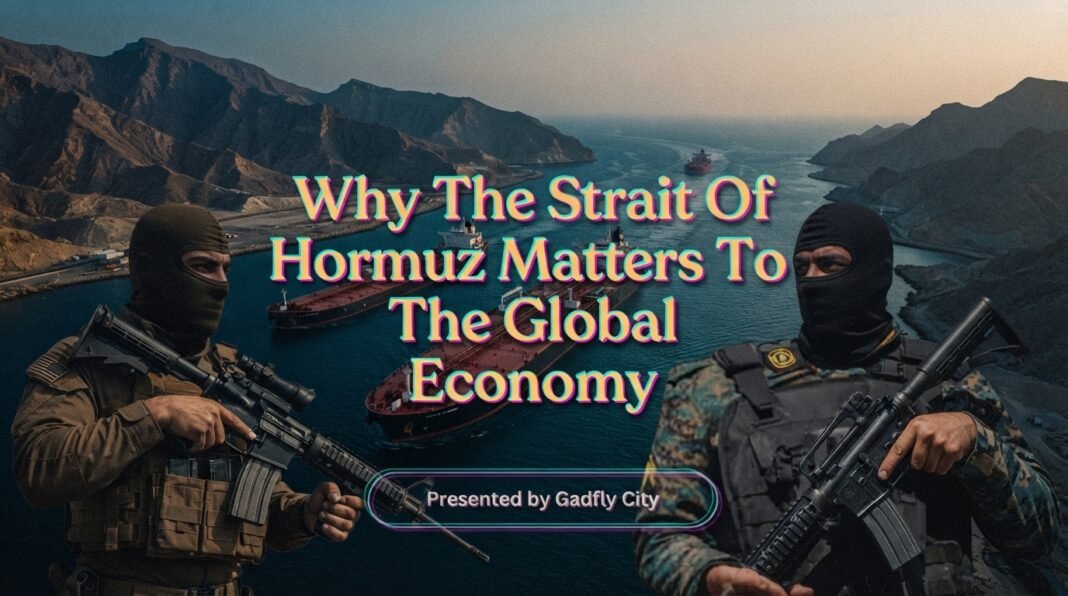
The Strait of Hormuz importance is easy to underestimate until something disrupts the ships moving through it. This narrow waterway between Iran and the Arabian Peninsula connects the Persian Gulf with the Gulf of Oman and the wider Arabian Sea. It is not simply a regional shipping lane. It is one of the key passages through which the modern global economy receives oil, natural gas and other essential commodities.
That matters because energy does not stay inside the energy sector. When the cost of moving oil rises, transportation becomes more expensive. When fuel costs rise, airlines, manufacturers, logistics companies and households eventually feel the pressure. The result is that a geopolitical event in the Gulf can become an economic issue thousands of miles away.
For readers trying to understand today’s geopolitical risks, the simplest way to think about Hormuz is this: it is a narrow physical point through which a disproportionately large amount of global energy trade must pass.
Where The Strait Of Hormuz Is Located
The Strait of Hormuz sits between Iran to the north and Oman and the United Arab Emirates to the south. At its narrowest point, the strait is only about 21 nautical miles wide, although the navigable shipping lanes are considerably narrower.
Geography explains much of its economic importance. The Persian Gulf contains some of the world’s largest oil and gas producers, including Saudi Arabia, Iran, Iraq, Kuwait, Qatar, the UAE and Bahrain. Much of the energy produced inside the Gulf therefore has to pass through Hormuz before reaching international markets.
This is why understanding geography is often the first step toward understanding geopolitics. Readers interested in how geography has shaped political and economic events can explore Gadfly Through History for broader historical context.
How Energy Flows Through Hormuz
The numbers explain why the Strait of Hormuz importance extends far beyond the Middle East.
According to the International Energy Agency (IEA), roughly 20 million barrels per day of crude oil and oil products moved through the strait in 2025. That represented around one-quarter of global seaborne oil trade. Around 80% of those oil flows were destined for Asian markets, making countries such as China, India, Japan and South Korea particularly exposed to disruption.
The strait also matters for natural gas. Qatar and the UAE depend heavily on Hormuz for LNG exports, meaning disruption is not limited to crude oil. The passage is therefore connected to several layers of the global energy system at once.
For a useful overview of the energy-security dimension, the IEA’s Strait Of Hormuz Analysis provides a detailed explanation of the flows and alternative routes.
Why Hormuz Is An Oil Shipping Chokepoint
A shipping chokepoint is not necessarily a place where all trade must physically stop. Its importance comes from the limited number of practical alternatives.
The Gulf’s geography creates exactly that problem. Saudi Arabia and the UAE have pipelines capable of moving some crude without using Hormuz, but the available alternative capacity is substantially smaller than the volume normally passing through the strait. The IEA estimates roughly 3.5 million to 5.5 million barrels per day of potential alternative crude-export capacity.
That creates a basic supply-and-demand problem.
If approximately 20 million barrels normally move through a particular route, but only a fraction of that volume can be redirected elsewhere, even a partial disruption can tighten the market. Buyers begin competing for fewer available barrels, while sellers and traders price in the possibility that supply could become even tighter.
This is the central reason the Strait of Hormuz importance is greater than its physical size suggests.
What Happens When Shipping Is Disrupted?
The first effect is usually uncertainty.
Oil traders do not need to know that millions of barrels have permanently disappeared from the market before prices react. They need to consider the possibility that future supply could become less reliable.
That distinction matters. Markets price expectations as well as present conditions.
If tankers face greater security risks, shipping companies can demand higher freight rates. Insurers may charge more for war-risk coverage. Longer routes may become attractive despite their additional cost. Those expenses eventually become part of the delivered price of energy.
UN Trade and Development has highlighted this broader transmission mechanism, noting that Hormuz disruptions can raise tanker freight rates, marine fuel costs and insurance premiums while affecting wider supply chains.
The issue therefore moves from Gulf shipping to the wider cost structure of international commerce.
How Higher Oil Prices Reach The U.S. Economy
For American consumers, the connection is relatively straightforward.
Suppose crude oil becomes more expensive because traders expect supply to remain constrained. Refineries and fuel distributors face higher input costs. Gasoline and diesel prices can then rise, although the size and speed of the increase depend on refining margins, inventories, domestic production and other market conditions.
Transportation is the next link.
Trucks, ships and aircraft all consume energy. Higher fuel costs can therefore increase the cost of moving products. Businesses may absorb part of that increase, pass it to customers or reduce spending elsewhere.
The same principle applies to manufacturing. Energy is an input into factories, warehouses, agriculture and chemical production. Fertilizer markets can also be affected because energy costs influence fertilizer production and transportation.
This is why a disruption thousands of miles from the United States can eventually appear in household budgets, corporate earnings and inflation data.
Readers who want more current geopolitical coverage can follow Gadfly City’s News section for additional explainers and reporting.
Why The Current Disruption Matters
The current 2026 situation demonstrates the mechanism more clearly than a theoretical example.
The IEA has described the recent disruption as the largest supply shock in the history of the global oil market, with normal Hormuz traffic severely reduced. It estimates that around 15 million barrels per day of crude and another 5 million barrels per day of oil products typically move through the passage.
The market response has extended beyond crude oil. Recent reporting has shown Brent crude moving above $100 per barrel amid continuing concerns over Gulf energy infrastructure and shipping.
That does not mean every barrel normally passing through Hormuz is permanently lost. Some supplies can be redirected, inventories can temporarily cushion shortages, and alternative infrastructure can move part of the flow.
The problem is that these buffers are limited.
Why Alternative Routes Cannot Fully Solve The Problem
It is tempting to assume that pipelines or other shipping routes can simply replace Hormuz. In practice, infrastructure takes years to build and cannot always substitute for an existing maritime route.
Saudi Arabia’s East-West pipeline, for example, can move crude toward the Red Sea rather than through Hormuz. The UAE also has infrastructure capable of bypassing the strait. But these routes do not have enough capacity to replace all normal Hormuz flows.
Recent events have also demonstrated another problem: alternative infrastructure can itself become vulnerable to geopolitical attacks.
A September 2026 disruption to Saudi Arabia’s East-West pipeline has added another layer of uncertainty to global oil logistics. Reuters reported that the outage threatened up to roughly 4% of global oil supply while repairs were expected to take from several days to potentially six weeks.
The lesson is important: diversification reduces risk, but it does not eliminate geographic risk.
The Financial Cost Of Uncertainty
The Strait of Hormuz importance is also visible in financial markets.
When traders become less certain about future energy supply, they tend to demand a larger risk premium. That can push commodity prices higher even before an actual physical shortage becomes severe.
Central banks then face a difficult trade-off.
Higher energy prices can increase inflation at a time when economic growth may already be slowing. Raising interest rates can help contain inflation but may also weaken investment and consumer demand.
UNCTAD has warned that Hormuz disruptions can spread through trade, prices and financial conditions, with developing economies particularly exposed because higher energy and transport costs can put pressure on currencies, government finances and household budgets.
For Americans, the effect may be less dramatic than in heavily energy-import-dependent economies, but the transmission channel still exists through fuel, transportation, inflation and monetary policy.
What Readers Should Watch Next
The most useful question is not simply whether the Strait is “open” or “closed.” The better question is whether energy can move through the region reliably and at what cost.
Several indicators can help explain where the situation is heading:
- Tanker traffic: Are commercial vessels returning to normal routes and schedules?
- Oil prices: Is Brent crude falling as supply fears ease, or remaining elevated?
- Shipping costs: Are freight and war-risk insurance premiums normalizing?
- Alternative pipelines: Are bypass routes operating consistently?
- Energy inventories: Are major importers drawing down strategic or commercial stocks?
- Diplomacy: Are regional governments reaching agreements that reduce risks to commercial shipping?
Looking at several indicators together is more useful than reacting to one day’s oil-price movement.
The broader lesson is that the Strait of Hormuz importance cannot be measured only by the number of ships passing through it. Its real significance comes from what happens when the market begins to doubt whether those ships can keep moving.
Why Hormuz Matters Beyond Oil
It would be a mistake to treat Hormuz purely as an oil story.
Natural gas, fertilizers, shipping insurance and broader maritime logistics are all connected to the route. UNCTAD has noted that disruptions can affect energy, transport and agricultural inputs, allowing a regional shipping problem to become a wider development problem.
This is particularly important for countries that import much of their fuel and food. They have less room to absorb sudden increases in transportation and energy costs.
For the global economy, the principle is simple: the more interconnected the supply chain, the farther a chokepoint shock can travel.
That is why geopolitical geography continues to matter even in an economy dominated by digital services, financial markets and globalized production.
The Bigger Economic Lesson
The Strait of Hormuz importance ultimately comes down to concentration.
The world has spent decades building an efficient energy system around large producers, large consumers and highly specialized transportation routes. Efficiency keeps costs down when everything works. But concentrated systems can become vulnerable when one critical connection is disrupted.
Hormuz is one of those connections.
The current crisis is a reminder that global markets do not operate only through spreadsheets and financial exchanges. They depend on physical infrastructure: pipelines, ports, tankers, refineries and narrow waterways.
For anyone following markets or geopolitics, that is perhaps the most useful way to understand Hormuz. The question is not simply whether one strait matters. It is whether the global economy has enough alternatives when a critical route becomes unreliable.
And that question will remain relevant long after today’s headlines disappear.
Frequently Asked Questions
Why Is The Strait Of Hormuz So Important?
The Strait of Hormuz connects major Gulf energy producers with international markets. Around one-quarter of global seaborne oil trade passed through it in 2025, making disruption capable of affecting energy prices worldwide.
What Would Happen If The Strait Of Hormuz Closed?
A closure would restrict a major oil and gas export route, potentially tightening global supply. Prices could rise, shipping costs could increase, and energy-dependent industries and consumers could face higher costs.
Does The U.S. Depend On The Strait Of Hormuz?
The U.S. is less directly dependent on Hormuz than many Asian economies because of domestic energy production. However, global oil prices affect American gasoline, transportation, inflation and business costs.
Which Countries Rely Most On Hormuz?
Major Asian energy importers, including China, India, Japan and South Korea, are particularly exposed. Several Gulf producers also depend heavily on the strait because alternative export routes have limited capacity.
Can Oil Bypass The Strait Of Hormuz?
Some oil can bypass Hormuz through pipelines operated by Saudi Arabia and the UAE. However, available alternative capacity is far smaller than normal Hormuz flows, limiting how much supply can be redirected.
Why Does Hormuz Affect The Global Economy?
Hormuz affects the global economy because energy is an input into transportation, manufacturing, agriculture and many other industries. Disruption can therefore increase fuel, shipping and production costs across international markets.
Follow The Story With Gadfly City
Geopolitical events rarely stay confined to the map where they begin. At Gadfly City, we follow the connection between geography, power, markets and the everyday consequences of major global events.
If you want clear explanations without unnecessary noise, follow Gadfly City and explore our latest geopolitical coverage. We believe understanding the forces behind the headline is often more useful than simply knowing what happened.
The Strait of Hormuz is a good example. A narrow waterway can influence an entire economy because modern prosperity depends on thousands of physical connections working reliably. Understanding those connections is one of the simplest ways to make sense of an increasingly complicated world.