


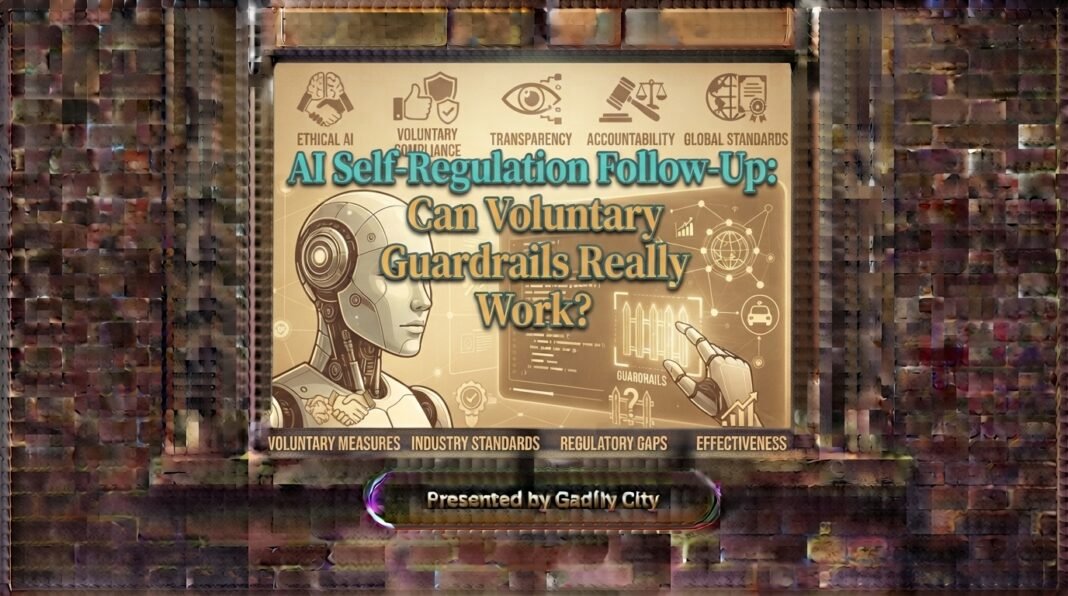
AI Self-Regulation has moved from a technical discussion inside technology companies to a serious policy question. The basic idea sounds straightforward: instead of waiting for governments to create detailed rules for every new AI system, companies voluntarily establish safeguards, test their models, disclose risks, and accept responsibility for harmful outcomes.
The appeal is obvious. AI is developing faster than traditional legislation can usually move. A law written today may struggle to address a capability that becomes common six months later. Voluntary AI Self-Regulation can therefore provide companies with a way to respond more quickly while policymakers work on longer-term frameworks.
But speed is only one part of the problem. The harder question is whether companies have enough incentive to police themselves when safety measures can increase costs, slow releases, or reduce competitive advantage.
That is where the current debate becomes more interesting.
What Does AI Self-Regulation Actually Mean?
AI Self-Regulation means that companies create and follow their own rules for developing, testing, deploying, and monitoring artificial intelligence. These rules can cover issues such as model testing, cybersecurity, privacy, transparency, human oversight, and responses to dangerous behavior.
It does not necessarily mean that government disappears from the picture. A better interpretation is that companies take responsibility for managing risks within a broader governance system.
The U.S. National Institute of Standards and Technology (NIST), for example, developed its voluntary AI Risk Management Framework to help organizations identify and manage AI risks. The framework is designed around four broad functions: Govern, Map, Measure, and Manage.
This distinction matters because voluntary does not have to mean informal. A voluntary framework can still involve documented procedures, testing, internal accountability, external evaluation, and continuous monitoring.
Why Has AI Self-Regulation Become A Policy Issue?
The recent U.S. debate illustrates the tension.
In July 2025, the White House announced voluntary AI safeguard commitments involving major technology companies. The broader policy environment under President Donald Trump subsequently emphasized faster AI development, reduced regulatory barriers, and stronger U.S. technological competitiveness. PBS reported that the administration’s AI policy was shaped partly by technology-industry priorities and included efforts to accelerate AI development and infrastructure.
That creates an important follow-up question: If companies are being asked to move quickly, who decides how much safety is enough?
This is where AI Self-Regulation becomes more than a corporate ethics exercise. It becomes a question of incentives.
A company may genuinely want to prevent harmful AI behavior. At the same time, it is competing for customers, investors, talent, computing resources, and market share. If one company spends heavily on testing while another releases faster with fewer safeguards, the first company may face a commercial disadvantage.
That does not make voluntary commitments useless. It simply means that their effectiveness depends on how they are designed and monitored.
The Strongest Case For AI Self-Regulation
The strongest argument for AI Self-Regulation is flexibility.
AI systems are not static products. Models are updated, applications change, new vulnerabilities appear, and users discover unexpected ways to use systems. A rigid regulatory process can struggle to respond to those changes.
Internal governance can move faster.
A company can change its testing process next week. It can introduce additional red-team testing before a model release. It can restrict a particular capability after discovering a new risk. Government legislation usually cannot operate at that speed.
There is also a practical advantage. Developers understand their systems in much greater technical detail than most policymakers. Asking companies to participate directly in designing safety procedures can therefore produce more technically informed rules.
The NIST approach reflects this principle. Its AI Risk Management Framework was developed through collaboration among government, industry, academia, and other stakeholders rather than being designed entirely within one institution.
Where AI Self-Regulation Can Fail
The central weakness is accountability.
Imagine two companies developing similar AI systems. Company A spends millions on testing, security, documentation, and monitoring. Company B does less testing and releases its product earlier.
If customers reward Company B for moving faster, the market has created an incentive to underinvest in safety.
That is the fundamental problem with relying exclusively on AI Self-Regulation.
There is also a measurement problem. A company can say that its model has been tested extensively, but outsiders still need enough information to determine whether those tests were meaningful.
This is why transparency matters. The OECD AI Principles emphasize transparency, explainability, robustness, security, safety, and accountability. They also argue that organizations should use systematic risk management throughout the AI lifecycle.
In other words, responsible AI is not simply about promising to behave responsibly. It requires processes that allow responsibility to be examined.
Voluntary Rules Work Better When They Are Measurable
One useful way to think about AI Self-Regulation is to separate promises from mechanisms.
A promise might be:
“We will make our AI systems safer.”
A mechanism is much more specific. It asks:
Who tests the system?
What risks are tested?
When does testing happen?
What happens if the system fails?
Who has authority to delay deployment?
What information is documented?
Can an outside party evaluate the process?
The second approach is stronger because it creates a chain between intention and outcome.
NIST’s framework takes a similar risk-management approach by encouraging organizations to identify, measure, and manage risks rather than treating AI safety as a single decision made before launch.
AI Self-Regulation And Government Oversight
The debate is often presented as a choice between company control and government regulation. That framing is too simple.
A more practical model is layered governance.
Companies can handle operational decisions because they understand their systems. Independent auditors and standards organizations can provide external scrutiny. Governments can establish minimum legal requirements where voluntary commitments are insufficient.
This resembles other areas of modern technology governance.
The important question is not whether every decision should be made by government. It is whether there is a credible mechanism for dealing with situations where private incentives and public interests diverge.
That becomes particularly important when AI affects financial markets, employment, public services, national security, or critical infrastructure. The potential economic impact of emerging technology shows why technology governance cannot always be separated from broader economic stability.
What Congress Is Watching
The political debate around AI Self-Regulation is likely to focus on whether voluntary commitments are sufficient or whether certain safeguards should become legally enforceable.
That does not necessarily mean every voluntary commitment will be rejected. Some voluntary standards may eventually become industry norms. Others may influence future legislation or technical standards.
The history of international policy also offers a useful comparison. Major technological risks have often required a combination of technical expertise, political negotiation, and enforceable boundaries. The discussion surrounding geopolitical regulation and policy frameworks illustrates how difficult it can be to establish shared rules when different actors have competing interests.
AI presents a different technological problem, but the governance lesson is similar: rules become more durable when the parties affected by them understand both the costs of compliance and the consequences of ignoring them.
A Practical Framework For Judging AI Self-Regulation
Rather than asking whether AI Self-Regulation is good or bad, it is more useful to ask five questions.
- Is the commitment specific?
Vague promises are difficult to evaluate. - Is compliance measurable?
There should be evidence that the stated process is actually being followed. - Is there independent scrutiny?
Internal review is valuable, but outside evaluation can identify blind spots. - Are consequences clear?
A safeguard without consequences for ignoring it may become symbolic. - Can the system adapt?
AI governance needs to change as capabilities and risks change.
This framework avoids both extremes. It does not assume that companies are incapable of acting responsibly, nor does it assume that voluntary promises automatically protect the public.
What Happens Next?
The future of AI Self-Regulation will probably not be decided by one agreement or one law.
Instead, several layers are likely to develop together: corporate policies, technical standards, voluntary commitments, industry practices, independent testing, and government regulation.
The most important development may therefore be the gradual conversion of broad principles into repeatable processes.
A company that says it values safety has made a statement. A company that can demonstrate how it identifies risks, tests models, documents failures, responds to incidents, and accepts external scrutiny has created a governance system.
That difference is important.
Readers who want to follow how these debates evolve can also explore Gadfly City’s modern tech policy news, where changes in technology, policy, economics, and society intersect.
The Larger Question Behind AI Self-Regulation
AI Self-Regulation is ultimately a question about trust.
We routinely allow companies to regulate parts of their own operations because specialized knowledge matters. But society also creates external rules when the consequences of failure extend beyond the company itself.
AI sits increasingly close to that boundary.
The sensible position is therefore neither blind faith in industry nor automatic distrust of it. Voluntary governance can move quickly, experiment with new approaches, and use technical knowledge. Public oversight can provide accountability when private incentives are not enough.
The challenge is finding the point where those two systems reinforce rather than undermine each other.
At Gadfly City, we believe that understanding that distinction matters more than choosing a simple side. As AI becomes part of everyday economic and social life, the quality of its governance may ultimately matter just as much as the quality of the technology itself.
Frequently Asked Questions
What Is AI Self-Regulation?
AI Self-Regulation is the practice of AI companies creating and enforcing internal standards for safety, testing, transparency, security, privacy, and responsible deployment without relying exclusively on government-mandated rules.
Why Do Companies Use AI Self-Regulation?
Companies use AI Self-Regulation because AI changes quickly. Internal policies can often be updated faster than legislation, allowing organizations to respond to emerging technical risks while broader regulatory frameworks develop.
Is AI Self-Regulation Legally Binding?
Usually, voluntary AI Self-Regulation is not legally binding in the same way as legislation or formal regulations. However, companies may still face contractual, reputational, regulatory, or legal consequences for their actions.
Can AI Companies Regulate Themselves Effectively?
They can manage many technical risks internally, but effectiveness depends on incentives, transparency, testing, documentation, and accountability. Independent oversight may still be necessary where public interests extend beyond the company.
What Is The NIST AI Risk Management Framework?
The NIST AI Risk Management Framework is a voluntary framework designed to help organizations identify, assess, and manage AI risks. It provides a structured approach rather than imposing a single mandatory set of rules.
Why Is AI Self-Regulation Being Debated In Congress?
Lawmakers are examining whether voluntary commitments provide enough protection as AI becomes more influential. The debate centers on where industry flexibility should end and legally enforceable safeguards should begin.
A Practical Takeaway
AI Self-Regulation should not be judged by how impressive a company’s safety statement sounds. It should be judged by what happens behind that statement.
If companies can identify risks, test their systems, document failures, respond quickly, and accept meaningful scrutiny, voluntary governance can be useful. If commitments remain vague and consequences are absent, self-regulation risks becoming little more than corporate policy language.
The most durable approach may be a middle path: let companies move quickly, but make accountability difficult to avoid.
Sources And References
- NIST – AI Risk Management Framework
- NIST – AI RMF Playbook
- OECD – AI Principles
- OECD – Advancing Accountability In AI
- PBS News – Trump Reveals AI Action Plan
- PBS News – What’s In Trump’s New AI Policy And Why It Matters
- Congressional Research Service – Artificial Intelligence: Overview, Recent Developments, And Issues